ARTS / CULTURE & LEISURE
Never too late to start: Senior citizens exhibit confidence in learning at English corner
Never too late to start
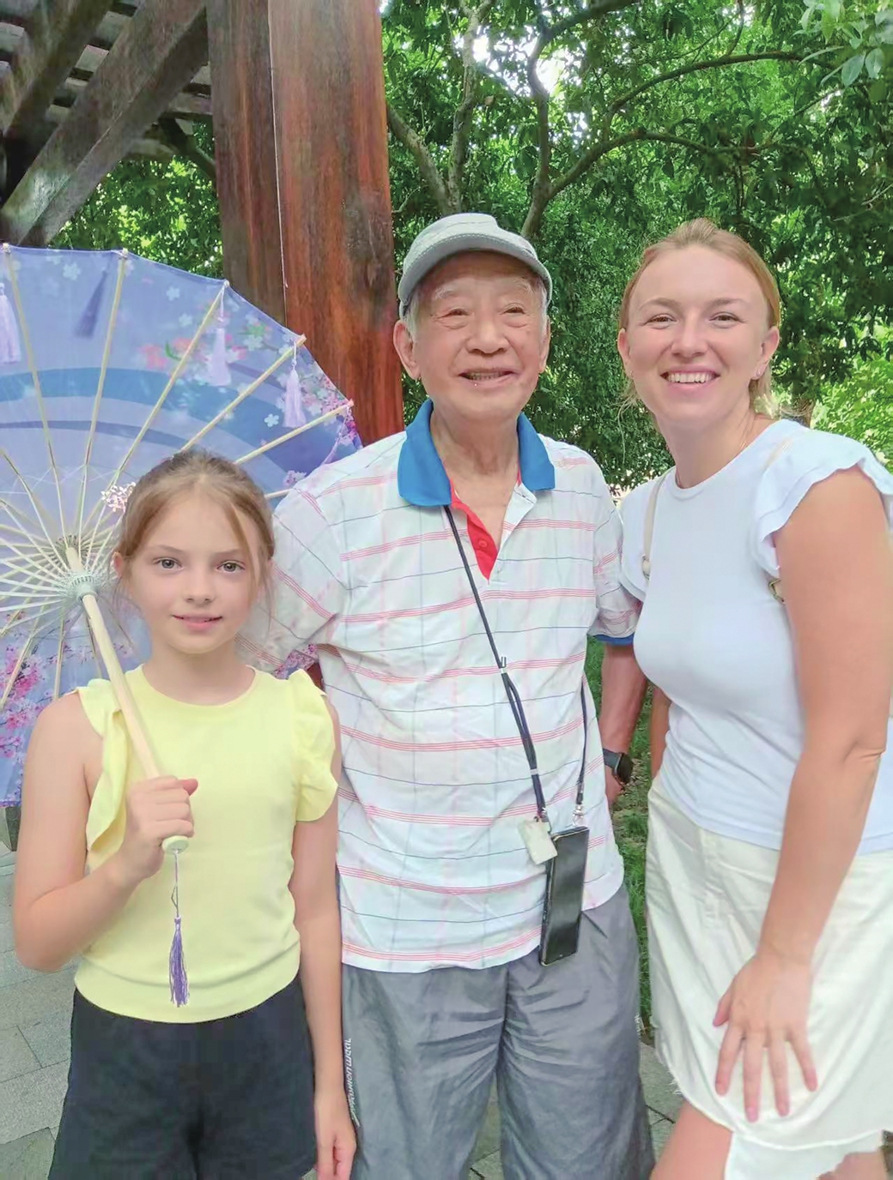
Zhou Panlin (center) poses with Russian tourists after chatting with them in English in Hangzhou, East China's Zhejiang Province. Photo: Courtesy of Zhou
On a winter afternoon by the iconic West Lake in Hangzhou, East China's Zhejiang Province, a white-haired grandfather chats confidently with an English-speaking visitor, warmly introducing him the city's famed "English corner."Their conversation later went viral on China's X-like platform Sina Weibo, where many praised the scene as a perfect example of lifelong learning in action.
The old man in the video, 98-year-old Zhou Panlin recalls the encounter fondly. He told the Global Times that the foreign visitor had been watching others practice calligraphy when Zhou approached him and broke the ice with a simple question: "Do you speak English?"
For Zhou, the moment felt entirely ordinary. As a long-time participants in Hangzhou's English corners, informal gatherings where residents hone their language skills alongside international travelers. Several of the most well-known spots are located along the shores of the picturesque West Lake.
Retirees make up the core of the regular participants, though younger learners occasionally drop by. For many of the aged attendees, these weekly conversations are more than just a pastime - they are a meaningful connection to the wider world, according to Zhou.
Never stop learning
Zhou first stumbled upon the English corners about seven or eight years ago while taking a walk near the lake. Intrigued by a small group of people chatting with foreign tourists, he mustered the courage to join in.
When the weather is fine, Zhou makes the trip to West Lake nearly every weekend. The journey is no small feat for him - nearly two hours round-trip - but he insists it is well worth the effort.
"I cannot just sit at home all day," Zhou said. "You must go outside, meet people and stay connected with society."
He joked that their mission at the English corners is simple: "catch foreigners and chat."
Some visitors from the Middle East or Russia may not speak English fluently, while tourists from English-speaking countries such as the US, Canada, Australia and the UK, as well as international students studying in China, are usually easier to converse with. As a result, participants often approach them first.
Chinese culture offers endless conversation starters: the beauty of the West Lake, the principles of tai chi, the ancient wisdom of qigong. Food is another reliable topic - Zhou delights in explaining the rich diversity of Chinese cuisine, encouraging visitors to explore beyond familiar fast-food chains and discover regional traditions.
Zhou's comfort with English developed long before his retirement. Born in Lishui, East China's Jiangsu Province, he grew up in Shanghai, where he was introduced the language in school during his youth. At the time, students who mastered English often had better career opportunities. After graduating from high school, Zhou was admitted to Zhejiang University. Later he became a university teacher, instructing students in both chemistry and English.
His career eventually expanded beyond teaching. After retiring from academia, Zhou was invited by friends to take on translation work - both written and spoken - across a wide range of technical fields over the years.
Today, nearing 100, Zhou still keeps his mind sharp with daily habits: reading English books at home and browsing English-language news online.
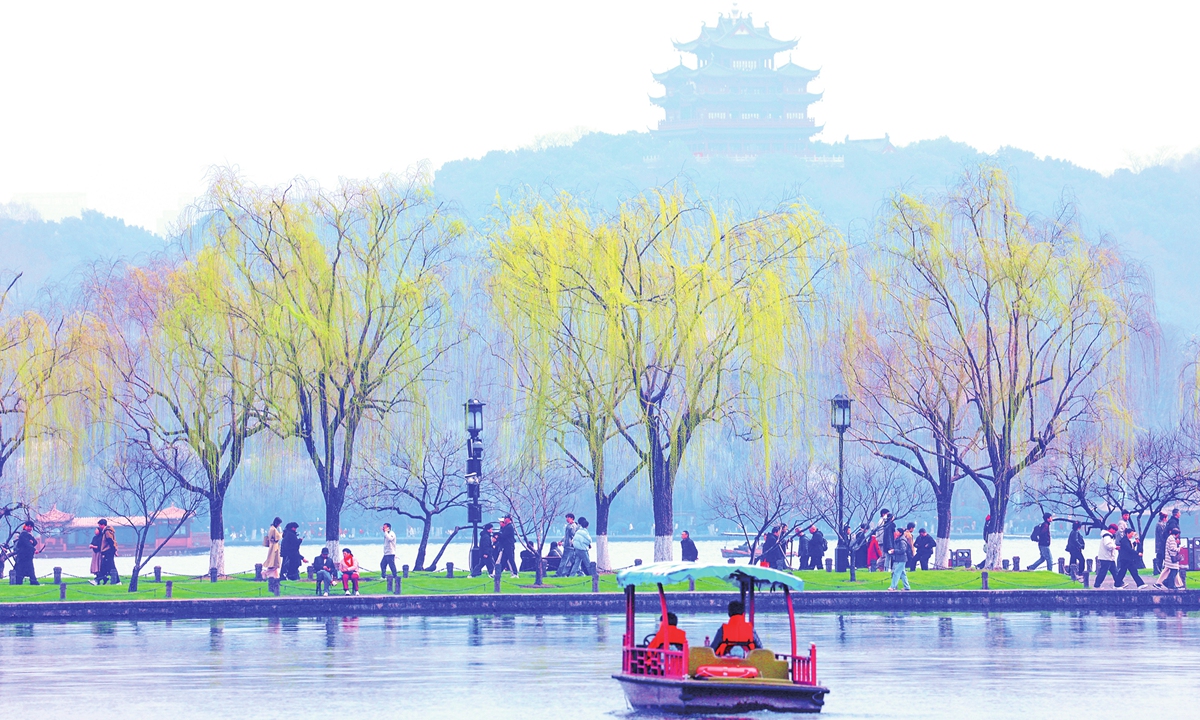
Visitors enjoy a picturesque scene of tranquility and lush green willows along the West Lake's Bai Causeway in Hangzhou, East China's Zhejiang Province, on March 8, 2026. Photo: VCG
English corner historyEnglish corners by the West Lake have a long history, according to the West Lake Water Management Office.
Near the lakeside, a group of bronze sculptures stand as silent witness to decades of park life. One depicts a young man and a woman leaning over an open book, their fingers gently tracing the lines of text. Another shows two girls holding a dictionary while talking with a backpack-wearing foreign student.
The statues capture a moment in China's modern history. In the early years of the country's reform and opening-up, many young people were eager to learn about the outside world. Around 1982, a three-story foreign-language bookstore opened near the lake. After buying books there, some readers would often sit by the water to study or talk - planting the seeds of what would become the city's earliest English corners.
By the late 1990s and early 2000s, the English corner at Sixth Park near the West Lake had reached its peak. On weekends, crowds of 100 and 200 people would gather there. Participants included university students, foreign trade workers, electricians and warehouse clerks.
One longtime observer, Wang Jizhe, 68, remembers those early years vividly. As a young man, Wang taught himself English using dictionaries and newspapers. Today, he teaches the language at a senior citizens' university in Hangzhou.
He also hosts his own English conversation group every Monday, 9 to 10 am - a routine that he has maintained for about nine years without fail. By his count, the sessions have surpassed 400.
Like Zhou, Wang often starts conversations with foreigners he encounters on the street. In his view, English remains useful as China becomes increasingly connected with the world and welcomes more international visitors.
At the same time, the role of the traditional English corners has changed.
Compared with the 1980s or 1990s, the crowds are smaller now. Online learning platforms, language apps and the wider availability of English education have given younger learners many new options.
Yet the lakeside gatherings still attract a devoted group of participants.
Most are retirees in their 60s or 70s, who embrace English not as a subject to master, but as thread woven into the fabric of a new lifestyle. They swap study tips, discuss books and encourage one another to keep growing - proving that learning has no retirement age. "If you want to learn English, pick up a skill, or try something new, it's never too late to start," said Zhou.
RELATED ARTICLES