ARTS / CULTURE & LEISURE
Unwavering task to stand against toxic fan culture in sports
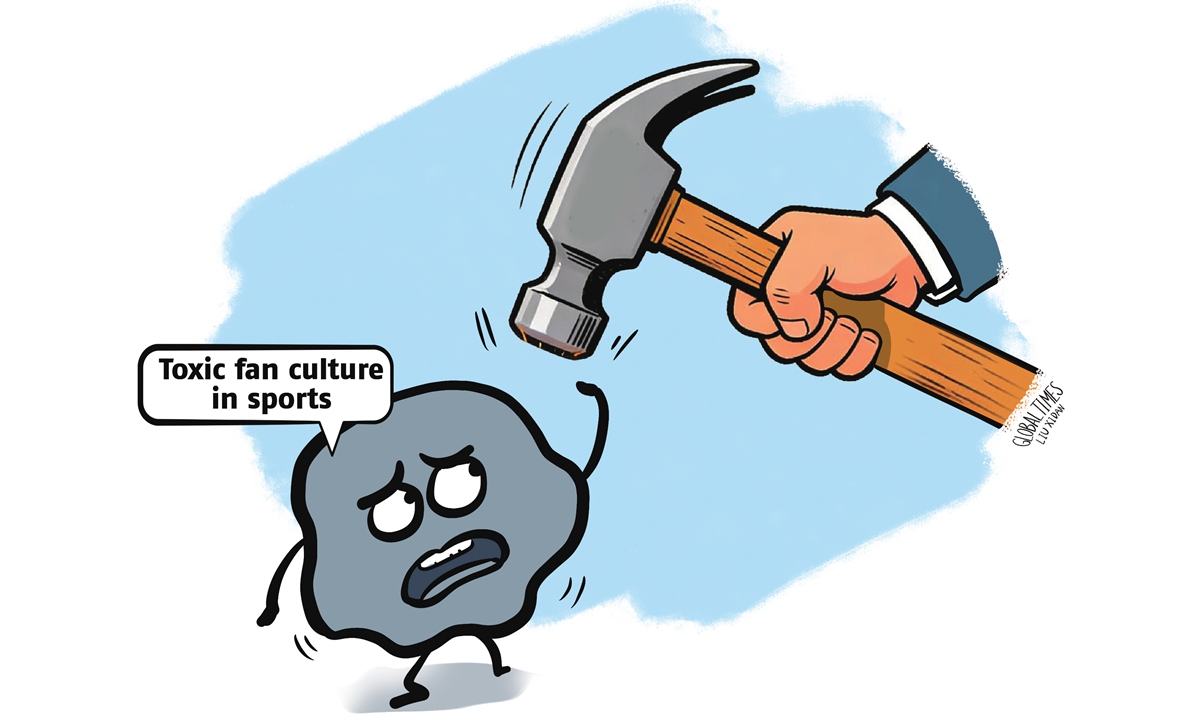
Illustration: Liu Xidan/GT
During China's annual national "two sessions," two prominent voices from the sports world delivered a powerful message concerning toxic fan culture. General Administration of Sport chief Gao Zhidan and Chinese Table Tennis Association (CTTA) President Wang Liqin unequivocally spoke out against the distorted "fan circle" phenomenon that has increasingly plagued professional sports.Gao emphasized the need for deeper governance in the sports sector, including dedicated action to vigorously rectify the chaos created by toxic fan culture, promote sports integrity and enforce strict competition discipline. Wang was even more pointed, describing the harm as profound, as it is disrupting training and preparation, and even undermining team unity.
The words represent a deliberate commitment to rooting out behavior that has threatened the very essence of Chinese sports excellence in recent years.
Fan culture begins innocently enough, as communities of enthusiasts bond through their shared admiration for athletes' skill and dedication. In its ideal form, it offers positive support to athletes: cheering at matches, celebrating achievements and fostering a sense of belonging.
But the infiltration of traffic-driven capital, social media algorithms and profit motives has twisted it into something unrecognizable and dangerous. What started as fandom has morphed into organized online armies engaging in vicious attacks, with rumor-mongering, privacy invasions and interference that crosses into real-world disruption.
The evidence of this distortion is obvious in table tennis, China's national pride and a sport long synonymous with disciplined excellence. Recent years have seen fan circles turn arenas and online spaces into battlegrounds. During the 2024 Paris Olympics, for instance, the women's singles final between teammates Chen Meng and Sun Yingsha triggered a wave of toxic backlash. Fans of the defeated Sun flooded social media with hostile comments and defamation of Chen, leading to the arrest of a 29-year-old woman for malicious slander.
Social media platforms like Sina Weibo and Douyin have removed over thousands of posts and suspended hundreds of accounts, under the guidance of the country's national cyberspace governing body. This reflected a small segment of the volume of "ultra fans" and self-appointed leaders manipulating discussions to provoke conflict.
Even more alarming are the direct intrusions into athletes' lives. Star player Fan Zhendong publicly recounted the panic of a stranger tracking him for days and breaking into his hotel room using a stolen keycard, an incident that left him in a panic and contributed to intense mental strain during critical preparation. Another star player Wang Chuqin, playing in Southwest China's Chongqing Municipality at a WTT event, said Wednesday that he has also been a victim of toxic fan culture.
Even sports journalists covering matches have also been targeted for neutral analysis, labeled as "traitors" for simply noting statistical realities like a player's consecutive losses.
In January 2025, the CTTA took decisive action by unanimously disbanding all fan groups for national team athletes on social media. The move was driven by fans "tearing each other apart," provoking fights, and spreading insults, slander and rumors that "seriously deviated from the original intention of sports and caused a bad social impact." The association declared, "The internet is not a lawless place," and called for respect toward athletes, coaches and referees.
These moves are not overreactions. Irrational fan interference disrupts training focus, erodes team cohesion, and indirectly weakens competitive performance. It distorts the core values of sports: fair play, resilience, and collective national pride. Instead of celebrating the sport, toxic fan culture reduces it to personality cults, where victory is mandatory and any loss is blamed on "betrayal" or conspiracy. This misleads young fans, normalizing online violence, doxxing and cyberbullying as acceptable expressions of "love."
This sports crackdown campaign builds logically on earlier efforts targeting entertainment fan circles. Back in 2021, the national cyberspace governing body launched a nationwide campaign against the online chaos that had already damaged youth mental health. Extending this campaign to sports is both consistent and urgent, as sports carry the weight of national glory. When fans attack their own team's players or coaches, they undermine the very foundation of China's sports success.
Critics might argue that curbing toxic fan culture stifles genuine passion or free expression. This misses the point entirely. The campaign targets only distorted, irrational excesses, not heartfelt support. Rational fandom thrives on analysis, appreciation of skill, and respectful engagement. True fans analyze matches, accept outcomes, either positive or negative ones, gracefully, and encourage athletes without invading their personal lives or pitting teammates against each other.
Chinese sports have delivered iconic moments of unity and triumph, from Olympic triumphs to grassroots football inspiring communities. Allowing fan circle chaos to fester risks turning these into division. The determination to override toxic fan culture is not just about cleaning up one sector but safeguards social values. It protects youth from toxic role models of hatred disguised as loyalty and restores the dignity of athletes who sacrifice years for honor. And it reinforces that sports remain a realm of merit, discipline and shared glory, not a battlefield for slander.
The author is a reporter with the Global Times. life@globaltimes.com.cn
RELATED ARTICLES