China's BRI vision listed in Government Work Report provides the Global South with a strategic window to diversify partnerships, enhance autonomous development capacity
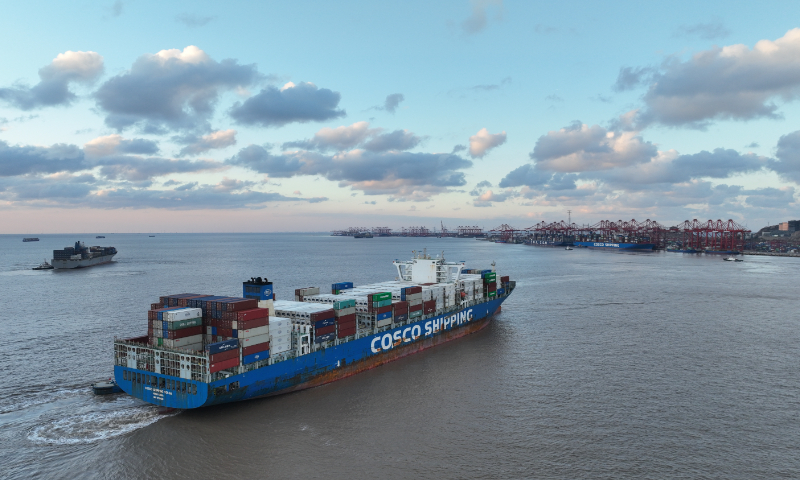
COSCO Shipping Volga sails toward Yangshan Port in Shanghai on December 26, 2025. It marks the first "Cherry Express" shipment by Cosco Shipping Co to arrive in China for the 2025-26 cherry season, carrying over 21,000 tons of Chilean cherries. Photo: VCG
China's Government Work Report stressed that the country will pursue high-quality Belt and Road cooperation. China will strengthen strategic alignment with Belt and Road partner countries and take solid, well-measured steps to promote stronger infrastructure connectivity, greater connectivity on rules and standards, and closer bonds with the people in these countries. Both major signature projects and "small and beautiful" public well-being projects will be launched.
The development of the China-proposed Belt and Road Initiative (BRI) has now entered a more mature phase, and one of the focal points today is to deepen strategic alignment with BRI partner countries by simultaneously advancing "hard connectivity," "soft connectivity," and "heart-to-heart connectivity." This conceptual triangle forms the backbone of the initiative's current upgrade.
"Hard connectivity" focuses on building and modernizing physical and logistical infrastructure - examples include China-Europe freight trains, the New International Land-Sea Trade Corridor, and the Chancay Port in Peru - which is poised to fundamentally reshape South American logistics and global trade patterns. "Soft connectivity" emphasizes regulatory and institutional harmonization, with mechanisms such as the Smart Customs cooperation partnership, written in this year's Government Work Report, and trade facilitation playing pivotal roles. "Heart-to-heart connectivity" centers on people-to-people exchanges, civilizational dialogue, mutual learning, and the cultivation of respect and trust among societies.
This three-dimensional approach reflects a complementarity between mega projects and grass-roots integration in the development of BRI projects. While landmark projects are expected to generate local employment, facilitate technology transfer, build institutional capacity, and produce multiplier effects across regional economies, smaller-scale initiatives directly address urgent needs: access to clean drinking water, primary healthcare, rural electrification, basic education, and food security. The holistic vision of the China-proposed BRI ensures that implementation remains adaptive to national contexts and involves active participation of local stakeholders, so that every project genuinely contributes to sustainable development and the well-being of the BRI partners.
A strategic window
The BRI vision demonstrates China's commitment to stability, inclusiveness, and mutual benefit in a turbulent global landscape. For the Global South, this represents not merely access to infrastructure and technology, but a strategic window to diversify partnerships and enhance autonomous development capacity under the BRI framework.
The Government Work Report also noted that China "will also expand practical cooperation in emerging fields to deliver more benefits to people in countries along the Belt and Road." I expect that in emerging domains, the BRI will accelerate cooperation in digital economy and green development.
According to the Government Work Report, China aims to raise the value added of core digital economy industries to 12.5 percent of GDP from 2026 to 2030, up from 10.5 percent in 2025. This goal also opens substantial South-South cooperation opportunities through three pillars: next-generation infrastructure, data governance, and orderly digital opening-up.
Cooperation in green transition constitutes another key pillar. China has set a target of a reduction of around 3.8 percent in carbon dioxide emissions per unit of GDP this year. For Latin America, which is rich in renewable energy, sustainable agriculture, and digital potential, this translates into expanded opportunities for technology transfer, investment, and local capacity building. It is noteworthy that "small and beautiful" BRI projects play an indispensable role, for example off-grid solar micro-grids for remote communities, municipal food production systems, early-warning networks for extreme weather, and community reforestation using native species.
China's green cooperation with Latin America is already materializing through targeted mechanisms. Landmark BRI projects such as joint photovoltaic parks in Chile, Cuba, and Argentina, wind-power projects in Brazil, and lithium-processing partnerships in Argentina, Bolivia, and Chile all illustrate how China has been aligning its supply-chain strengths with the Latin American region's critical mineral and renewable endowments.
These collaborations not only support China's own energy goals but also help Latin American countries capture greater value along the clean-energy value chain - moving from raw extraction toward mid- and downstream processing, local assembly, and technology localization. When combined with "small but beautiful" community-level projects, this layered approach ensures that macro-level decarbonization gains translate into tangible improvements in rural livelihoods, energy access, and environmental stewardship at the grass roots.
During the 15th Five-Year Plan period (2026-30), China has set a goal of an annual average increase of at least 7 percent in nationwide research and development (R&D) spending, which will ensure that R&D spending continues to grow at a steady pace. China is pursuing technological self-reliance while expanding openness.
In an era of rising protectionism and geopolitical complexity, this dual strategy is increasingly urgent. And for Latin America, the picture is one of both opportunity and asymmetry. The 2025 Latin American AI Index reveals the region attracts only 1.12 percent of global AI investment yet ranks third worldwide in downloads of generative AI applications - indicating demand far outstrips local capacity. Closing gaps in infrastructure, talent, innovation, and governance remains essential. China's advanced tech ecosystem offers Latin America a pathway to diversify export baskets, upgrade industrial capabilities, and strengthen South-South ties.

Isaura Diez Photo: Courtesy of Isaura Diez
Isaura Diez is the China Bureau Chief for Prensa Latina, a news agency based in Cuba.
RELATED ARTICLES