15th Five-Year Plan opens 'new pathways' for China-Latin America BRI cooperation: Brazil expert
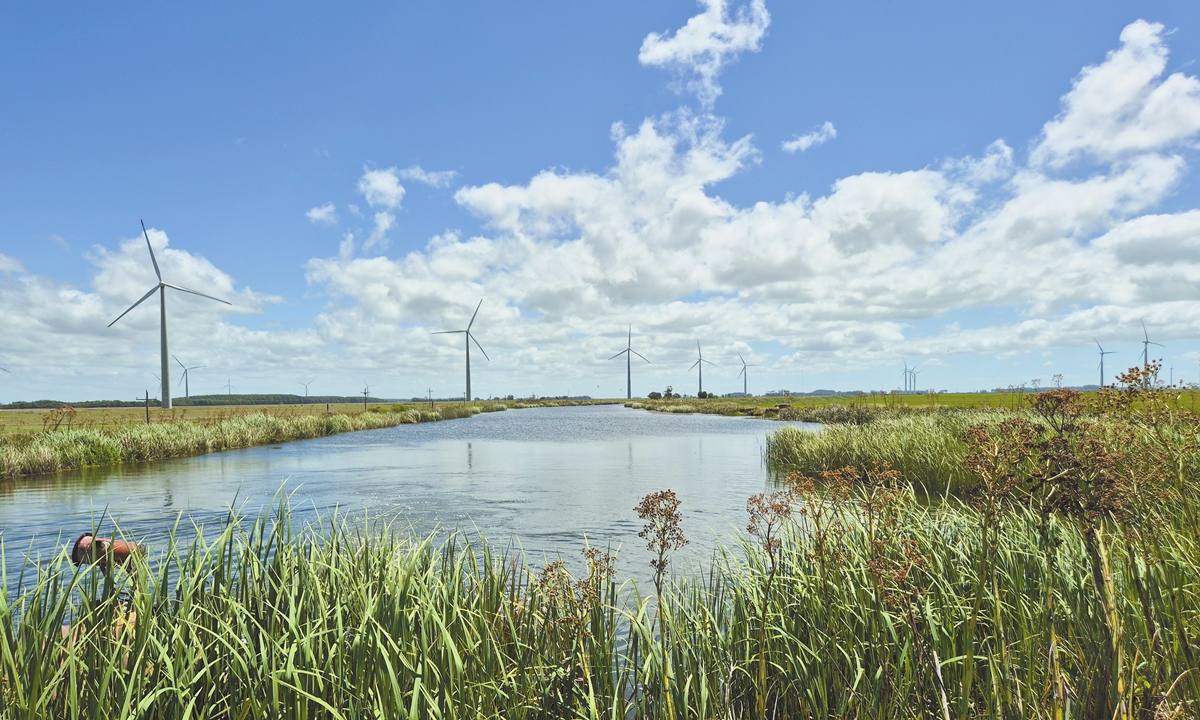
A wind power project in Brazil built by the China General Nuclear (CGN) Power Group Photo: Courtesy of CGN
As China's annual two sessions get underway and the draft outline of the 15th Five-Year Plan (2026-30) for national economic and social development has been submitted to the national top legislature for review, China's evolving development priorities are sending important signals about the future direction of its economy and international partnerships.
An important aspect of the guidelines for the 15th Five-Year Plan is the emphasis on promoting high-standard opening-up, achieving greater self-reliance and strength in science and technology, and steering the development of new quality productive forces. Together, these priorities point to a new stage of development driven by innovation, green transformation, and industrial upgrading, which will shape China's future growth and create new opportunities for cooperation with developing regions, including Latin America, under the China-proposed Belt and Road Initiative (BRI).
The 15th Five-Year Plan also calls for strengthening strategic alignment with Belt and Road partner countries, while urging enhanced connectivity in infrastructure, as well as rules and standards, and fostering closer bonds between peoples. By promoting deeper policy coordination and institutional connectivity, these priorities aim to create a more integrated framework for cross-border cooperation.
In this context, practical collaboration in areas such as trade, investment, industrial development, and people-to-people exchanges is expected to deepen, while cooperation may also expand into emerging fields including green development, artificial intelligence, the digital economy, health, tourism, and agriculture.
One area where these evolving cooperation priorities could take concrete form is the development and use of critical minerals, a sector gaining increasing attention and strategic importance. In today's global geoeconomic landscape, such resources are becoming increasingly vital amid technological competition and the global energy transition. Latin America holds abundant reserves of key minerals, including copper, niobium, nickel, lithium, and the rare earths. China, meanwhile, has developed strong capabilities in mineral processing, industrial manufacturing, and clean energy technologies, creating clear potential for complementary cooperation across the value chain.
Against this backdrop, deeper collaboration with China could play a significant role in shaping a new model of engagement between China and Latin America. Rather than replicating the traditional North-South pattern, such partnerships have the potential to foster more balanced South-South cooperation. This approach can support local development in the region by jointly developing technological capabilities and professional skills, while moving beyond a model focused primarily on the extraction of natural resources.
In addition, backed by policies under China's new Five-Year Plan, BRI cooperation between China and Latin America may increasingly move beyond traditional infrastructure projects toward deeper industrial and technological collaboration. Latin America has significant potential for clean energy generation, including hydropower, solar and wind resources. This energy capacity could support new forms of industrial development across the region.
For example, abundant renewable energy resources could lower energy costs and create favorable conditions for energy-intensive industries. They could also support the development of digital infrastructure such as data centers that benefit from lower electricity prices. In this way, the region's renewable energy advantages could attract new industrial investment and technological activities, strengthening Latin America's position in emerging global supply chains.
China can play an important role in this process. As a reliable and predictable political and economic partner, China is well positioned to help address many of Latin America's development needs. As China continues to expand its economic opening, new opportunities may also emerge for Latin American economies to increase the added value of their export structures, which are still largely based on commodities.
Unlike some countries constrained by rigid economic doctrines, the Chinese government has adopted a pragmatic approach to economic cooperation. Through mechanisms such as joint ventures, China can work with partners to develop new industries and sectors, contributing to more diversified economic development.
At a time when protectionist tendencies are rising in parts of the global economy, China's commitment to openness and cooperation carries broad global significance. By promoting partnerships through initiatives such as the BRI, China is helping to create conditions for a more inclusive global economy. In this context, the coming years may mark a new phase in China-Latin America cooperation, opening new development pathways by combining Latin America's natural resources, energy potential, and human capital with China's technological and industrial capabilities.
Although some Western countries, as part of a broader strategy to contain China, have sought to promote negative narratives about BRI cooperation through media, think tanks, and NGOs, such claims do not change the initiative's fundamentally mutually beneficial nature. In reality, the opportunities and development momentum that the BRI has brought to Latin America are tangible and align with the region's goals of economic growth and improving livelihoods.
Looking ahead, China and Latin America should further expand communication through public diplomacy, media cooperation, and exchanges among universities and think tanks. This would allow more people in the region to better understand China's development and help foster a more open and mutually beneficial environment for cooperation.

Marcos Cordeiro Pires, a professor at the Department of Political and Economic Sciences, São Paulo State University Photo: Courtesy of Marcos Cordeiro Pires
The article was compiled based on an exclusive interview with Marcos Cordeiro Pires, a professor at the Department of Political and Economic Sciences, São Paulo State University, Brazil. bizopinion@globaltimes.com.cn
RELATED ARTICLES