ARTS / CULTURE & LEISURE
Tomb of Chinese writer Lu Xun’s teacher discovered in Shaoxing, Zhejiang
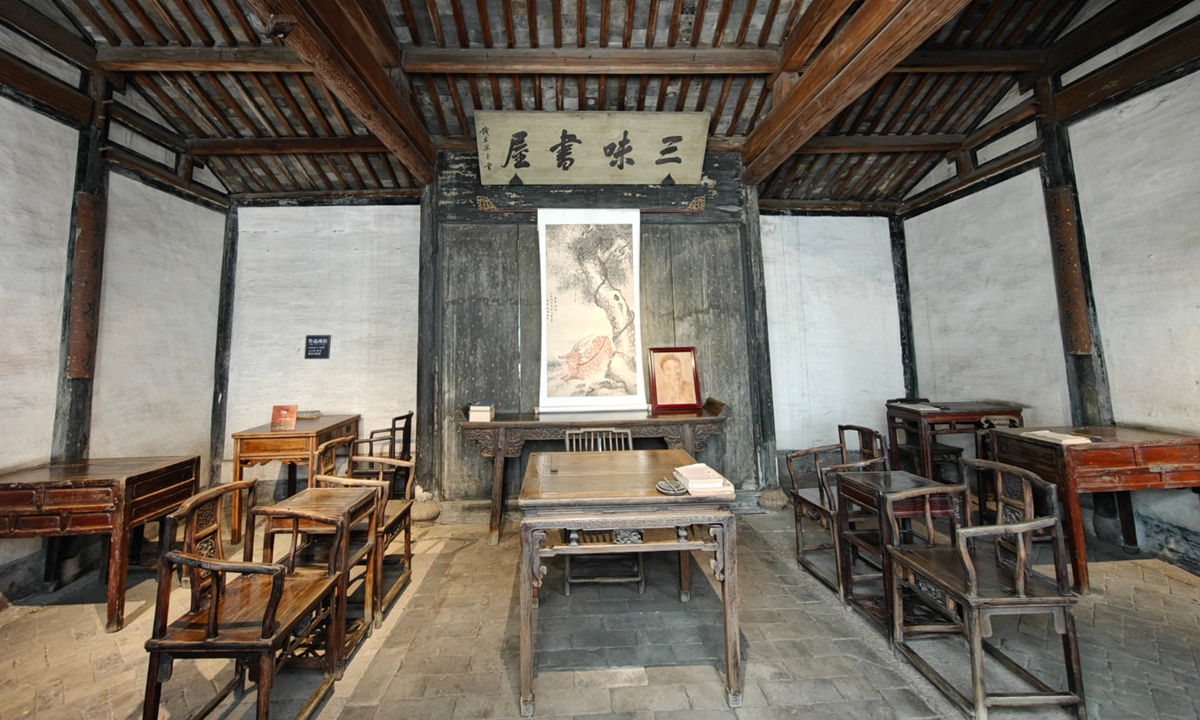
Sanwei Study Photo: VCG
Discovered on the bamboo-covered outskirts of Shaoxing, East China's Zhejiang Province, the tomb of Shou Jingwu, the teacher of Chinese writer Lu Xun, has recently been found. Lu Xun is the pen name of Zhou Shuren (1881-1936). He is widely regarded as the titan of modern Chinese literature.The discovery was led by the Shaoxing Institute of Cultural Relics and Archaeology. Its deputy director Wang Renfang told the Global Times that this discovery began by "chance." The tomb was found on Qiujialing hill in Shaoxing's Sifeng village. Initially, a clue was provided by nearby villagers, and then, the archaeological team located the grave site with the help of elderly grave keepers from the local area.
The tomb was found surrounded by vegetation such as red maple trees. Researchers found scattered stone tablets inscribed with remnants of text, including the characters "Shou Jie" (the territory of the Shou family). The tomb showed some damage, as both the front and rear walls of the stone chamber had collapsed, exposing the interior of the tomb.
During the cleaning and excavation process, archaeologists identified it as a double-chamber tomb. "Our preliminary speculation held that this was most likely the burial site of Shou Jingwu and his wife," Wang told the Global Times.
Building on this, through surveys and interviews with elderly local villagers, the archaeological team learned that the area surrounding Qiujialing is the ancestral burial ground of the Shou family. Local villagers also informed the experts that as early as 1967, Shou Jiming, Shou Jingwu's eldest grandson, had visited the site to pay his respects. Yang Yecheng, an expert specializing in Lu Xun studies, noted that historical records document that Shou Jingwu's tomb was located on "Mountain Zao" - a site geographically corresponding to present-day Qiujialing.
Inside the tomb, researchers discovered traces of skeletal remains. In collaboration with researchers at Fudan University, the archaeological project went further to conduct DNA studies on the remains. Researchers compared the Y-chromosome haplogroup of the male skeletal remains found in the tomb with that of the existing paternal descendants of the Shou family, and the results were found to be consistent. "While this further strengthens our belief in the identity of the tomb's owner, in addition to DNA testing, we will adopt more scientific research methods in the subsequent stages to confirm the identity of the tomb's occupant," said Wang.
Born in 1849, Shou Jingwu was not only Lu Xun's respected teacher, but also the founder of the Sanwei Study. The Sanwei Study stands as one of the most renowned private schools in modern Chinese cultural history. Lu Xun himself studied there from the ages of 12 to 17. Later, Lu Xun immortalized memories of his teacher Shou in his famous essay From the Baicao Garden to the Sanwei Study. In the essay, he described Shou as an "upright, unpretentious, and learned man."
In 1898, Lu Xun left the Sanwei Study to pursue further studies in Nanjing, Jiangsu Province. Thereafter, he sent greetings during the Spring Festival to Shou every year. He maintained this correspondence for years, with the total number of letters reaching over 100.
"This archaeological discovery provides a clearer lineage for research into Lu Xun's cultural legacy. At the same time, the heritage left by Lu Xun has evolved into a core cultural engine powering Shaoxing's own development," said Wang. He also added that next, the institute will carry out the work such as "delineating the protection scope and carrying out repairs and preservation" of the site.
RELATED ARTICLES