BUSINESS / PRESS RELEASE
Hohhot emerges as ‘Grassland Silicon Valley’ to reinforce China’s green computing drive
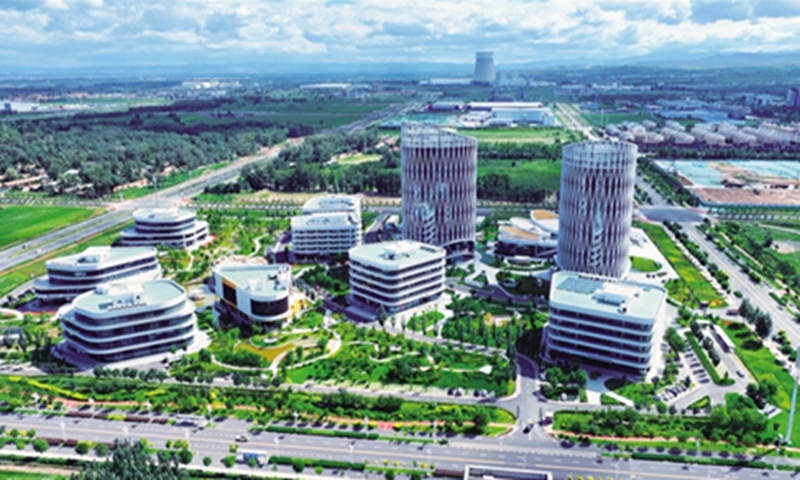
Data center in Hohhot, North China’s Inner Mongolia Autonomous Region
In the vast grasslands of North China's Inner Mongolia Autonomous Region, a quiet digital revolution is unfolding. Hohhot, renowned for its unique policy support, strategic location, and energy advantages, is emerging as a key pillar of northern China's computing landscape. As a strategic hub of nation's "East Data, West Computing" project, the city is developing a green data hub to meet the country's growing demand for data processing and storage.
Enjoying the dual advantage of policy support and convenient traffic network, Hohhot has become one of the nation's key sites of the integrated national data center cluster network. Only a two-hour trip from Beijing, Tianjin and most cities in North China's Hebei Province, the network latency can be shorter than three milliseconds in the Beijing-Tianjin-Hebei region, enabling real-time applications such as financial trading and autonomous driving. The city's natural assets prove equally valuable: an annual average temperature of 7 C enables over 200 days of free cooling annually, driving Power Usage Effectiveness ratios down to 1.1, rivaling the world's leading efficient facilities.

Data center in Hohhot, North China’s Inner Mongolia Autonomous Region
Hohhot is reshaping how high-performance computing meets sustainability goals with low costs and stable clean energy supply. Through Inner Mongolia's robust grid, the city's data centers now source over 80 percent of their electricity from green energy. Market reforms have further improved competitiveness. Electricity prices have remained steady at 0.34-0.38 yuan per kilowatt-hour, being among the lowest in major hubs.
The full-fledged local manufacturing and application ecosystem has helped Hohhot become home to 50 major computing projects and more than 522,000 deployed standard data center racks for holding multiple servers, making the city's total computing capacity reach 125,000 petaflops (PFLOPs) and intelligent computing account for 120,000 PFLOPs. The vast computing capacity scale places Hohhot firmly among the top in total computing capacity across the eight national hubs, and equivalent to the combined power of 113 of the world's top-tier supercomputers. Industry giants including Huawei and Douyin have established their largest self-built facilities here, underscoring strong investor confidence in the region's long-term trajectory.
Beyond hardware, Hohhot is cultivating a vibrant digital economy by enhancing application innovation and data trading vitality. The city's municipal authorities have aggregated 20.9 billion data records within the city's "Trusted Data Space," while the Inner Mongolia Data Trading Center has facilitated transactions for over 800 specialized products worth 148 million yuan. More than 60 specialized firms, including Cambricon's liquid-cooling laboratory, now operate in the region, building out a 167-terabyte data annotation industry that underpins the nation's artificial intelligence development.
The 2026 Government Work Report has outlined that China will be moving faster to achieve greater self-reliance and strength in science and technology. With a solid foundation in green computing, Hohhot, whose name means "Green City" in Mongolian language, is set to play a pivotal role in the high-quality growth of China's digital economy.
