ARTS / CULTURE & LEISURE
Natural beauty and local culture make Xichang a standout destination in Daliang Mountains

A Long March-3B carrier rocket carrying the Shiyan-22 satellite blasts off from the Xichang Satellite Launch Center, on December 9, 2025. Photos: VCG
Before setting off on a reporting trip to Liangshan Yi Autonomous Prefecture in Southwest China's Sichuan Province, I held certain preconceived notions about the area. Indeed, I believed it to be an impoverished mountainous region marked by isolation and harsh living conditions.
The presence of the Xichang Satellite Launch Center only reinforced the image of a remote and desolate place.
Before departing, I had some packing to do and I prepared as best I could for what promised to be quite an adventure. A colleague traveling with me reminded me to bring extra clothes, as temperatures would be much lower than in Beijing. Concerned about sanitation in the mountainous areas, I even brought my own kettle.
Yet the moment I set foot in Xichang, the capital of the prefecture, I began to see this "City of the Moon" nestled in the Daliang Mountains in a whole new light.
Daughter of the Moon
Located in Sichuan's far south, at a relatively high elevation, Xichang enjoys a mild and sunny climate, in stark contrast with the more humid conditions of the Sichuan Basin. The climate of Xichang rivals that of Kunming in Southwest China's Yunnan Province, which is known as a "spring city" for its mild climate and green environment. For that reason, Xichang has been nicknamed "little spring city."
Blessed with a low latitude (27 degrees North), a high altitude (1,500 meters), a favorable launch inclination and a short ground-to-space distance, Xichang enjoys a uniquely advantageous location, which makes it an ideal satellite launch site. The low latitude allows satellites to leverage the Earth's rotational linear velocity during launch, saving fuel for rocket ascent, increasing the rocket's payload capacity, and shortening the distance from the ground to the satellite orbit, according to Sun, a local government official.
Xichang has been seeking to develop tourism related to aerospace, benefiting local farmers in the process. Two kilometers away from the Xichang Satellite Launch Center, a small village of ethnic Yi people has become a cluster of family inns.
Besides beautiful natural scenery, Xichang is also characterized by a variety of unique minority ethnic cultures, which stand out as a key local attraction. In total, the city attracted more than 3 million tourists during the 2026 Spring Festival holidays.
Stepping out of the Xichang Qingshan Airport after a three-hour flight from Beijing, the sculpture of a girl reclining on a crescent moon immediately caught my eye.
"This statue is called Daughter of the Moon. It is a precious cultural symbol of the Yi people," said Sun. He then shared with us a local legend that has been handed down through many generations.
"Long ago in the Daliang Mountains, there lived a skilled Yi maiden named Zimo Lingzha. The cattle and sheep she herded grew plump and strong and the woolen cloaks she wove bore vivid patterns."
"The Moon Fairy was so impressed by Zimo Lingzha's weaving skill that she asked the Sun Mother to invite the girl to the Moon Palace to teach her. However, after 99 days of learning, the Moon Fairy still could not master the craft. Ashamed, she volunteered to step down and give her position to Zimo Lingza, who refused. Instead, the Moon Fairy invited Zimo Lingzha to manage the Moon Palace. From that day forward, Zimo Lingza became the daughter of the Moon. To thank the Sun Mother for her kindness, Zimo Lingzha presented her and the Moon Fairy with a red woolen cloak," said Sun.
Zimo Lingzha represents diligence, courage and wisdom of women. Nowadays if we want to praise someone for these qualities, we still call them Daughter of the Moon, Sun added.
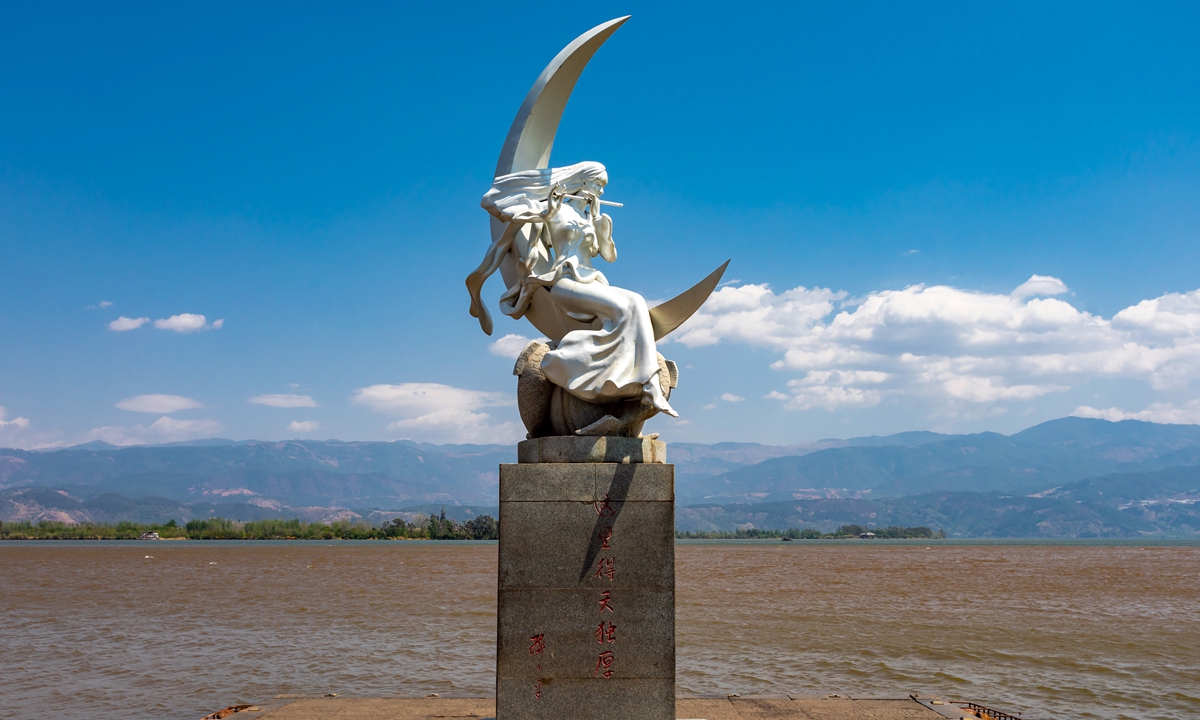
The statue of Daughter of the Moon in Xichang, Southwest China's Sichuan Province
Fire's spiritThe Yi people are known to be fire-worshippers and embody the spirit of fire through optimism, enthusiasm and braveness. Summer, especially during the Torch Festival, is the city's most vibrant season. Torches line the streets, and both locals and tourists gather hand in hand in the squares, singing and dancing around bonfires.
The fire's spirit is etched into the bones of the Yi people and lies the most solid foundation for this land's journey from poverty alleviation to rural revitalization. "We always jokingly say that if you put the Yi people in any impoverished area, soon there won't be any poverty at all," said a local woman.
Jilie Ziri, Party secretary of Abuluoha village and a deputy to the National People's Congress, has expressed the Yi people's fiery passion for change and improvement through concrete actions. After leaving the mountains to pursue education, he returned home as the village's first college graduate and started devoting himself to the village's development with the goal of leading fellow villagers toward a better life within 10 years.
Over eight years of constant efforts, Jilie has witnessed the village's transformation from an impoverished isolated area into a paradise hidden away from the world. Today, he continues to lead villagers in developing local industries.
"The most important thing for me is to truly turn the crops grown in the fields into real money in the villagers' pockets," he told the Global Times.
Although most of the working-age population in Abuluoha village has left for jobs elsewhere, the elderly and children who stayed behind all showed a positive and optimistic outlook. Their smiles vividly reflect a community steadily moving toward a brighter future, strongly dispelling the reporters' stereotypes about the Liangshan area.
RELATED ARTICLES