BRASIL 247 / MORE
Lula highlights trade and energy as pillars of Brazil-Bolivia relations
Brazilian president says South American integration is a "historical necessity"
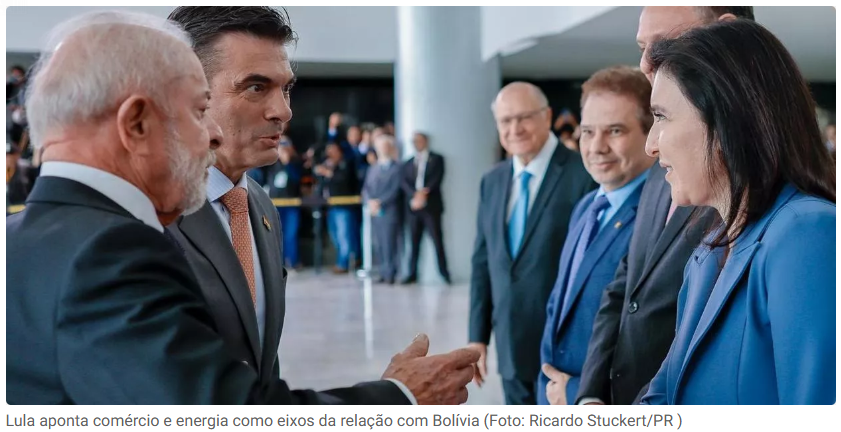
Photo: screengrab from the official website of Brasil 247
By Brasil 247 - Brazilian President Luiz Inácio Lula da Silva said on Monday that integration among South American countries is essential for the region's economic and political development, during a press statement marking the state visit of Bolivian President Rodrigo Paz to Brasília, according to Brasil 247.
Welcoming Paz and a delegation composed of ministers, governors and business leaders, Lula noted that the two leaders had previously met in January at a regional event in Panama and emphasized the symbolic importance of Brazil as the destination of Paz's first bilateral visit after taking office. He also recalled historical ties between the countries, mentioning former Bolivian president Jaime Paz Zamora, Rodrigo Paz's father, who visited Brazil in 1990.
Lula described the Brazil-Bolivia border as a "living frontier" connecting peoples, cultures and economies across the Amazon, the Pantanal, the Andes and the Southern Cone. The two countries share a border of more than 3,400 kilometers linking Brazilian states including Acre, Rondônia, Mato Grosso and Mato Grosso do Sul with the Bolivian departments of Pando, Beni and Santa Cruz.
The Brazilian president said bilateral trade remains below potential, noting that commercial exchange fell from $5.5 billion in 2013 to $2.6 billion last year. He highlighted efforts to reverse the trend, including the participation of more than 100 Brazilian companies in the Expocruz fair in Santa Cruz de la Sierra in 2025 and the presence of 120 Bolivian business representatives accompanying Paz to Brazil for a business forum in São Paulo.
Lula pointed to opportunities for cooperation in agriculture and biotechnology, including sectors such as food production, dairy, seeds, fruits, cotton, sugarcane and soybeans, with support from the Brazilian Agricultural Research Corporation (Embrapa). He also cited the recently approved Brazilian Export Credit System, which will expand export financing through the National Bank for Economic and Social Development (BNDES).
On infrastructure, Lula recalled the inauguration in 2004 of the first bridge linking Brasiléia, in Acre, to Cobija, in Bolivia, and announced progress on a second bridge project over the Mamoré River connecting Guajará-Mirim in Rondônia to Guayaramerín in Beni, with construction expected to begin in 2027. The project forms part of the South American Integration Routes initiative and aims to facilitate access to Pacific ports in Chile and Peru, expanding trade with Asian markets.
Lula also said Brazil proposed a tripartite agreement with Bolivia and Paraguay to improve navigation along the Paraguay River waterway, including interventions in the Tamengo Channel.
Energy cooperation was another central topic of the meeting. Lula highlighted Petrobras' historical role in developing Bolivia's hydrocarbon sector and stated that Bolivia remains Brazil's largest supplier of natural gas. The leaders discussed expanding investments and export volumes, as well as new uses for the Brazil-Bolivia gas pipeline, including potential supply to a fertilizer plant planned in Puerto Quijarro.
The two countries also advanced an agreement to interconnect their electrical systems through a transmission line linking the Bolivian province of Germán Busch to Corumbá in Brazil. Lula added that Brazil is willing to cooperate with Bolivia in developing biofuels and other renewable energy sources to strengthen energy security and support regional decarbonization.
Security cooperation was addressed through an agreement aimed at strengthening coordination against organized crime, drug and human trafficking, smuggling, vehicle theft, money laundering, illegal mining and environmental crimes along the shared border.
Lula also highlighted social and educational ties, noting the presence of thousands of Brazilian students at Bolivian universities, particularly in medical programs, which he said reinforces cultural exchange between the two nations.
The governments signed a memorandum of understanding on tourism cooperation, promoting exchanges between destinations in both countries, including Brazil's Copacabana beach and Bolivia's historic Copacabana on the shores of Lake Titicaca.
During the statement, Lula stressed the broader geopolitical importance of regional cooperation, saying that integration is "not an ideological project" but "a historical necessity." He described Bolivia's accession to Mercosur as a historic step that strengthens the bloc's strategic autonomy and confirmed his participation in the upcoming Community of Latin American and Caribbean States (Celac) summit scheduled for March 21 in Bogotá.
The Brazilian president also emphasized the shared responsibility of Brazil and Bolivia in protecting the Amazon and its biodiversity through cooperation within the Amazon Cooperation Treaty Organization, concluding by reaffirming his commitment to democracy and regional stability.
(Reported by Brasil 247 on March 16, 2026)
