ARTS / CULTURE & LEISURE
Tai chi links world as both sport and smart answer for our times
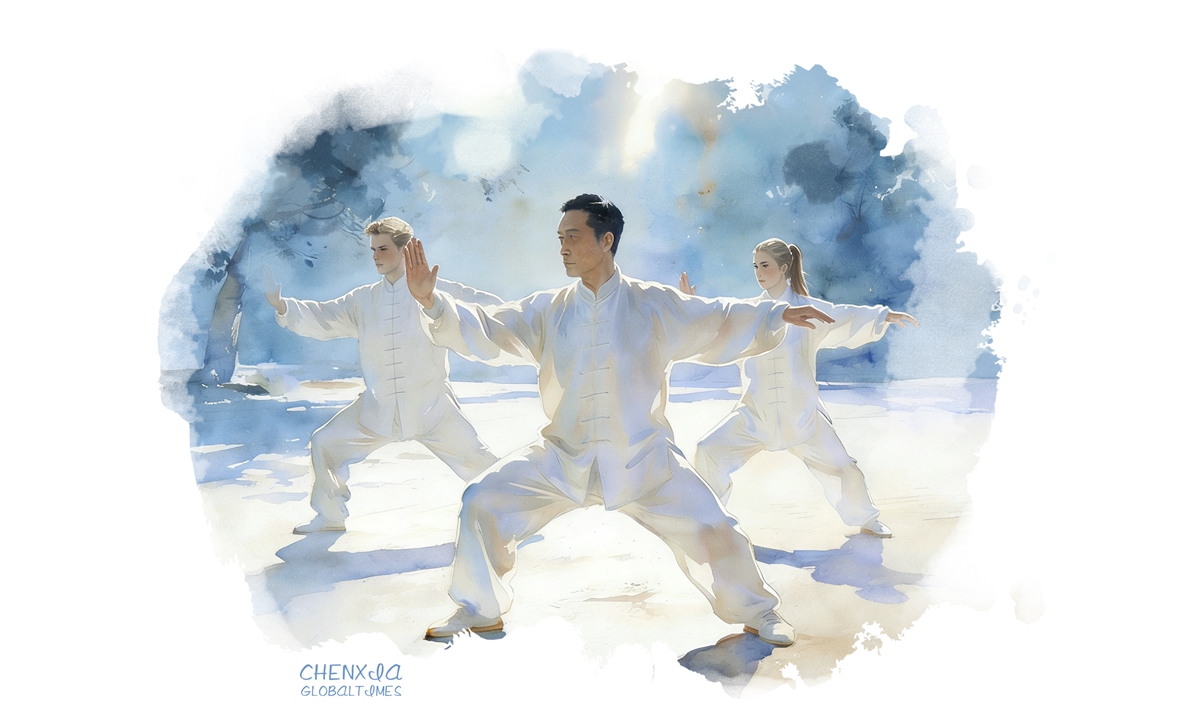
Illustration: Chen Xia/GT
Across China, France, Argentina, and beyond, people from diverse cultural backgrounds, spanning languages and time zones, came together Saturday in their own corners of the world to practice the same thing, Taijiquan, also known as tai chi, a UNESCO-listed Chinese martial art. March 21 marked the very first International Taijiquan Day.In an era obsessed with speed and stimulation, Taijiquan, which seeks a slow and balanced rhythm in every breath, is by no means as instantly appealing as the sensational news or video memes on people's screens.
However, what enables it to unite people across the world is actually its sense of slowness and tranquility, qualities that stand out as precious in contrast to the ever-shifting desires of our time.
Originating in China nearly 400 years ago, Taijiquan is a national intangible cultural heritage (ICH) that was inscribed on UNESCO's Representative List of the Intangible Cultural Heritage of Humanity in 2020.
Taijiquan embodies several strands of Chinese philosophy. On the one hand, the Confucian principle of Zhongyong, or the Doctrine of the Mean, forms one of Taijiquan's core philosophical foundations, manifesting in techniques such as "maintaining an upright and centered posture."
Meanwhile, Taijiquan also draws on the insights of Chinese Taoism, translating the concept of aligning human affairs with the natural order into bodily movements characterized by fluidity, freedom from stiffness, and responsiveness to circumstance. For example, in exercises like tuishou (lit: push hands), when facing a strong attack from an opponent, practitioners do not meet force with brute force. Instead, they neutralize the attack by yielding to and guiding the direction of the opponent's energy. This marks a vivid expression of the Taoist philosophy of overcoming hardness with softness.
These philosophical ideas are difficult to convey through words as they require translation and rely heavily on intuition. But when braided into physical movements, these abstract concepts turn into concrete experiences.
That's to say, this is one of the core reasons why people, even without understanding the Chinese language, can still feel the charm of Taijiquan. Yet it is not so much the charm of its individual movements they experience, but rather, through those movements, the charm of the Chinese cultural spirit.
But if Taijiquan was merely delivering ancient Chinese spirit, it could hardly become a world cultural heritage. In other words, Taoist or Confucian, the wisdom in Taijiquan practice has survived to this day because it still works.
It helps modern people manage anxiety, navigate relationships, and find balance. And these are precisely the kinds of problems that modern life brings - challenges that are universal, crossing every border.
French practitioner Trappler Marie-Line, studying at Taijiquan's cradle Wudang Mountain in Hubei Province, said that Taijiquan "helped her find herself," while British artist Holly told the Global Times that the seemingly peaceful practice instead stirred "a richer inner emotion" that fueled her painting.
These two examples are once again highlighting why Taijiquan is a universal practice: It is not like a standardized sport that demands everyone conform to the same mold, but rather a mirror that reflects what each person needs moment to moment.
Going beyond sports, as the world turns into a vast arena where everyone competes for external victories, the wisdom of Taijiquan reminds us that true strength lies not in controlling the outside world, but in settling the self within. And how, then, can this philosophy not offer some fresh perspectives for today's society and international relations?
The pursuit of self-awareness and inner peace has also distinguished Taijiquan from the sports logic of pursuing faster or higher aims. Traditional sports culture has long been dominated by such logic, in which one seeks for external success. While pushing the body to its extremes often comes at the cost of mental and emotional balance, Taijiquan cultivates an inward-looking bodily experience - reminding people to reclaim themselves in practice.
That's to say, in the long run, Taijiquan is a more sustainable form of exercise - one that is not only borderless, but also ageless and accessible to all.
It is this inclusiveness that has enabled Taijiquan to attract hundreds of millions of practitioners across more than 180 countries and regions.
The current International Taijiquan Day is indeed a milestone, because it offers these worldwide practitioners a stronger sense of community.
But, more importantly, Taijiquan actually underscores a value that extends far beyond community: As a cultural symbol that knows no borders, it can spark meaningful cultural dialogue across the world.
In Senegal, Africa, Taijiquan became an official event at its Youth Olympic Games. Meanwhile, practitioners from more than 30 countries brought what they had learned in China all the way to UNESCO headquarters in Paris. Such examples speak of one thing: Taijiquan sparks cultural dialogues through people, by people.
The author is a reporter with the Global Times. life@globaltimes.com.cn
RELATED ARTICLES