BRASIL 247 / MORE
Lula calls for stronger CELAC and rejects external tutelage over Latin America
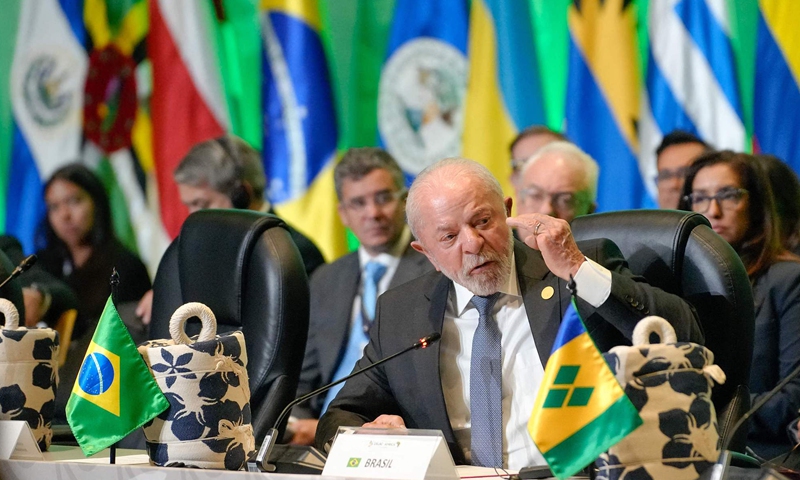
Handout picture released by the Colombia Presidency press office showing Brazilian President Luiz Inacio Lula da Silva speaking during the X Summit of Heads of State and Government, within the framework of the CELAC-Africa High-Level Forum in Bogota, on March 21, 2026. Photo: CFP
By Brasil 247 - President Luiz Inácio Lula da Silva called for a stronger and more cohesive Community of Latin American and Caribbean States (CELAC) during the bloc's 10th Summit in Bogotá on March 21, 2026, in a speech read by Foreign Minister Mauro Vieira. The text, released by Brazil's presidential office, argued that Latin America and the Caribbean must deepen integration, defend their sovereignty and resist external attempts to turn the region into a mere sphere of influence.
Lula said CELAC represents the most significant effort ever made to affirm the region's own identity on the international stage. He warned that weakening the bloc serves outside interests and issued one of the speech's most striking lines: "But Latin America and the Caribbean do not fit in anyone's backyard."
The president framed CELAC as the result of a long historical process in which regional countries too often reacted to external pressures instead of building a common internal agenda. He recalled that earlier moments of unity were usually responses to international crises, while CELAC emerged as a more autonomous political space.
According to Lula, the bloc marked a turning point because it allowed the countries of Latin America and the Caribbean to meet without external tutelage. "For the first time, we were able to define our own agenda, guided by our needs and interests," he said. He added that this helped launch a form of integration that was "active, rather than reactive," grounded in peace, international law and non-interference.
The speech, however, also delivered a harsh diagnosis of the current regional landscape. Lula said Latin America and the Caribbean are now "cornered and divided," lacking even the ability to clearly condemn violations of the sovereignty of member states. He cited the crisis in Haiti, threats against Cuba and tensions among neighboring countries as signs of a troubling fragmentation.
He also said the gradual emptying out of CELAC summits is not accidental. "Weakening CELAC means removing the main obstacle to attempts to transform the region into a zone of influence," he said, linking the bloc's fragility to broader geopolitical disputes over Latin America and the Caribbean.
Organized crime was another central theme. Lula argued that a disjointed region creates fertile ground for transnational criminal networks and said cooperation among countries is the best defense, as long as sovereignty is preserved. "A disarticulated region favors organized crime. Collaboration among us, without giving up sovereignty, is our best shield," he said.
He argued that fighting cartels and criminal organizations requires going beyond street-level operators. "It is necessary to strike the entire chain of command, especially the highest levels, which live in luxurious apartments and offices," he said. He also linked the problem to global financial and logistical structures, including money laundering in tax havens, the flow of weapons from rich countries, fraud and the lack of regulation of cryptocurrencies.
Presenting Brazil's recent measures, Lula said the country wants to create a Unified Public Security System and has already approved an anti-gang law. He said the aim is to improve coordination among police forces and strengthen the role of the Federal Police in combating criminal organizations and private militias operating across state and national borders.
He also highlighted the recently launched Integrated Force Operation in Brazil. According to the speech, simultaneous actions in 15 states led to 116 arrests, the seizure of more than 700 kilograms of drugs and the freezing of nearly $20 million in illicit assets. Lula said this kind of coordination should also exist across Latin America and the Caribbean.
The president praised Colombia's current CELAC presidency for expanding the bloc's dialogue with external partners such as China, the European Union and African countries. He said these actors often recognize the region's potential more clearly than Latin American countries themselves do.
A major part of the speech focused on development and strategic resources. Lula said Latin America and the Caribbean are rich in energy, biodiversity, agriculture and critical minerals, yet remain marked by deep inequality and technological dependence. He stressed that the region holds the world's second-largest reserves of critical minerals and rare earths, which are essential for chips, batteries and solar panels.
"It is fair that we have access to all stages of value chains, from extraction to the final product, from processing to recycling," he said. He argued that the region must avoid repeating a historical pattern in which other parts of the world become richer through Latin America's raw materials while local societies remain underdeveloped.
Toward the end of the speech, Lula reaffirmed CELAC as the main political instrument available to Latin America and the Caribbean to project their own voice in world affairs. He also said Mercosur's institutional solidity offers a strong platform for broader South American integration, welcoming Bolivia's accession as a full member and noting the interest of other countries in associating with the bloc.
He concluded with a call for unity. "Let this be our commitment: to transform diversity into strength, unity into sovereignty and hope into future," he said.
Quoting Cuban singer-songwriter Pablo Milanés and his "Song for Latin American Unity," Lula ended on a symbolic note: "What shines with its own light no one can extinguish; its brightness can reach the darkness of other shores."
(Reported by Brasil 247 on March 22, 2026)
