China to launch pilot programs for high-quality datasets to empower AI agents
By Published: Mar 24, 2026 09:33 PM

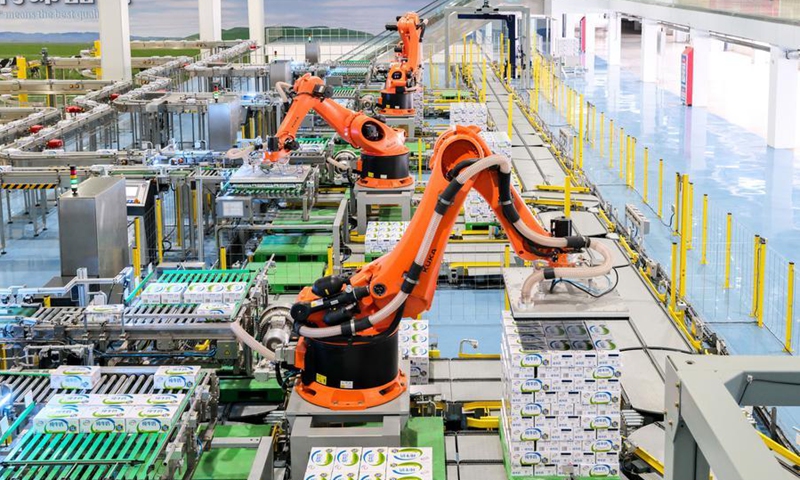
Robotic arms carry out packaging operation at the Global Intelligent Manufacturing Industrial Park of Yili Modern Intelligent Health Valley in Tumd Left Banner in Hohhot, north China's Inner Mongolia Autonomous Region, April 17, 2025. (Photo: Xinhua)
China's Ministry of Industry and Information Technology (MIIT) announced on Tuesday that it will carry out pioneering trials for the development of high-quality industry datasets, aiming to empower industrial intelligent agents.
The announcement was made during a press conference held by the State Council Information Office. Wang Yanqing, an MIIT official, outlined the ministry's roadmap for piloting the construction of high-quality industry datasets for artificial intelligence (AI) empowerment.
According to Wang, the key process numerical control rate in major industrial enterprises reached 68.6 percent as of the end of 2025. He noted that a range of industrial 5G-specific chips, modules, and terminal products have been developed, helping to transform old equipment at industrial sites into smart sensors.
These advancements have laid a solid foundation for the aggregation and application of massive industrial data, he said. "This year, we launched the industrial data infrastructure building initiative to pioneer the construction of high-quality industry datasets," Wang stated.
The ministry plans to promote policies that leverage data elements to empower new-type industrialization. It will also issue reference guidelines for the application of data elements in industrial scenarios, while stepping up efforts to formulate industrial data standards and foster data service enterprises specializing in areas such as data consulting, governance, and annotation.
With the rapid development of a new generation of information technologies, represented by AI, these technologies are now deeply integrating into every process and aspect of the manufacturing industry. Like computing power and algorithms, data is increasingly becoming an important factor of production in industry as well as a valuable strategic resource, Wang noted.
On March 10, the MIIT released a notice regarding the industrial data infrastructure building initiative.
According to the notice, by the end of 2026, China aims to cultivate industry data cooperation consortia, establish trusted interconnect platforms for key industry data, aggregate a range of industry data resources, achieve breakthroughs in key data technologies, develop a set of industrial data standards, and create a batch of high-quality, standardized, and tradable industry datasets.
These efforts are ultimately intended to empower the deployment of industry-specific large-language models and industrial intelligent agents.
Simon Zhang, vice president and chief data officer of Midea Group, told the Global Times on Tuesday that intelligent agent factory is a "completely new species."
Under the command of the factory's brain, every factor of production - people, machines, materials, methods, and the environment - is no longer an isolated unit. Various intelligent terminals, including embodied robots, robotic arms, autonomous mobile robots, injection-molding machines, cameras, sensors, and more, are endowed with the capabilities of perception, understanding, decision-making, and action, according to Zhang.
Liu Liehong, head of the National Data Administration, said on Tuesday that during the 14th Five-Year Plan (2021-25) period, the added value of core industries in the digital economy increased from 7.8 percent of GDP in 2020 to more than 10.5 percent in 2025.
Based on GDP accounting for the respective years, the scale of core industries grew to more than 14.7 trillion yuan ($2.14 trillion) from about 8.1 trillion yuan, representing an average annual compound growth rate of 12.8 percent, significantly higher than the GDP growth rate over the same period.
This indicates that the core industries of the digital economy have played an increasingly fundamental and pillar role in the national economy, Liu said.
RELATED ARTICLES