ARTS / CULTURE & LEISURE
Dunhuang Tibetan manuscripts kept in UK, France published in China
Speaking across centuries
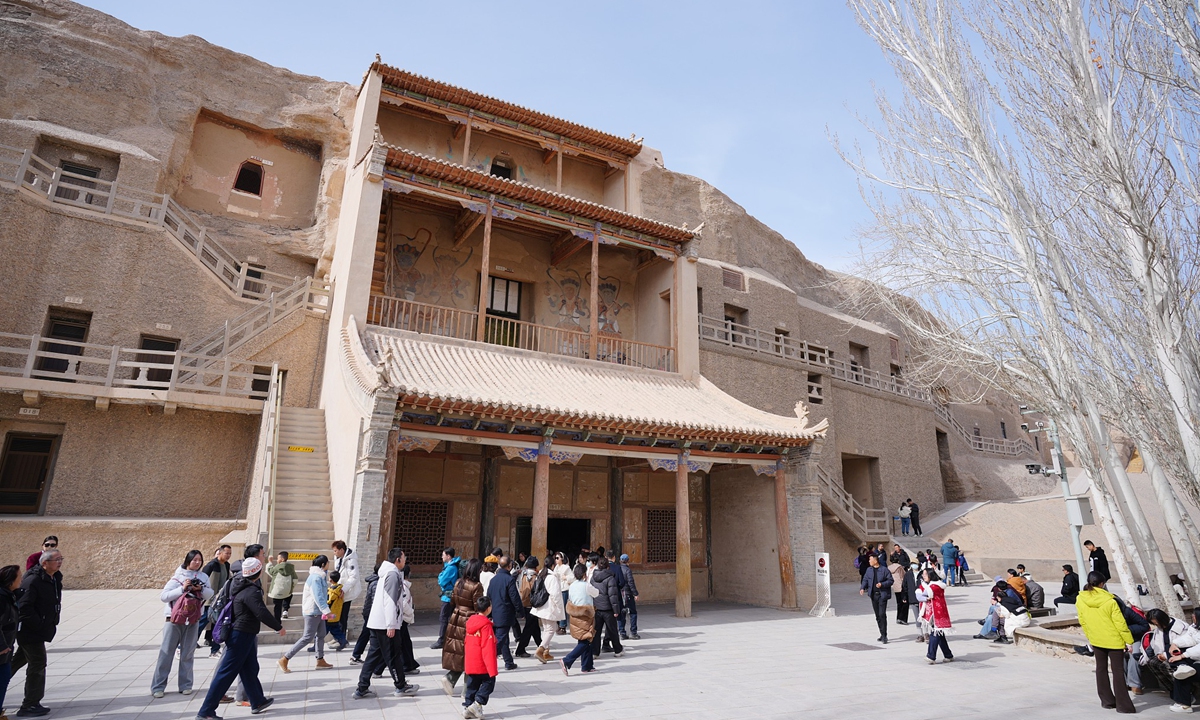
Tourists walk outside of the Library Cave of the Mogao Caves in Dunhuang, Northwest China's Gansu Province on February 22, 2026. Photo: VCG
After two decades of collaboration, a vast trove of ancient Tibetan manuscripts from the Silk Road oasis of Dunhuang has been compiled and published in China, offering scholars an unprecedented window into the political, cultural and religious life of a pivotal era in Chinese history.The newly released collection, totaling 61 volumes of Dunhuang manuscripts written in the Tibetan language, collected in the British Library and the National Library of France, were taken abroad from the Library Cave of the millennium-old Mogao Caves in Dunhuang in the early 20th century, according to Cai Rang, director of the Institute of Overseas Ethnic Documents at Northwest Minzu University (NWMU), a key project participant based in Lanzhou, the capital of Northwest China's Gansu Province.
The Dunhuang manuscripts are considered the oldest known surviving Tibetan-language documents on paper.
Their contents span Buddhist scriptures, administrative records, legal texts, contracts and historical documents, painting a vivid picture of life during the rule of the Tubo Empire (618-842) over Dunhuang.
However, due to historical circumstances, a significant portion of these manuscripts was dispersed overseas, with collections now held in places like the UK, France and Russia.
Among them, the Dunhuang Tibetan manuscripts housed at the British Library and the National Library of France constitute the largest and most important body of such ancient ethnic-language documents preserved outside China.
The manuscripts published in this collection date from the seventh to the 11th centuries.
"As original handwritten documents that have not been altered by later generations, they serve as primary historical sources, which document history, religion and social life during the Tubo period and are considered to be of exceptional academic value," Zhaxi Dangzhi, a professor at NWMU, told the Global Times.
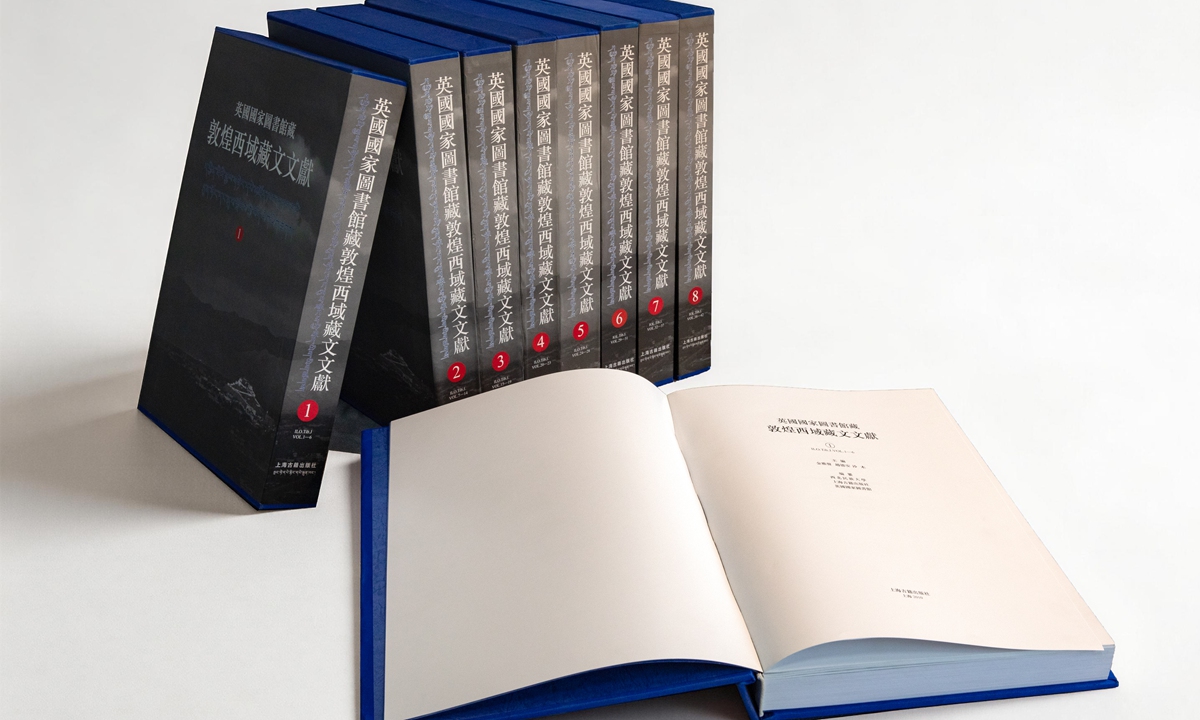
The newly published books on the Library Caves manuscripts Photo: Courtesy of NWMU
Hidden treasuresThe manuscripts trace their origins to the famed Library Cave at the Mogao Caves, a UNESCO World Heritage site. In 1900, a Daoist caretaker discovered the sealed cave while clearing sand, revealing a cache of more than 70,000 documents and artifacts accumulated between the fourth and 11th centuries.
Hidden for nearly a millennium, the cave contained an extraordinary range of materials, from religious texts and official documents to poetry, calendars, medical prescriptions and commercial contracts, written in multiple languages, including Chinese, ancient Tibetan and Sogdian language.
The discovery of the precious texts also coincided with a period of political weakness in the late Qing Dynasty (1644-1911). Foreign explorers acquired large portions of the collection, taking many manuscripts to Europe.
The Tibetan-language documents preserved in London and Paris represent some of the most significant and extensive materials among those dispersed overseas.
Located along the Hexi Corridor, Dunhuang was a crossroads of trade, religion and cultural exchange, where diverse ethnic groups and traditions intersected, according to Zhaxi.
The Tibetan manuscripts reflect this diversity. Alongside Buddhist texts, an example of the Tubo rulers' patronage of the religion, are secular documents such as land contracts, personal letters and legal records.
"These provide rare insights into everyday life, economic activity and social relations more than a thousand years ago," said Zhaxi.
Some texts also shed new light on historical figures and events. Records related to Princess Wencheng and Princess Jincheng in the Tang Dynasty (618-907), both vital to early relations between central China government and then-government in the Tibetan region, include detailed accounts of their lives and deaths that were previously unknown.
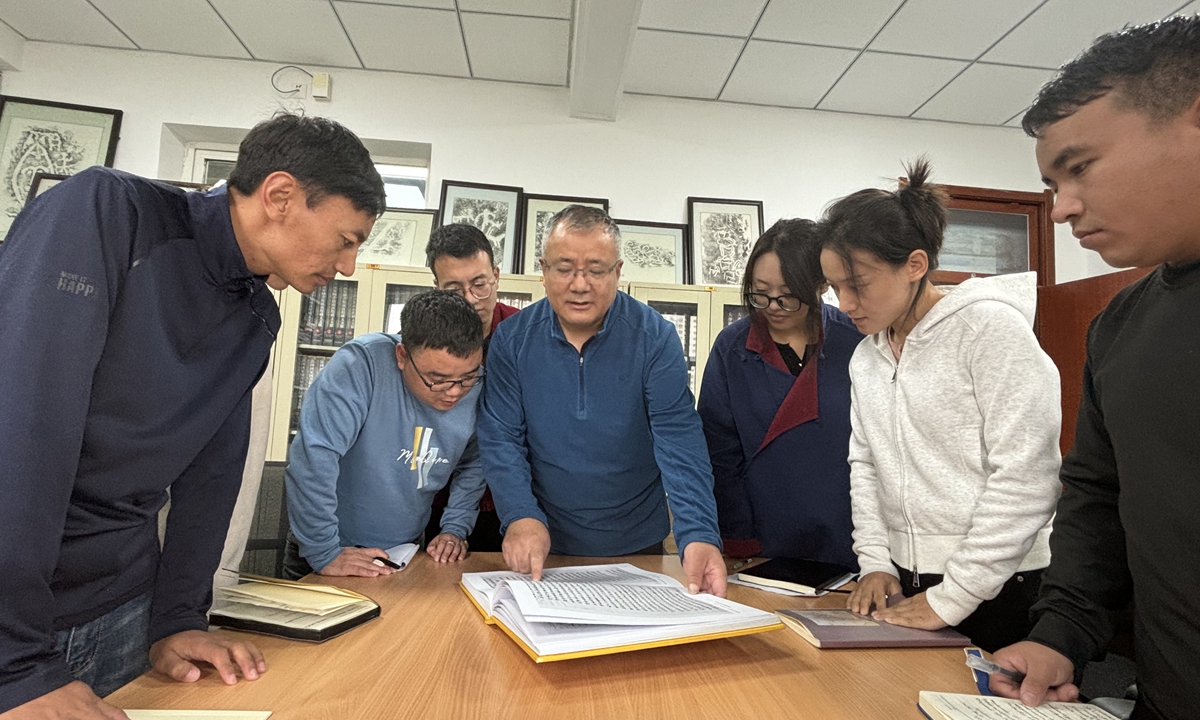
Professor Zhaxi Dangzhi discusses research of the Dunhuang manuscripts with students. Photo: Courtesy of NWMU
Bringing history homeFor decades, access to these manuscripts overseas was limited, with only a fraction reproduced or studied in detail. The new publication project changes that.
Work began in 2005 and required close coordination between Chinese and European institutions.
In 2021, researchers completed 35 volumes of manuscripts held in France, comprising more than 3,100 cataloged items and over 28,000 high-resolution images.
The remaining 26 volumes from the British collections were finalized in 2025, bringing the total to 61.
The scale of the effort was matched by its complexity. Many manuscripts are damaged, with missing characters, faded ink and irregular writing styles. The language itself, an early form of Tibetan, also posed additional challenges.
"We had to examine every character, every line," said Zhaxi. "For unidentified texts, we relied on internal evidence and cross-referenced authoritative sources such as the Tibetan canon to ensure accurate classification and translation."
These manuscripts provide an authentic record of the social and economic structures of Dunhuang during Tubo rule, as well as the realities of cross-cultural exchange among different ethnic groups, noted Zhaxi.
In addition, they clearly show how the Tubo actively absorbed and integrated elements of Tang Dynasty culture, underscoring the deep cultural ties and shared history between the Han and Tibetan peoples, and offering strong historical support for a sense of national cohesion.
A new project has been launched to produce a fully collated, full-color edition of the Dunhuang Tibetan manuscripts held in France.
The updated edition will refine cataloging and standardize titles, while high-resolution color reproduction will present red and black ink annotations, as well as illustrations, with greater clarity. The digitization of key manuscripts is also underway, according to Zhaxi.
RELATED ARTICLES