From 1st Five-Year Plan to 15th Five-Year Plan: a new look at China’s ‘first factories’
Editor’s Note:
The outline of the 15th Five-Year Plan (2026-2030) proposes optimizing traditional industries, which form the foundation of China’s industrial system and account for about 80 percent of the manufacturing sector value. Upgrading traditional industries is vital to accelerating new quality productive forces.
How can traditional industries upgrade to achieve high-quality development?
Success does not come from waiting; it must be earned through hard work. Those time-honored factories bearing the marks of their times are forging ahead with full enthusiasm now.
Recently, the reporters visited China’s "first factories" from the first Five-Year Plan (1953-1957), including FAW Group, China First Heavy Industries Co (CFHI) and YTO Group, to see how they are fostering and developing new driving forces and setting sail again at the start of the 15th Five-Year Plan.
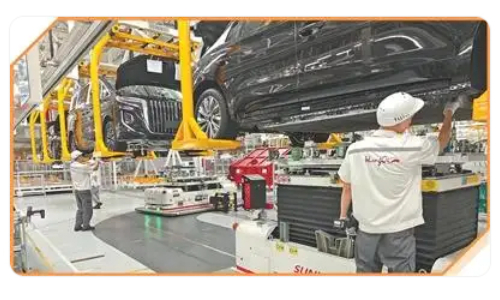
Workers test vehicles on the assembly line at the Hongqi Fanrong Plant of FAW Group. Photo: Men Jiewei
By Men Jiewei
In Changchun, Northeast China’s Jilin Province, FAW Hongqi’s Fanrong Plant sees a new-energy vehicle (NEV) roll off the assembly line every 54 seconds, with industrial robots ensuring the efficiency.
"Digital upgrading boosts efficiency significantly," said Zhang Guolong, FAW’s senior assembly-technology director, noting that the Fanrong Plant has a daily output of around 1,000 vehicles.
From using the wrenches in the past to leveraging various types of industrial robots today, FAW Group takes innovation as its primary driver to propel high-quality development.
Founded in 1953, as a key project of China’s first Five-Year Plan, FAW produced China’s first truck "Jiefang" three years after its ground-breaking ceremony in Changchun, Northeast China’s Jilin Province, which ended the history of China being unable to manufacture automobiles.
The workers fought day and night for 33 days and hand-hammered out China’s first sedan Hongqi, said Xu Dongming, director of FAW Hongqi Culture Exhibition Hall.
Growing with China’s automobile industry, FAW has been continuously exploring new technologies through persistent innovation. In 2025, its total sales hit 3.3 million, with independent brands at 940,000, up 15 percent. The company’s NEV production reached 366,000 cars, up 71.4 percent year-on-year.
Innovation-driven transformation has brought vigorous vitality. The carmaker has tackled more than 1,500 core technologies and applied for more than 22,000 patents during the 14th Five-Year Plan.
It has completed the trial production and verification of 66Ah all-solid-state battery cells, with major indicators leading the world; jointly developed China’s first advanced process multi-domain fusion chip — "Hongqi No 1" and deeply integrated artificial intelligence (AI) into the entire chain of production, operation and after-sale services.
The NEVs produced by FAW are now shipped to Europe via China–Europe freight trains at Changchun International Land Port. Actively participating in high-quality Belt and Road cooperation, FAW has established a presence in more than 100 countries and regions, with its brand prestige continuously growing.
To promote the high-quality development of China’s automobile manufacturing industry, a key effort lies in strengthening the independent research and development (R&D) of core technologies and key components and making national brands stronger and larger.
"Facing the 15th Five-Year Plan period, FAW has launched a three-year action plan for comprehensive transformation and new breakthroughs, and is accelerating its strides toward building itself into a world-class carmaker," said a person in charge of FAW.
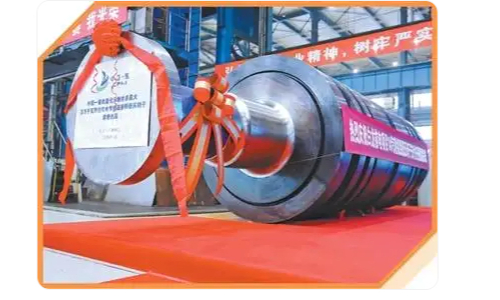
China’s first domestically developed and independently manufactured one-million-kilowatt integral forging low-pressure rotor, developed by China First Heavy Industries (CFHI) Photo: Li Cong
By Liu Mengdan
In Qiqihar, Northeast China's Heilongjiang Province, China First Heavy Industries Co (CFHI) recently completed China’s first domestically made 1-million-kilowatt conventional-island integral forging low-pressure rotor. As the red silk cloth was slowly lifted, the "heart" component of the nuclear power conventional island unit came into view, with the surface of the giant forging as smooth as a mirror.
The manufacturing process of the conventional-island integral forging low-pressure rotor is complex and imposes strict requirements on manufacturing capabilities.
"After multiple rounds of technological research and advancement, CFHI has overcome a series of difficulties, laying a solid foundation for the localization of core equipment for China’s nuclear power conventional islands," said Song Chuanbao, Deputy Secretary of the Party Committee and General Manager of the Material Industry Department of CFHI.
Since the 1950s, CFHI has shouldered the mission of “building major equipment for the nation”. In 1958, it produced its first batch of molten steel and iron. In its early days, workers carried heavy parts manually in temperatures of minus 30 C without lifting machinery, said Chi Hai, a Chief Milling Technician of the Engineering Equipment Division of CFHI.
Today, CFHI continues to forge core nuclear power components with craftsmanship and innovation, said Liu Boming, a national role model worker and Chief Forging Technician at the Material Industry Department of CFHI, who has participated in the whole process of tackling key bottlenecks for the million-kilowatt-class rotor. “We have carried out hundreds of simulation tests to ensure its precision.”
Liu said that to encourage exploration and innovation, the company selects leading technical and skilled talents and grants them both honors and material rewards, which has boosted everyone’s enthusiasm for innovation. Over the past 70-plus years, CFHI has provided 6 million tons of mechanical products for national economic development, filled 624 technological gaps in domestic industrial products, and developed 452 new products.
With more advanced technologies and higher-quality services, the company has deeply integrated into the global industrial and supply chains.
Last December, two ethylene oxide (EO) reactors, manufactured by CFHI for the China-Saudi Arabia Gulei Ethylene Project’s EO/EG unit, were shipped from CFHI’s Dalian Nuclear Power and Petrochemical Equipment Manufacturing Base.
CFHI has now become one of the world's largest manufacturers of ethylene oxide reactors, according to Feng Dongxu, Secretary of the Party Committee, Director and General Manager of CFHI Nuclear Power and Petrochemical Company.
Looking toward to the 15th Five-Year Plan period, CFHI will focus on high-end equipment making, advanced materials and new energy to enhance its core competitiveness and deepen integration into global industrial and supply chains, according to a person in charge of the CFHI.
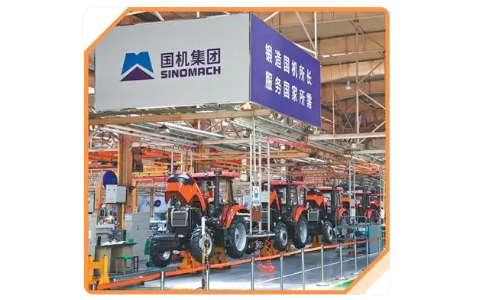
The final assembly line at the Large Tractor Company of YTO Group Photo: Shen Zhiyuan
China’s YTO Group: Focusing on R&D to explore broader agricultural machinery market in the world
By Zhang Wenhao
An automatic guided vehicle was seen transporting chassis weighing several tons to the assembly line; truss manipulators lifting large tires and placing them precisely on the frames... At the assembly workshop of YTO Group, an “Oriental Red”-brand tractor rolls off the production line every three minutes on average.
"These products are heavy-duty power-shift tractors newly developed and put into production for large-scale farm operations. They are not only large in size and powerful, but also smarter and more efficient," said Wang Yuzhe, Director of the Product R&D Department of YTO Group’s Large Tractor Company.
In 1955, the predecessor of YTO Group — the First Tractor Manufacturing Plant — broke ground in Luoyang city, Central China’s Henan Province. In 1958, the first tractor left the factory, marking the beginning of agricultural mechanization in China.
Inside the agricultural museum in the factory, the Oriental Red 54 crawler tractor is on display. As China’s first independently developed "iron ox," it has witnessed the development of this time-honored enterprise from the first Five-Year Plan period.
"In the early days, without specialized equipment, the factory relied on a large workforce, with all pulling, lifting, carrying and cranking done manually," said guide Zhang Ying.
In the early days of reform and opening-up, following the implementation of the household contract responsibility system, rural farmland was divided into small plots. "The factory adjusted its R&D strategy in a timely manner and produced the first generation of low-power wheeled tractors," said Xue Zhifei, a national role model worker and professor-level senior engineer at YTO Group.
Models such as the 15-horsepower Oriental Red small four-wheel tractor could be used for ploughing during busy farming seasons and for transportation in slack periods, winning wide market recognition, according to Xue.
Today, YTO Group has developed products of different horsepower levels to meet full-scenario operation demands, including hilly and mountainous areas, dry and paddy fields, and protected horticulture.
"A high-horsepower wheeled tractor contains more than a thousand components, and a single machine relies on a huge supply chain system," said Xue. In Luoyang, more than 200 enterprises supply parts to YTO Group.
At the Henan Oriental Red International Land Port, containers on China-Central Asia freight trains are slowly departing, carrying YTO’s latest tractors and parts to Kazakhstan.
"At present, the company’s products have been exported to more than 100 countries and regions," said Shan Chunyu, Deputy General Manager of YTO Group’s International Trade Company.
"Following the development trends of agricultural machinery such as intelligent control, efficient operation, energy conservation and environmental protection, we will focus on overcoming key ‘bottleneck’ technologies. Entering the 15th Five-Year Plan period, the company will accelerate the R&D and application of high-end intelligent tractors featuring high-horsepower continuously variable transmission, power shifting and hybrid power, boosting the high-quality development of domestic agricultural machinery," said a person in charge of YTO Group.
RELATED ARTICLES