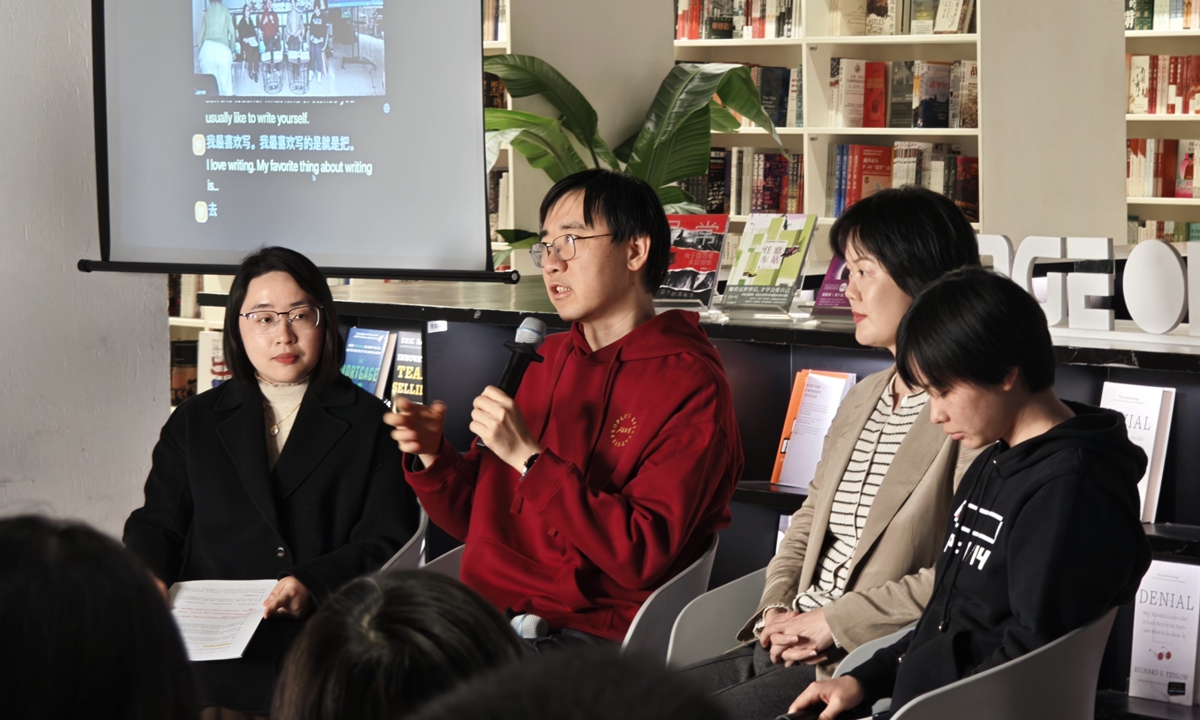
Chinese writer Baoshu (second from left) speaks at a sci-fi work promotional event in Beijing on March 26, 2026. Photo: Li Qian/GT
A group of renowned sci-fi writers and readers took part in a salon hosted by the China Writers Association (CWA) in Beijing on Thursday, aiming to promote emerging authors and their works overseas.
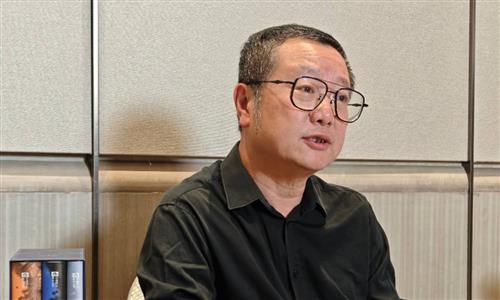
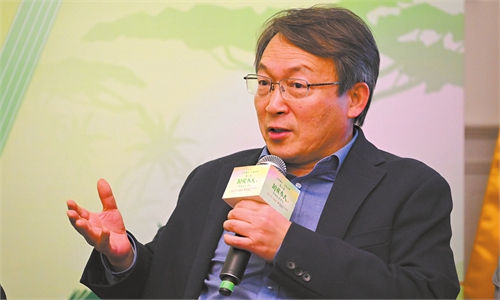
They highlighted seven rising stars of China's new generation of sci-fi writers - Chen Qiufan, Liang Qingsan, Baoshu, Gu Shi, Wang Weilian, Shen Dacheng, and Liang Ling - whose works blend futuristic themes with profound cultural insights. Spanning AI-driven dystopias to philosophical explorations of humanity, their writings have been translated into multiple languages. At a bookstore in central Beijing, the seven authors - either present in person or participating via video link, shared their insights in literary creation with an audience of enthusiastic readers, wannabe sci-fi writers and publishing industry representatives.
Liang Ling, a 1992-born writer from Wuhan, combines poetic prose with hard sci-fi elements in her short story collection Any Station, which delves into themes of labor, technology, and human connection.
Another writer Gu Shi said that she began publishing her works in 2011. "That same year, The Three-Body Problem won the Hugo Award. It felt like a door suddenly swung open, revealing new possibilities for Chinese sci-fi writers. For the first time, we realized that our stories could one day reach readers all over the world. That realization has fundamentally changed the way we approach our craft," she said, after watching a congratulatory video message from Liu Cixin, the author of the award novel.
Wang Jinkang, a veteran sci-fi writer with 30 years in the literary circle, traveled from out of town to attend the event and endorse the younger generation of authors.
"Three decades ago, when Chinese sci-fi was still struggling to find its way, I stumbled into the sci-fi genre by chance. Today, seeing these young writers take up the mantle and connect Eastern aesthetics with the world through their words, I truly feel that the golden age of Chinese sci-fi is fast approaching," Wang said. "Sci-fi writers are those who stand on their tiptoes to see the future; they must capture both the blazing and the glimmering lights of technological frontiers, while holding fast to the essence of humanistic care."
Li Hongce, a Beijing-based journalist and fan of Wang, attended the event specifically to meet his literary idol. Inspired by the works of Wang and other veterans, Li revealed that he had just completed his own debut sci-fi novel, which is now awaiting publication.
The Thursday event is part of a broader effort by the CWA to elevate contemporary Chinese literature internationally.
Overseen by the CWA's International Department, the project aims to introduce at least 50 outstanding young Chinese writers - starting with the seven sci-fi authors - to international readers.
"Apart from leveraging big data analytics and consulting with overseas experts to curate this list based on global reader preferences, we took into account other factors such as previous international reception of their works and feedback from overseas sinologists," a project spokesperson told the Global Times.