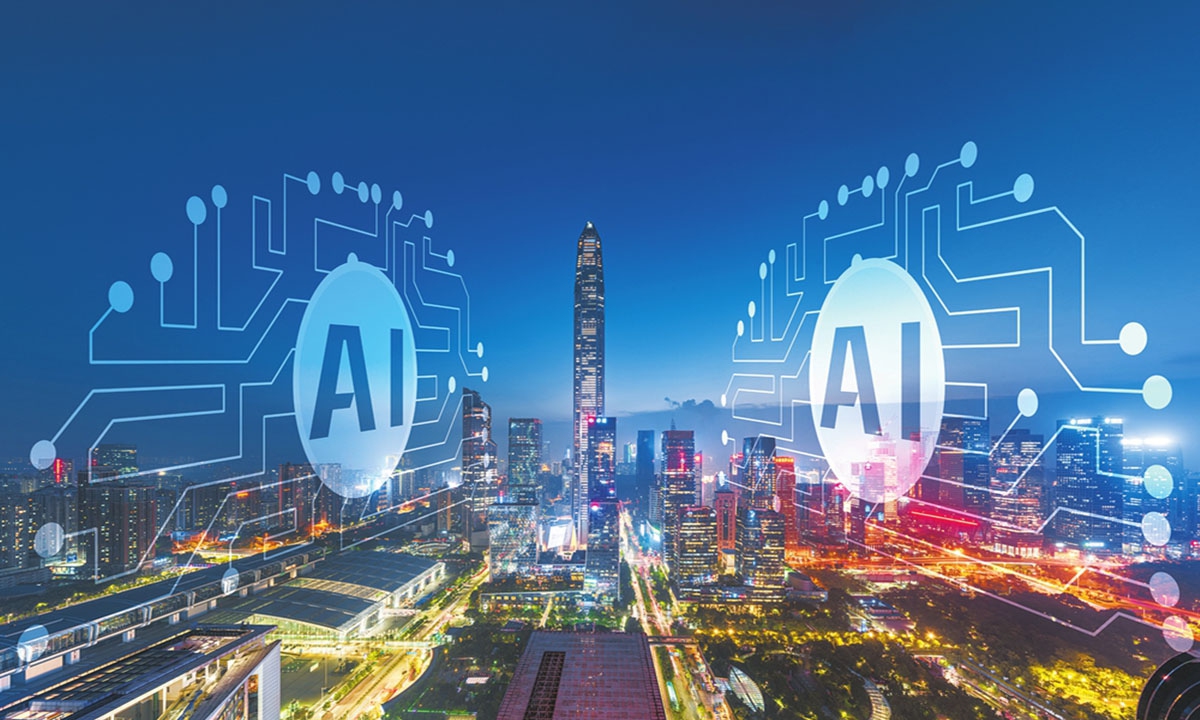
A concept picture of AI city File photo: VCG
South China's tech hub of Shenzhen recently powered up its newly built 11,000 petaflop intelligent computing cluster. This is China's first 10,000-card level full-stack domestically controlled intelligent computing cluster built entirely with advanced Chinese chips, the Shenzhen Special Zone Daily reported on Monday.
Supported by high-security infrastructure, low-cost computing power, high-quality data resources, and market-oriented ecological operations, the project will provide strong support for building a nationwide integrated computing network and advancing the high-quality development of domestic large-language models and chips, according to the report.
The 10,000-card level cluster represents a major breakthrough in scaling computing power and achieving synergy, Wang Peng, an associate research fellow at the Beijing Academy of Social Sciences, told the Global Times on Monday.
"The computing cluster can lay a solid foundation for artificial intelligence (AI) large-language model training, and also significantly shorten the R&D and commercialization cycle of large-language models, lower the threshold for AI innovation, and provide powerful computing support for intelligent manufacturing, smart cities, and other fields, thereby accelerating industrial digital transformation," said Wang.
Industry insiders explained that an "intelligent computing cluster" refers to tens of thousands of servers specialized in AI computation, interconnected through ultra-high-speed networks and centrally scheduled to work together.
A 10,000-card level cluster means that it is composed of more than 10,000 AI accelerator cards. Such a cluster can simultaneously support hundreds or even thousands of enterprises using AI computing power.
According to the Shenzhen Special Zone Daily, the city now has a full-scale 14,000 petaflop intelligent computing cluster, after being combined last year with the previously launched 3,000 petaflop cluster, which was the first phase.
A petaflop is a unit of measurement used to determine a computer's speed, and a system of one petaflop can complete one quadrillion floating-point operations per second.
According to a report by the Xinhua News Agency, 100 petaflops is equivalent to the computing capacity of 50,000 computers. Therefore, Shenzhen's new 11,000 petaflop cluster has a computing power equivalent to 5.5 million personal computers - an AI superbrain at the global top-tier level.
Meanwhile, according to the Shenzhen Special Economic Zone Daily, the newly powered-up cluster is the country's first 10,000-card cluster using Huawei's Ascend 910C chips. Its operation marks a breakthrough in Shenzhen's efforts to build a self-reliant and controllable computing power foundation.
This means that the project uses 100 percent advanced domestic chips and relies on full-stack autonomous and controllable technology to create a competitive independent software and hardware ecosystem.
It will effectively guide innovation in underlying AI technologies and accelerate the localization of key technologies, the report said.
"Relying on a fully domestic technology pathway, the cluster breaks overseas monopolies, builds a secure digital ecosystem, and comprehensively enhances the competitiveness of China's AI industry," said Wang.
Several key technical indicators of the project are internationally leading. The average daily failure rate of intelligent computing equipment in the first-phase cluster of 3,000 petaflops was only 0.3 per 1,000 significantly lower than that of top global clusters such as Meta, read the report.
Training performance matched that of leading international clusters such as Google. In terms of green and efficient operations, the project adopts natural cooling sources, full liquid cooling for computing equipment, integrated power supply, and other energy-saving measures, continuously optimizing data center energy consumption and reducing operating costs.
Analysts pointed out that since the beginning of this year, China's computing power industry has made solid progress with surging momentum. The scale of intelligent computing continues to expand, breakthroughs have been achieved in key core technologies, and intelligent computing center clusters are rapidly taking shape — laying a solid foundation for the construction of a digital China.
As of the end of 2025, China had built 42 10,000-card level intelligent computing clusters, with the total scale of intelligent computing power exceeding 1,590 exaflops (EFLOPS; 1 EFLOP equals 1,000 petaflops), ranking among the world's top tier.
This has strongly supported the rapid development of the AI industry, an official of the Ministry of Industry and Information Technology said in January during a press conference.
RELATED ARTICLES