ARTS / CULTURE & LEISURE
Performers remain central, with technology serving art: Feng Yuanzheng
A lifelong devotion to the stage
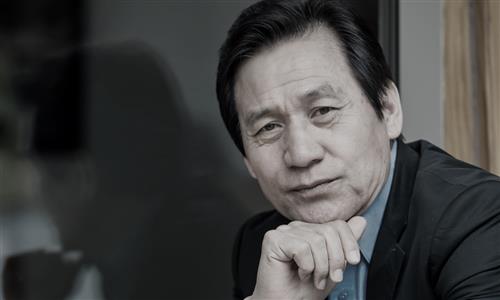
Feng Yuanzheng Photo: VCG
Editor's Note:Feng Yuanzheng is no stranger to the stage in China. As a celebrated actor and president of the Beijing People's Art Theatre, he has spent decades in Chinese theater. Renowned for his versatility and dedication, Feng has played a pivotal role in both preserving and innovating classic productions, from Teahouse to Zhang Juzheng, bringing traditional Chinese dramas to audiences at home and around the world.
What is new under his leadership is the theater's thoughtful integration of technology, used sparingly to enhance storytelling while keeping the actor at the center of the stage, reflecting Feng's belief that the heart of Chinese drama lies in human performance and emotional resonance.
The Global Times spoke with Feng about his philosophy on acting, theater management, the role of technology in enhancing performance, and cross-cultural storytelling.
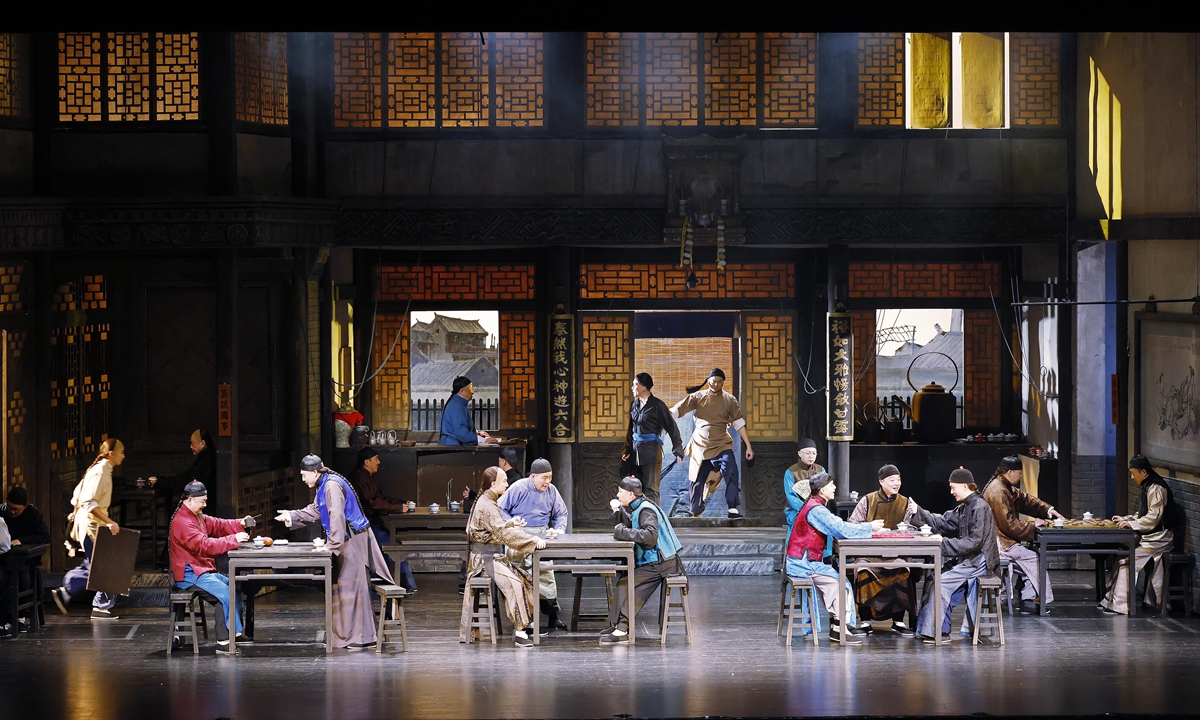
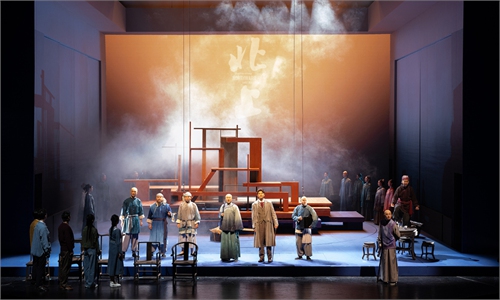
A stage photo of the stage drama Teahouse Photo: VCG
Teahouse, a classic drama exploring the vicissitudes of modern Chinese society in a small teahouse, is regarded as the Beijing People's Art Theatre's (BPAT) "signature production." It returned to the stage at the Capital Theatre on March 17, once again inviting audiences into the richly layered world created by famous novelist and dramatist Lao She."Teahouse is a classic in our exploration of a distinctly Chinese style of spoken drama," Feng Yuanzheng, 63, president of the theater and an actor in the production, told the Global Times. "Even today, we are still searching along that path, and our stage expression continues to evolve."
Over nearly seven decades, BPAT's Teahouse has been performed more than 700 times. Onstage, the production features some of the theater's most accomplished actors, many from the 1950s and 1960s generations. Offstage, a quieter transition is taking place, as younger performers born in the 1990s gradually assume greater responsibility.
For Feng, now in his fourth year as president of the theater, the generational shift on stage reflects his own ongoing transformation. Once solely an actor, he now balances multiple roles that require constant adaptation.
"The switch is instantaneous," he said. "In the morning, I might be in meetings handling administrative work; in the afternoon, I'm in rehearsal; and by evening, I could be onstage performing."
The expansion of responsibility, he added, has not only changed him but also deepened him.
"It has made me more complete," Feng said. "If one day I return to acting full-time, I believe I will perform many roles better than before."
In an interview with the Global Times, Feng reflected not only on how he juggles his many roles, but also, drawing from his own experience, on how technology can enhance the stage without overshadowing it, and how Chinese stories can be better understood by audiences around the world.
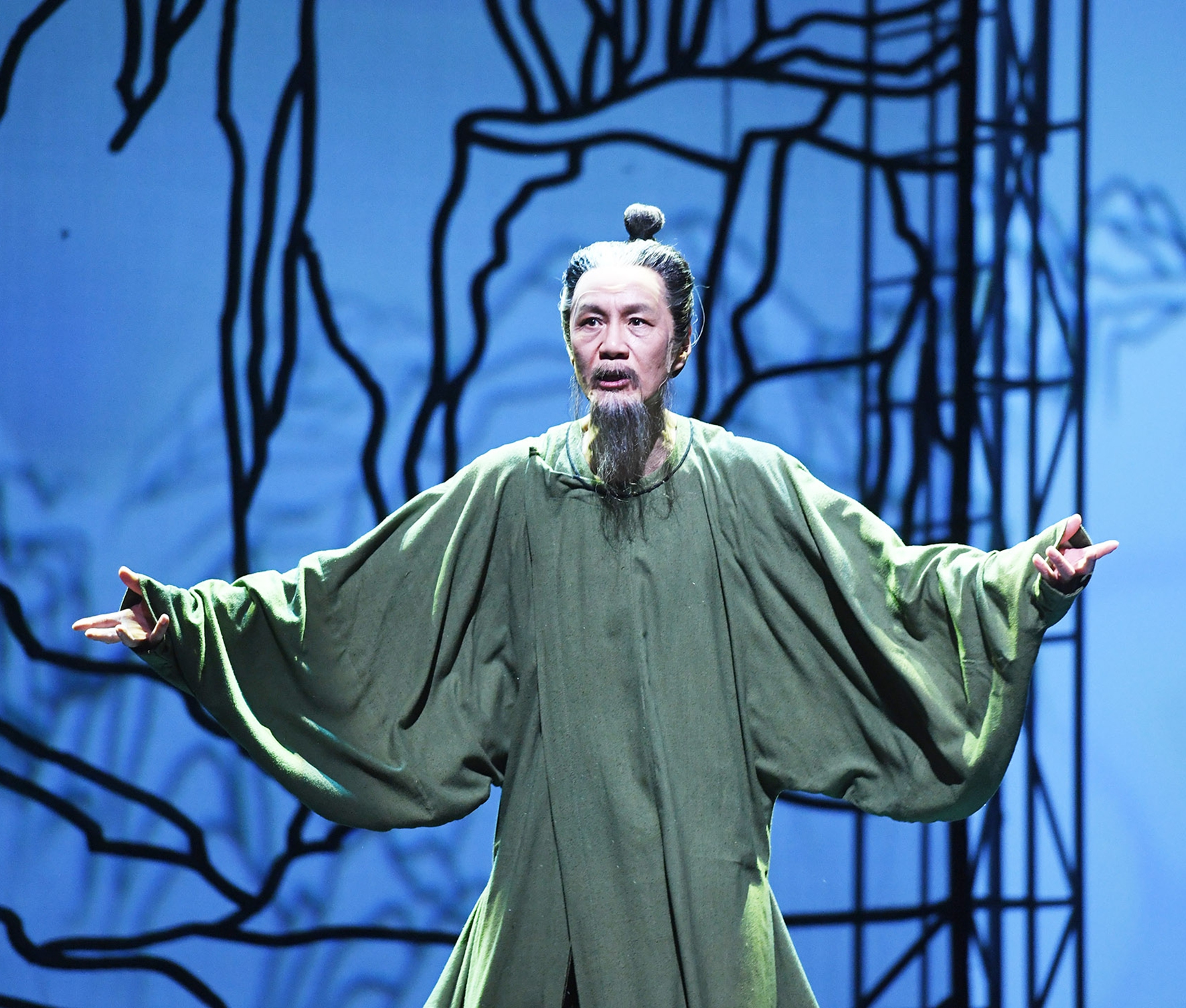
Feng Yuanzheng plays the character of Du Fu in the stage drama Du Fu. Photo: VCG
Forged on the stageKnown to audiences as a versatile actor, Feng now occupies multiple positions: performer, director and administrator.
He admits that where he once focused solely on his craft as an actor, he now finds himself responsible for the theater in its entirety, from staging productions and maintaining facilities to nurturing young talent and managing external exchanges. Much of it, he said, requires him to be hands-on, learning as he goes.
Yet among all these roles, it is the identity of an actor that weighs on him most. "At my age, people tend to see me as successful and established," he said. "But every time I take on a new role, it still feels like walking a tightrope."
Feng did not arrive at acting through a straight or predictable path. His journey to the stage, and ultimately to BPAT, was neither direct nor without its twists and turns.
As a teenager in the late 1970s, Feng's first passion was not performance but sports. He joined a parachuting training program almost by accident. For four years, he discovered in the process a sense of discipline, focus and courage that would later inform his acting career. In 1981, however, he faced a pivotal choice: compete in a national parachuting competition or sit for the college entrance exam. Confident in his athletic prospects, he chose the former, only to be cut from the team afterward. The decision left him adrift. He took a job at a zipper factory, entering what he assumed would be stable employment.
This changed unexpectedly when a co-worker invited him to join an amateur vocal and recitation class at a local cultural center. There, Feng encountered performance in a new form.
After a year at the factory, Feng made a decisive break: He quit his job to pursue acting full-time. Without formal training or financial support, he scraped together money for short-term courses and took odd jobs to cover tuition. He even worked as an extra in productions to gain experience.
Still, his lack of formal credentials limited his opportunities. Advised that he was unlikely to succeed as a full-time actor without professional training, he returned to study performance. In 1985, Feng was accepted by both BPAT and the Central Academy of Drama. In the end, he chose BPAT.
At BPAT, Feng began from scratch. His first major role at the theater was in Peking Man. To cultivate the calm, composed presence his character demanded, he practiced traditional Chinese painting and calligraphy. He even grew his fingernails long and applied a bit of oil to maintain them, striving for the graceful hands of his role. Curious about every detail, he consulted experts on raising pigeons - how to feed them and even how to encourage them to bathe themselves - adding an authentic touch.
At the time, Feng often stayed up late, listening to music while thinking about how to portray the character. He recalled that performing in Peking Man felt like a revelation: He began to understand the essence of acting as a process of shedding the self and entering the inner world of a character - a journey from "breaking down" to "building up."
"For months, I would spend two hours a day repeating the same lines," he said. "Every simple sentence was carefully tasted, refined and absorbed, gradually maturing until opening night, when we could present a high-quality production to the audience."
Feng rose to national prominence with the 2001 television drama Don't Talk to Strangers, a series addressing domestic violence that made him a household name. The 2004 film Shanghai Story earned him the Golden Rooster Award for Best Supporting Actor.
It wasn't until 2022, when he assumed the presidency of BPAT, that Feng looked back on decades devoted to life on the stage.
Putting actors first
Feng's reflections come at a time of rapid change in China's cultural landscape. The rise of short-form video, AI-generated content and digital entertainment has reshaped audience expectations and consumption habits.
For a traditional institution like the BPAT, which is long regarded as a benchmark for Chinese drama, the shift presents both opportunity and challenges.
"The biggest opportunity is the era itself," Feng told the Global Times. "People's living standards have improved, and their demand for cultural experiences is growing. That gives us a strong foundation."
"The challenge is navigating technological change without compromising artistic integrity. To me, theater is a form of slow art," Feng said.
In his view, in recent years, people have talked a lot about technology empowering art. "But sometimes it becomes the opposite - art serving technology." He pointed to productions overloaded with LED screens and multimedia effects on stage, where spectacle overshadows performance.
So far, the BPAT has not staged a major production using LED screens. In his opinion, in some shows where multimedia dominates, the art itself, and the presence of the actors, can be diminished.
"If audiences are focused on the screen and not the actor, then something has gone wrong," Feng said. "That's not empowerment. That's intrusion."
He emphasized that theater must exist in a shared space between audience and actor. "The stage only works when both are present together - that is how it should be."
Feng is not opposed to technology. On the contrary, he acknowledged its potential to enhance storytelling, when used thoughtfully.
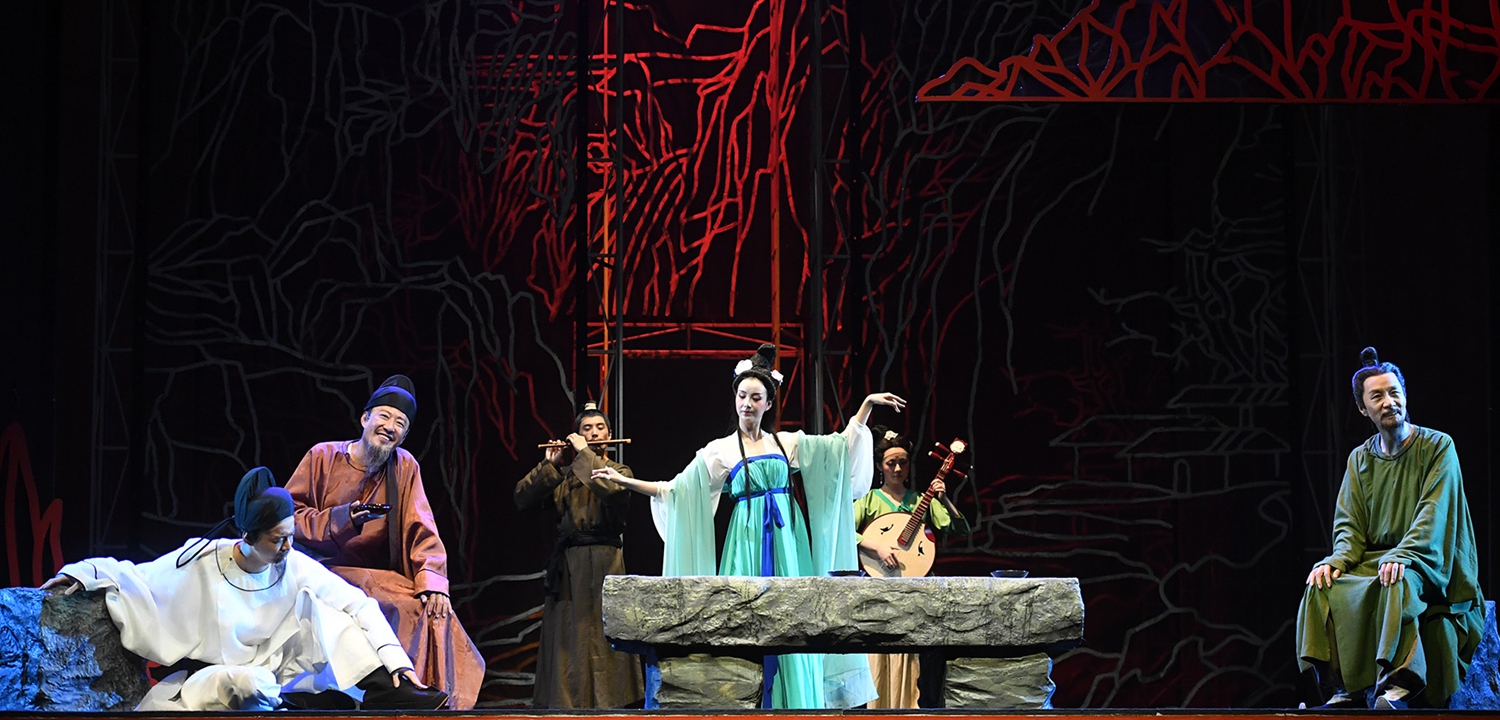
A stage photo of the stage drama Du Fu Photo: IC
BPAT has been using technology for a long time, from Du Fu to Zhang Juzheng. However, he adheres to one principle: "Technology should empower art, not dominate it."This philosophy also guides the theater's approach. In some productions, such as the theater's original historical drama Zhang Juzheng, technology plays a supporting role. Multimedia elements are used sparingly to extend the visual scope of the stage, while keeping the actor at the center.
This restraint, he said, is essential to preserving the unique power of live theater - its immediacy, its unpredictability and its emotional resonance.
This innovation has not only been well received by audiences in China but has also won acclaim abroad: During performances in St. Petersburg, Russian audiences applauded for more than 10 minutes and the cast gave multiple curtain calls, showing that the spirit of China's reforms could resonate universally through the language of art, Feng noted.
In addition, BPAT has already secured release permits for four theater films. Feng said the purpose of these films is not to bring productions to mainstream cinema, as he knows these theater films will appeal primarily to audiences who love stage dramas.
Instead, their main function is to expand the reach of the performances. By streaming online, audiences around the world can experience the productions. The films also serve as an archival resource: Capturing actors' subtle expressions and performances allows future generations of performers to study and learn the roles, making them a form of artistic inheritance, said Feng.
Bringing Chinese stories to world
Feng's vision extends beyond China's borders. Over the years, he has led the theater on international tours, introducing Chinese productions to audiences in cities such as St. Petersburg, Paris and Berlin.
The response, he said, has been overwhelmingly positive. "You don't need to explain it with words; As long as you bring out quality works and tell Chinese stories well, the world will fall in love with Chinese culture."
In 2019, the production of Sima Qian showcased traditional Chinese culture through Hanfu costumes and Han Dynasty (206BC-AD220) brick elements, highlighting both the historical drama's elegance and depth. Meanwhile, Zhang Juzheng features a life-size replica of the Forbidden City's dragon throne and 15-kilogram costumes made of six layers of silk that flowed with grace, allowing overseas audiences to experience the richness and sophistication of Chinese culture firsthand.
Feng emphasized that the heart of Chinese stories is the human element: The emotional connections between people and the universal pursuit of spirit. "By focusing on this core of human experience, cross-cultural dialogue becomes possible," remarked Feng.
RELATED ARTICLES