SPORT / FOOTBALL
Youth resilience offers hope as China football rebuild tests new structure
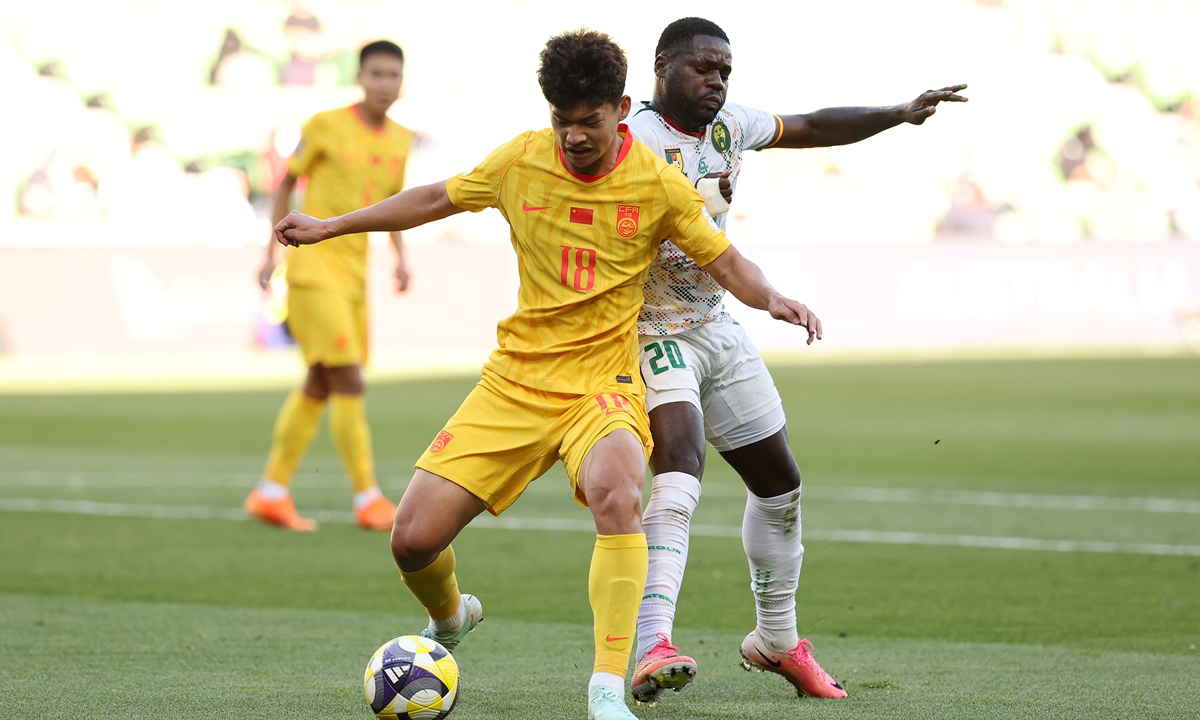
China’s Liu Haofan shields the ball against Konrad Nfanseu of Cameroon during the FIFA Series match between China and Cameroon on March 31, 2026 in Melbourne, Australia. Photo: VCG
It was an unusual day for Chinese football: three national teams, the senior side, the U23s and the U19s, were all in action simultaneously on Tuesday, offering a snapshot of a system attempting to rebuild itself after years of disappointment at the top level.
This rare alignment underscores the Chinese Football Association's (CFA) ongoing effort to construct a coherent talent pipeline amid years of senior-level disappointment. The senior loss tempers immediate optimism, but the youth teams' recent showings suggest structural progress that could sustain the rebuild.
The senior national team, under head coach Shao Jiayi, entered the FIFA Series double-header in Australia with cautious optimism.
The friendly against Curaçao on Friday in Sydney delivered an encouraging 2-0 victory, marking Shao's first win as the head coach for the national team and injecting early confidence. The players showed organized defending and clinical finishing, offering a glimpse of a side trying to move beyond the tactical disarray that plagued previous qualification campaigns.
However, Tuesday's encounter against Cameroon in Melbourne delivered a sobering 2-0 defeat. Cameroon, ranked significantly higher and boasting greater physicality, struck early through Karl Etta Eyong in the 3rd minute and Saidou Alioum in the 9th, exposing defensive vulnerabilities in transition. Match statistics paint a clear picture: Cameroon dominated shots on goal with 6-1, and overall attempts of 17-6, while China managed just 41.8 percent possession and struggled to create a sustained threat.
These warm-up series were designed as preparation windows, yet the loss reveals persistent gaps in midfield control and the ability to absorb early pressure from technically proficient and athletic opponents. Coach Shao also reflected that the Chinese team needs not only discipline and organization, but also the elevation of individual abilities, adding that the players must improve after experiencing the intensity of a world-class opponent.
Shao's appointment in November 2025 was widely viewed as a step toward stability. His background coaching China's youth sides as well as his tenure with the Chinese Super League (CSL) newcomers Qingdao West Coast, which led to a club-best ninth-place finish with a youth-focused squad, suggests an understanding of youth integration, a critical element given the senior team's historical reliance on naturalized and established players.
While the win over Curaçao demonstrated tactical discipline, the Cameroon defeat highlighted the need for greater intensity in training and squad depth. The core task for the senior side is clear: use these international match windows to test player combinations, rebuild morale after World Cup elimination and lay the groundwork for the 2027 AFC Asian Cup. Without consistent results against mid-tier international opposition, however, skepticism, fueled by decades of underperformance, will persist. Shao's challenge is not just getting results but proving that a homegrown coach can bridge the gap between domestic league quality and global standards.
Shifting to the U23 level offers a more uplifting narrative. Head coach Antonio Puche has engineered a genuine breakthrough as he led the China U23 to reach the final of the U23 Asian Cup in Saudi Arabia in February, finishing as runners-up with an impressive campaign that included clean sheets before the final match. This marked the first time a China side had advanced so far in the tournament, signaling a tactical evolution under Puche's disciplined setups emphasizing collective defense and counterattacks.
In the invitational friendly International Youth Tournament in Xi'an in Northwest China's Shaanxi Province recently, the U23s displayed remarkable resilience despite 10 former U23 players being called up to the senior team. However, the squad was significantly younger, with 17 U21 players included in the 25-man roster, most of whom are eligible to play in the 2028 Olympics qualifiers.
The team finished the invitational series in second place to North Korea due to goal difference, after defeating their Vietnamese counterparts 1-0 on Tuesday. Previously, they held Thailand 2-2 after trailing from 2-0 on March 25, before leveling their North Korean counterparts 1-1 after an early concession to the opponents and late equalizer on Saturday. The two comeback draws against their Asian peers demonstrated mental fortitude, yet some fans criticized the side for "rough play" and over-reliance on individual moments rather than structured build-up. Yet the overall trajectory is positive.
These draws expose inconsistencies in early-game concentration and attacking fluency, issues Puche has acknowledged that players need to deal with under pressure. The U23s' tournament task this year is triple: maintain momentum from the Asian Cup while serving as a feeder for the senior team as well as solidify preparation for the Asian Games.
The U19s, coached by Serbian Dejan Djurdjevic, represent another foundational layer of this pyramid. Their Australia-China Friendship Series in Yiwu in East China's Zhejiang Province provides vital exposure against a physically robust opponent. Saturday's first leg ended in a narrow 1-0 victory for China, while suffering a 4-2 defeat to the Young Socceroos.
Djurdjevic's role is less about immediate glory and more about long-term scouting to identify prospects who can ascend to senior teams. Challenges include limited domestic playing time for this age group and the perennial issue of physical conditioning gaps versus international benchmarks. Success here is measured not in wins alone but in the number of graduates who contribute higher up the chain.
Tuesday's fixtures, though mixed in outcome, may offer the clearest snapshot yet of the multi-level rebuilding strategy taking shape within Chinese football. The real test will come in the next qualification cycles, when these layers must prove that structural reform can finally translate into results on the international stage. For now, the young players' resilience gives Chinese football its strongest reason in years to believe the rebuild is real.
The author is a reporter with the Global Times. life@globaltimes.com.cn
