US Artemis mission sends astronauts around the Moon more than 50 years after the Apollo program, sparking attention, discussions among Chinese netizens
By Published: Apr 02, 2026 02:14 PM

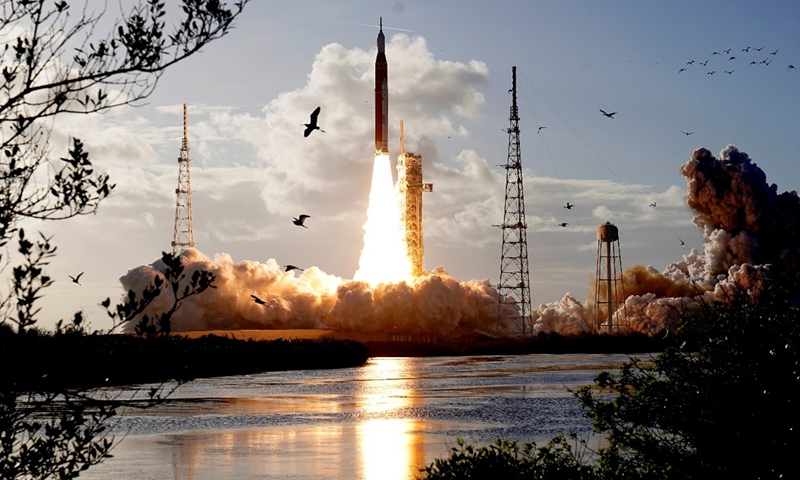
NASA's Artemis II moon rocket lifts off from the Kennedy Space Center's Launch Pad 39-B on April 1, 2026, in Cape Canaveral, US. Photo: VCG
NASA's Artemis II Moon mission lifted off Wednesday from the US state of Florida, carrying four astronauts on the first crewed flight around the Moon since 1972. The Space Launch System rocket, with the Orion spacecraft on top, launched from NASA's Kennedy Space Center at 6:35 pm Eastern Time, according to media reports.
It is NASA's first crewed mission under the Artemis program. The four-member crew consists of NASA astronauts Reid Wiseman, Victor Glover and Christina Koch, along with Canadian Space Agency astronaut Jeremy Hansen, per Xinhua News Agency.
The Artemis II Moon mission is sending the four astronauts on a nine-and-a-half-day journey around the moon and back. The launch window at the Kennedy Space Center opened at 6:24 pm EDT and the rocket lifted off at 6:35 pm EDT. If all goes according to plan, the crew will get an unprecedented view of the far side of the moon and set a record for the farthest distance ever traveled from Earth: 252,000 miles, according to the CBS News.
With about two hours to go before the launch window opened, the launch was a "NO-GO" while teams tried to fix a problem with a key safety system, but the issue was resolved around 5:15 pm EDT. Artemis II is intended as a test flight to check out systems and equipment, laying the groundwork for future missions to land astronauts on the moon in 2028, per CBS.
This launch represents the second major step in the Artemis program, marking its transition from concept and design into a more substantive operational phase. While the previous mission was an uncrewed lunar test flight, Artemis II carries astronauts on a lunar flyby, completing a critical stage in the program's progression, Kang Guohua, a senior member of the Chinese Society of Astronautics and a professor of Aerospace Engineering at Nanjing University of Aeronautics and Astronautics, told the Global Times on Thursday.
To achieve the national goal of landing American astronauts on the surface of the Moon and "maintaining US superiority" in exploration and discovery, NASA announced on February 27 that it is increasing the cadence of Artemis missions, standardizing the Space Launch System (SLS) rocket configuration, and adding a new mission, according to a NASA release.
The update focuses on the transportation systems needed to carry crews to the Moon, including plans to send astronauts to explore the lunar South Pole for the first time in 2028 and to begin building a Moon base. Artemis I was the first in the series, which completed an uncrewed test flight of the SLS rocket and Orion spacecraft in November 2022, per NASA.
Artemis II will take astronauts farther from Earth than any human mission in history, bringing challenges such as communication delays with ground control and exposure to deep-space radiation. The most critical technical challenge lies in the orbital transfer maneuver, when the crew must separate the capsule and execute precise operations to enter the planned lunar trajectory, according to Kang.
Extensive attention
In a post on Truth Social, US President Donald Trump wrote that "for the first time in over 50 YEARS, America is going back to the Moon!" and "We are WINNING, in Space, on Earth, and everywhere in between — Economically, Militarily, and now, BEYOND THE STARS. Nobody comes close! America doesn't just compete, we DOMINATE, and the whole World is watching."
The mission launch also drew extensive attention from US media and some international outlets, with organizations such as CNN and CBS providing live coverage.
A Guardian report described it as a "historic moon mission" and said that a "mass of spectators cheers dazzling Florida launch" as astronauts head to the moon for the first time in nearly 54 years. It added that, politics aside, NASA is eager for Artemis II's lunar flyby to succeed, viewing it as a cornerstone of newly confirmed administrator Jared Isaacman's ambitious plan to establish a $20 billion moon base by the end of the decade.
While the Reuters report on Thursday described the mission as "a high-stakes 10-day trip around the moon" and it claimed this "marks the US' boldest step yet toward returning humans to the lunar surface this decade before China's first crewed landing."
As of press time on Thursday, in China, the mission also drew heated discussion on Weibo. One related hashtag, "US first crewed flight around the Moon in more than 50 years," had received more than 24.1 million views.
Among the comments, netizen "MoyingtianshiGavin" wrote: "Congratulations! This is a positive development for humanity's exploration of space. We should acknowledge the United States' strength in this field, given its extensive experience. As for us, we should remain grounded, scientific and rigorous, and work step by step toward achieving our own goals."
Another user, "Moyanghupan999," wrote: "Wishing the mission every success. Humanity, small as it is in the universe, can reach the stars only by standing together. Only by expanding our living space and gaining access to more resources can we truly move beyond Earth, rather than remaining confined to this small world and trapped in geopolitical rivalry."
At the same time, some netizens questioned whether the mission was also being driven by a "space race" mentality, while others said China would pursue its lunar program at its own pace and advance step by step without rushing.
Kang said that space exploration among major powers is undergoing a fundamental shift. In the past, it was largely defined by a "plant the flag first" mentality, centered on who could arrive first and seize the symbolic upper hand. Today, however, the real contest is increasingly about who can stay on the Moon and build the capacity for long-term, sustainable exploration and utilization.
Against that backdrop, Kang said, the US is advancing its lunar program with unusual urgency, reflecting clear strategic anxiety. Part of that anxiety comes from China's steady and methodical progress in its own moon program, which has sharpened Washington's sense of competition.
However, China, for its part, has made clear that it will not pursue a "Star Wars"-style confrontation or engage in an arms race in space, but will instead advance its lunar program steadily and at its own pace, without rushing in response to outside pressure, said Kang.
China is holding firm to its goal of landing astronauts on the moon by 2030, and has outlined a packed schedule of development and testing for its ambitious crewed lunar program. A series of crucial upcoming tests include integrated testing for the Lanyue lunar lander, thermal tests and maximum dynamic pressure escape tests for the Mengzhou manned spacecraft, and low-altitude and technology verification flights for the Long March-10 carrier rocket, said the China Manned Space Agency (CMSA), according to the Xinhua.
China has consistently maintained that the Moon is a shared asset of all humanity, and the current global enthusiasm for space exploration reflects that idea. This shift has been made possible in part by the growth of China's space capabilities. Human space exploration is moving toward a contest over long-term presence and sustainability. The question now is no longer simply who gets there first, but who can stay longer and do more, said Kang.
RELATED ARTICLES