BRASIL 247 / MORE
Brazil launches national bioeconomy plan aiming at up to $284 billion GDP boost
National strategy focuses on sustainable development, innovation and income generation
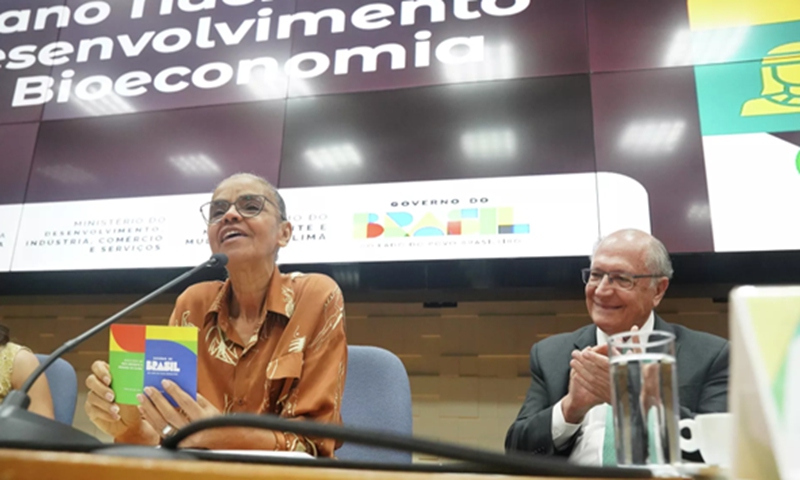
Rogério Cassimiro/MMA
By Brasil 247 - The Brazilian government launched on April 1 the National Bioeconomy Development Plan (PNDBio), an initiative focused on the sustainable use of natural resources, innovation, social inclusion and income generation. The proposal was developed over several months through technical working groups and public consultations and seeks to integrate environmental preservation with economic activity, according to Sputnik Brasil, as reported by Brasil 247.
The launch took place at the headquarters of the Brazilian Institute of Environment and Renewable Natural Resources (Ibama) in Brasília. National Secretary of Bioeconomy Carina Pimenta described the plan as a "national development strategy" and a "new paradigm," stating that the initiative aims to expand income generation through sectors such as bioindustry and health. She emphasized that the proposal contains defined targets and practical implementation measures. "It is not a declaratory plan, but an implementation plan," she said, adding that it represents "a concrete path to respond to the climate crisis."
The program includes incentives for initiatives led by Indigenous peoples, traditional communities and family farmers, as well as expanded use of biomass in agricultural production.
Tereza Campello, socio-environmental director of the Brazilian Development Bank (BNDES), stated that the bank has already allocated R$1.6 billion to actions linked to the plan. According to her, the Amazon Fund will play a significant role in financing future initiatives.
Júlia Cruz, secretary for Green Economy at the Ministry of Development, Industry, Trade and Services (MDIC), said diversification of renewable sources is connected to national sovereignty. She noted that the bioeconomy already accounts for about one quarter of Brazil's Gross Domestic Product and could generate up to $284 billion in additional economic output, with direct impacts on local communities. "The bioeconomy is already a reality," she said.
Deputy Executive Secretary of the Ministry of Finance Rafael Dubeux stated that sustainability has become a guiding principle for economic growth, integrating environmental policies with development strategies.
Vice President Geraldo Alckmin said the current administration has reduced deforestation across all Brazilian biomes. "And it continues to fall," he stated while commenting on the data presented at the event.
Marina Silva also recalled the history of Brazil's extractivist movement and cited her work with Chico Mendes at the Cooperacre cooperative. She said that while the group previously depended on external support, the cooperative currently receives R$69 million in investments backed by BNDES funding. Assessing her tenure, the minister stated that "the ending is better than the beginning."
