Trump claims US will continue pressure on Iran if no deal reached, Chinese expert says speech aims to project US 'victory' to supporters, deepen global energy reliance on US
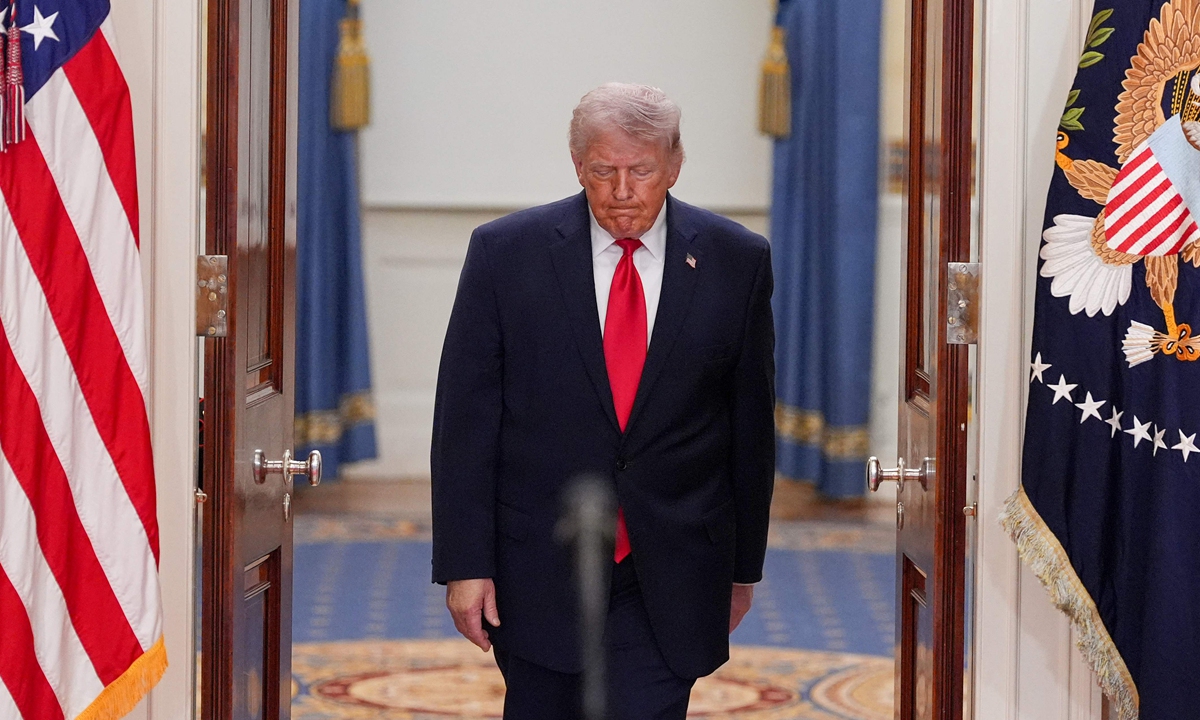
US president Donald Trump arrives to speak about the Iran war from the Cross Hall of the White House on Wednesday, April 1, 2026. Photo: VCG
US President Donald Trump on Wednesday delivered a televised address outlining Washington's position on the escalating Middle East conflict, emphasizing continued military pressure in future two to three weeks on Iran if there's no deal reached.Marking one month since the launch of "Operation Epic Fury," the nearly 20-minute speech from the US president covered battlefield developments, future military plans, nuclear policy and energy security, and a Chinese expert says the core purpose of the speech was to reassure his supporters that the US had "won," while reinforcing global energy markets' dependence on the United States.
Starting on the speech, Trump claimed the US has achieved "overwhelming victories", claiming Iran's navy, air force and missile and drone capabilities have been severely degraded.
"Our armed forces have delivered swift, decisive, overwhelming victories on the battlefield, victories like few people have ever seen before," he said, adding that Iran's navy is "gone," its air force "in ruins," and its missile and drone capabilities "dramatically curtailed.
Trump said the US is "systematically dismantling the regime's ability to threaten America," including by "eliminating Iran's navy," crippling its missile program and "annihilating their defense industrial base."
He added that these efforts are nearing completion. "I can say tonight, we are on track to complete all of America's military objectives shortly, very shortly," Trump said, noting that regime change "was not our goal." "We never said regime change. But regime change has occurred because of all of their original leader's death," he said.
"It's clear that the speech was less about signaling to the outside world than about consolidating domestic political support, portraying US actions as consistently successful. How many times has Trump said that they had severely damaged Iran on military forces, and how true is that?" Li Haidong, a professor at China Foreign Affairs University, told the Global Times on Tuesday.
"He made no mention of the setbacks and failures in the war, while suggesting that after such a long period of conflict, any problems were simply inherited from previous administrations," Li said.
Indeed, Trump renewed his criticism of the nuclear deal reached under former president, calling it "a disaster" that would have enabled Iran to build "a colossal arsenal of massive nuclear weapons."
Looking ahead, he warned that the next phase of the campaign could intensify significantly. "We're going to hit them extremely hard over the next two to three weeks," Trump said. He also issued a direct threat tied to ongoing negotiations. "If there's no deal, we're going to hit each and every one of their electric generating plants very hard and probably simultaneously," he said.
Li analyzed Trump in fact did not signal any real intention to halt the fighting, instead making clear that any end to the conflict would hinge on a deal on his terms - while Iran has so far shown little willingness to compromise.
Several media outlets echoed the point, saying the speech highlighted military gains but offered little clarity on how the conflict would end. Reuters noted that Trump signaled continued military action without giving a clear timeline, raising market concerns, while the Washington Post reported the address framed the war as "nearing completion" but stopped short of outlining an exit strategy. The Guardian similarly pointed out that the speech stressed US dominance and battlefield "success," yet provided little detail on a concrete endgame.
Among US netizens listening to the speech, reactions were sharply divided. One praised it as an address delivered "at a time of global tension," adding that in such critical moments, "words vs consequences, leadership vs legacy - the speech isn't just communication, it's direction." Another, however, argued that it offered "nothing of a revelation apart from proceeding to keep going with the war and extending Iran deaths from 32k to 45k."
Another netizen offered a deeper analysis of the speech, saying it revealed a widening trust gap in the US, where the same presidential address is interpreted in completely different ways, reflecting not a media or political divide but a deeper crisis of public confidence, and that ultimately, history will judge not the rhetoric itself, but whether the promises made are actually followed through.
In addition to the military campaign, Trump linked the conflict to global energy security, blaming recent fuel price increases on Iranian attacks on oil shipping and stressing the importance of keeping key maritime routes open.
He also underscored US energy independence, saying the country "doesn't need" Middle Eastern oil and urging other nations to take greater responsibility for protecting critical shipping lanes. Framing the operation as both a security necessity and a strategic investment, Trump said the campaign would ensure long-term safety.
Industry insiders appear unconvinced. Russel Chesler of VanEck said "the key question remains when is this going to be over," warning that ongoing uncertainty is fueling volatility and raising stagflation concerns; meanwhile, Saxo's Danny Khoo noted markets had expected a pathway to winding down the conflict, but Trump instead warned of "heavy strikes" against Iran in the coming weeks, per Reuters.
Here you see Trump's final objective—to emphasize that this war is beneficial to US. This ties into global energy dynamics: in the event of oil shortages, countries would turn to the US for supply, while key energy-producing regions are weakened, shifting dependence in the global energy market toward the US—as long as it serves US interests, Li noted.
RELATED ARTICLES