Photo: Xinhua
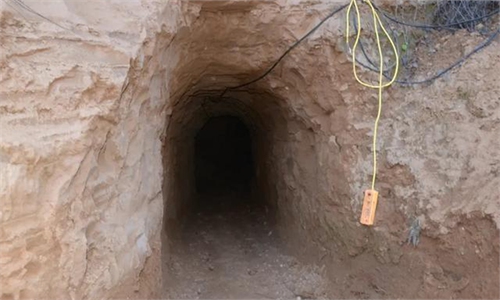
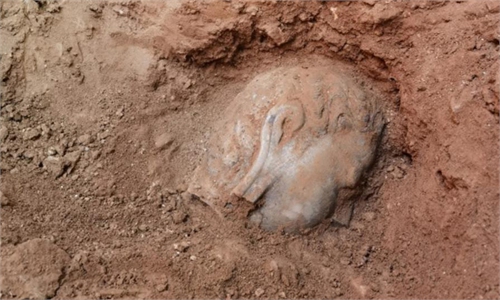
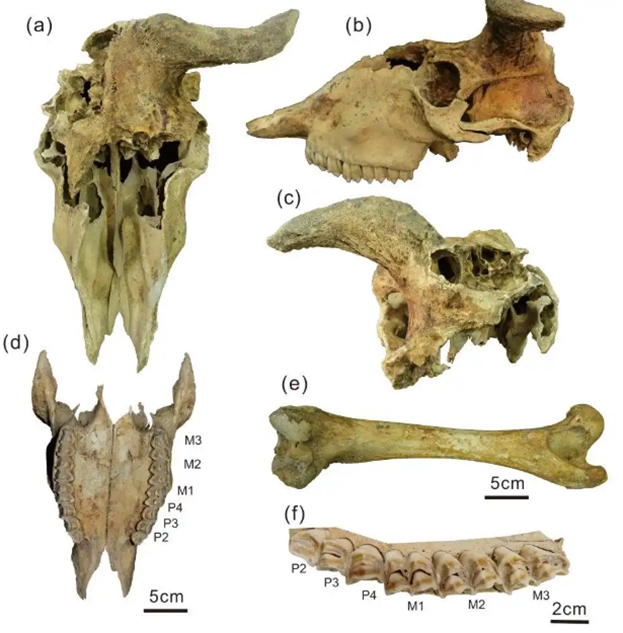
A breakthrough has been made in Suiyang county, Southwest China's Guizhou Province, with the discovery in Shuanghe Cave of the most complete takin fossil ever found in China. According to the Xinhua News Agency, this and the other similar fossils discovered nearby are also the first reliable fossil records of Late Pleistocene takins in the country.
This discovery was the result of a joint Chinese and international scientific expedition. The report said that in May 2025, Jean Bottazzi, a French caver and member of the expedition team, noticed a large, relatively well-preserved mammal skeleton while conducting systematic cave exploration and field research in the Jinzhong Mountain area around Shuanghe Cave. The unique features of the remains caught his attention.
Upon further excavation and cleaning of the area, the team found another individual fossil about 20 meters away from the first specimen. After morphological measurements, dating, and systematic classification, both fossils were confirmed to be takins - one a juvenile and the other an adult. Both fossils date back to the Late Pleistocene, estimated to date back to about 15,000 and 11,000 years.
Experts say that both takins must have entered the cave and, due to the narrow and rugged passageways, fell about five meters down a steep drop and became trapped, unable to find their way back out.
Wang Deyuan, an associate research fellow at the Institute of Mountain Resources, Guizhou Academy of Sciences, explained that the well-preserved takin fossils from the cave provide critical evidence for research into the evolutionary history and past distribution of the species.
Modern-day takins are typical high-altitude animals, mainly living in mountain forests and meadows between 2,000 and 4,500 meters above sea level, and only moving down to coniferous forests below 2,500 meters for short periods in winter.
However, Shuanghe Cave is located in the Dalou Mountains, where the surrounding area is at an elevation of only 600 to 1,700 meters, with a warm and humid climate that is quite different from the typical present-day habitat of takins, Wang noted.
During the 24th international cave expedition at Shuanghe Cave in October 2025, two more relatively complete takin fossils were discovered. This brings the total number of individual takin fossils found in the cave to four, according to Xinhua.
In addition to takin fossils, Chinese and international experts also found giant panda, stegodon, rhinoceros, serow, and other animal remains in Shuanghe Cave during the expedition.
As for evidence of human activity, experts discovered a large number of bones with clear signs of human intervention in a vertical shaft that dates to about 1,400 years ago, the Guangming Daily reported.
Shuanghe Cave, discovered by Chinese and overseas experts after 30 years of joint scientific expeditions, is currently the longest known cave in Asia.
Also the longest dolomite cave and the largest celestine cave in the world, the cave has been termed a "natural karst cave museum," according to Xinhua.