ARTS / CULTURE & LEISURE
China’s Plum Blossom Award takes the world stage with unique local operas
By Published: Apr 06, 2026 11:19 PM

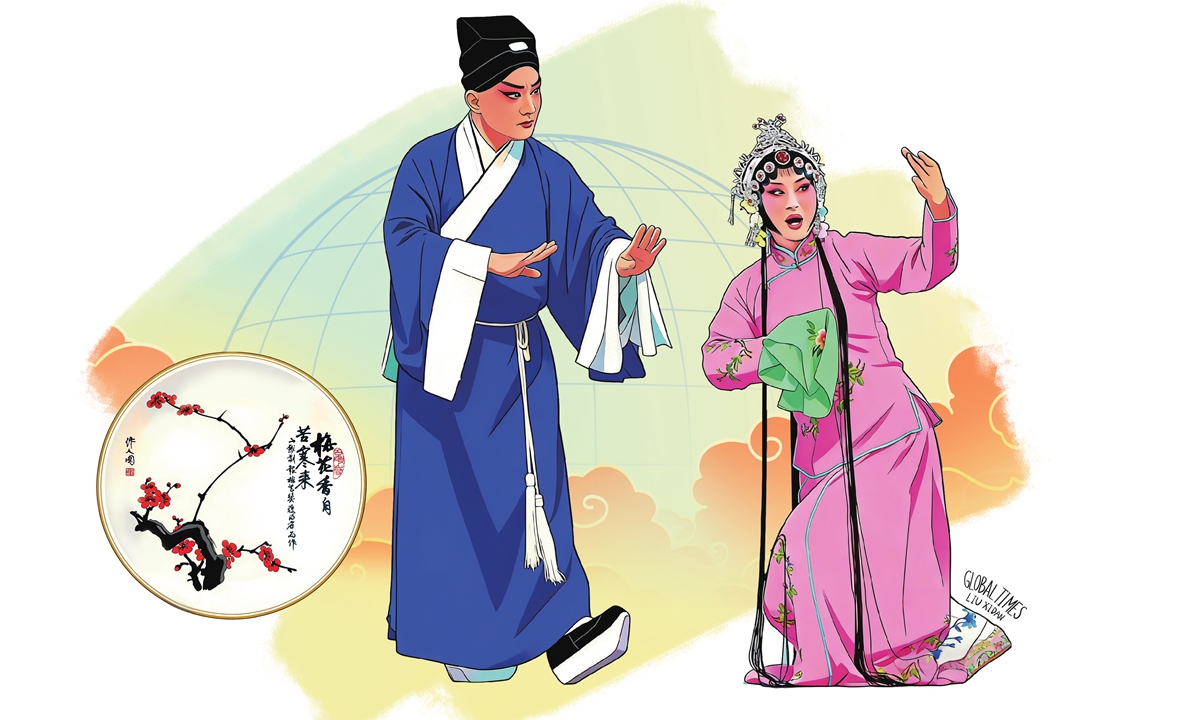
Illustration: Liu Xidan/GT
Shanghai is about to become the permanent home of a cultural milestone. From May 21 to 31, the First Showcase of Outstanding Repertoires by China Theatre Plum Blossom Award winning artists hosted by China Theatre Association will lift its curtains in the city. What makes this event historic is not merely the gathering of 16 Plum Blossom Award laureates and 10 landmark productions spanning eight major opera schools and one dance drama. This will be the moment China's highest theatrical honor steps beyond domestic recognition to claim its place as a global cultural brand. For the first time, the Plum Blossom Award is "sailing to the world" as a unified, systematic force rather than isolated performances. This marks a decisive shift in how traditional Chinese drama engage with the world.The term "packaged export" captures the innovation perfectly. In the past, individual troupes or single plays occasionally traveled abroad, creating ripples of interest that quickly faded. A Kunqu excerpt here, a Peking Opera fragment there, they were impressive yet fragmented. Today, under the banner of the Plum Blossom Award, China presents an entire artistic ecosystem: the loyal righteousness of Cheng Ying in Yuju Opera's Cheng Ying Saves the Orphan, the transcendent passion of Du Liniang in Kunqu Opera's Peony Pavilion, the expansive spirit of Su Dongpo in Yueju Opera's play of the same name, and the exquisite harmony of nature and humanity in the dance drama Crested Ibis. These works, performed by three generations of artists, from veterans like Mao Weitao and Li Shujian to rising stars such as Zhu Jiejing and Lou Sheng, form a powerful narrative stream. They carry not only technical brilliance but the living pulse of Chinese aesthetics: subtlety, stylized movement, and an unyielding belief that art should illuminate shared human emotions.
This generational stage picture is itself a statement. Older masters embody the accumulated depth of their forms; younger Plum Blossom Award recipients demonstrate that the classical performing arts are not museum relics but vibrant, contemporary voices capable of addressing modern concerns. New creations like Su Dongpo prove that ancient conventions can translate contemporary reflections on intellect, integrity and the human condition without losing their classical soul. For international audiences, the message is unmistakable: Chinese opera is a living, growing art that speaks to the times while remaining rooted in its history. That vitality is precisely what allows it to cross cultural borders and resonate universally.
The exhibition's internationalization strategy is deliberately dual-track, reflecting both professional ambition and long-term audience cultivation. On the one track, the focus is brand internationalization. International theater organizations, artistic festival directors and overseas promoters have been invited to Shanghai to witness the Plum Blossom Award not as a distant Chinese prize but as a recognizable global brand. The goal is to embed its productions into the world's touring and co-production networks, the same way Broadway, West End and major festivals operate.
On the other track is "localized internationalization." Leveraging Shanghai's dense university ecosystem and international communities, the organizers are rolling out guided appreciations, workshops and master classes. Young people from around the world will experience the unique beauty of Chinese operatic conventions, its painted faces, symbolic gestures and imaginative stagecraft, through direct participation rather than passive spectatorship. This is cultural diplomacy at its most intelligent: respecting the art on its own terms while building future stewards who understand its language.
China is not inventing the wheel, but it is refining it with distinctive Chinese characteristics. The Tony Awards have long operated a "Tony Awards China" platform that not only broadcasts ceremonies but incubates local musicals, trains talent and imports Broadway hits in a two-way exchange. The Edinburgh Festival's "China Focus" program has, since 2017, presented dozens of Chinese works, creating concentrated "China blocs" that amplify visibility through established audience pipelines. The Plum Blossom initiative learns from these models yet transcends mere imitation. It is anchored in cultural confidence rather than commercial expediency. It does not dilute Chinese aesthetics to cater to foreign taste; it confidently offers the world an intact system - its philosophy, ethics and life wisdom, packaged in a modern, accessible format.
Critics might ask whether traditional opera can truly compete in a global market dominated by musicals, immersive theater and digital spectacle. The answer lies in the very nature of the Plum Blossom Award itself. By gathering the finest across schools and generations, China demonstrates that its dramatic tradition possesses both depth and adaptability. It does not need to become something else to be relevant; it needs only to be presented systematically and dialogically. Shanghai, with its blend of heritage and cosmopolitan energy, is the ideal permanent host for this biennial event.
The plum blossom, long a symbol of resilience and elegance in Chinese culture, is blooming beyond borders. Its fragrance promises to linger in the global theatrical imagination for years to come.
The author is a reporter with the Global Times. life@globaltimes.com.cn
RELATED ARTICLES