Explosives found near pipeline that carries Russian gas to Hungary; Chinese expert warns fresh energy risks may deepen Europe’s crisis
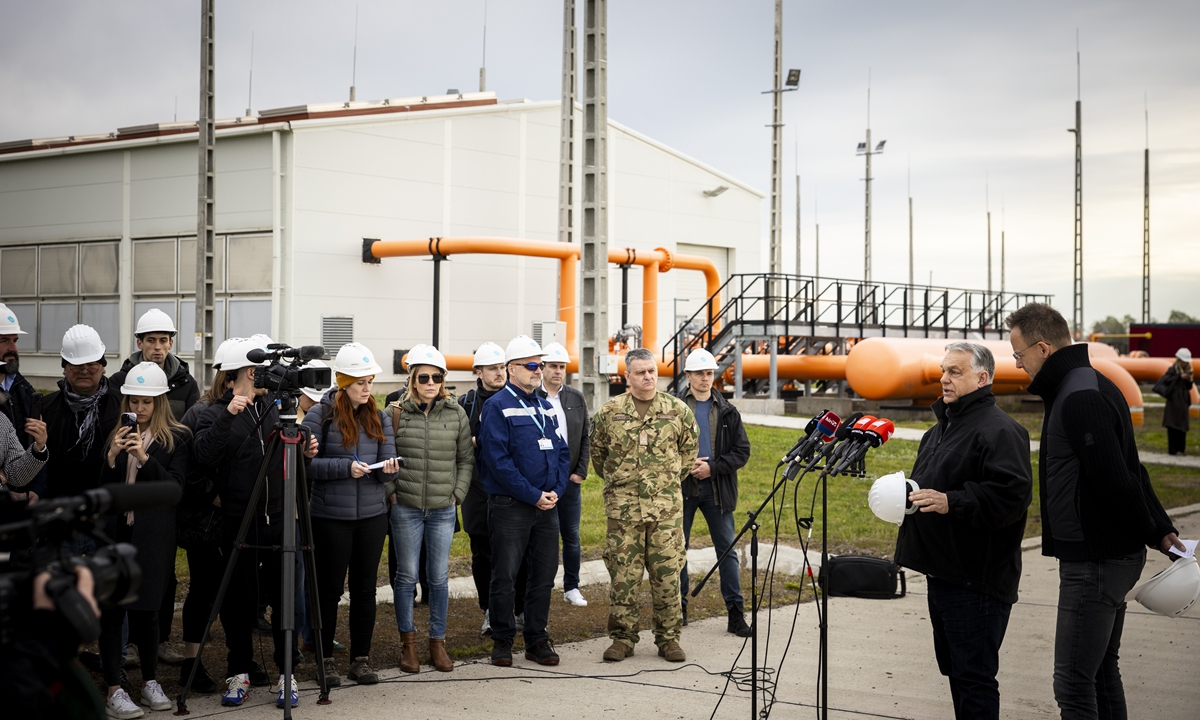
Hungarian Prime Minister Viktor Orban, with Hungarian Minister of Foreign Affairs and Trade Peter Szijjarto, holds an extraordinary press briefing as he inspects military protection measures for the TurkStream natural gas pipeline at a gas supply station in Kiskundorozsma, Hungary, on April 6, 2026.
Serbian President Aleksandar Vucic said the army and police found two backpacks containing explosives Sunday near a gas pipeline to Hungary, prompting Hungary's Prime Minister Viktor Orban to call an emergency meeting just days ahead of the country's crucial elections next Sunday.
Orban visited the area near the Kiskundorozsma to inspect the reinforced military protection of the Hungarian section of the TurkStream gas pipeline, according to a Facebook post by its government on Monday.
Chinese analysts noted that Europe has been mired in a severe energy supply crunch following the Russia-Ukraine conflict, and tensions over the Strait of Hormuz have further exacerbated the crisis.
According to the BBC, two rucksacks full of explosives and detonators were found by the Serbian army near the village of Tresnjevac in the Kanjiza district, about 20km from the point where the TurkStream pipeline crosses into Hungary.
"Our units found an explosive of devastating power," Vucic said in a post on Instagram. "I told PM Orban that we would keep him updated on the investigation."
As to the origin of the explosives, Vucic said there were "certain traces" he could not discuss immediately. He added that the explosives could have "endangered many lives" and caused significant damage to the pipeline, CNN reported.
Orban later called the incident a "sabotage action" on Facebook on Sunday adding that "We have strengthened military control and protection of the Hungarian section of the Turkish Current gas pipeline."
Per Reuters, without directly blaming Ukraine for the incident in Serbia, Orban said, "Ukraine has been for years trying to cut off Europe from Russian energy," adding that "Ukraine's efforts pose a life-threatening danger to Hungary."
The head of Serbia's Military Intelligence Agency, Djuro Jusic, said the explosives found on a section of pipeline linked to the TurkStream system were produced in the US, without providing further details, per the Reuters report.
Rejecting what it said were attempts to link Kiev to the explosives, Ukraine's foreign ministry spokesman Heorhii Tykhyi said on X that "Ukraine has nothing to do with this," claiming that it could be "a Russian false-flag operation as part of Moscow's heavy interference in Hungarian elections," according to media reports.
In another post on X, the Hungary's Prime Minister stressed, with two exclamation marks, "What's coming will hit Europe hard. No energy, no economy. Without a functioning economy, everything is at risk."
According to BBC, Hungary receives between five and eight billion cubic meters of Russian gas a year through the TurkStream pipeline. Serbia, an EU candidate, is also heavily dependent on Russian gas, media reported.
Cui Heng, a scholar from the Shanghai-based China National Institute for SCO International Exchange and Judicial Cooperation, told the Global Times on Monday that Europe is currently trapped in a severe energy supply crunch.
"The Russia-Ukraine conflict has cut off the main natural gas pipelines transporting gas to Europe via Ukraine. The TurkStream pipeline mainly supplies gas to Central and Eastern Europe. Since tensions flared up over the Strait of Hormuz in March, crude oil exports from the Gulf region have been blocked, further worsening Europe's energy crisis," Cui explained.
The analyst noted that though Europe has prepared to release strategic reserves, expanding output takes time and depleting stockpiles incurs huge costs. Coupled with skyrocketing energy prices, the impact could be devastating.
RELATED ARTICLES