ARTS / CULTURE & LEISURE
Candidates revealed for top 10 Chinese archaeological discoveries
Shortlisted sites reveal timeline of civilization
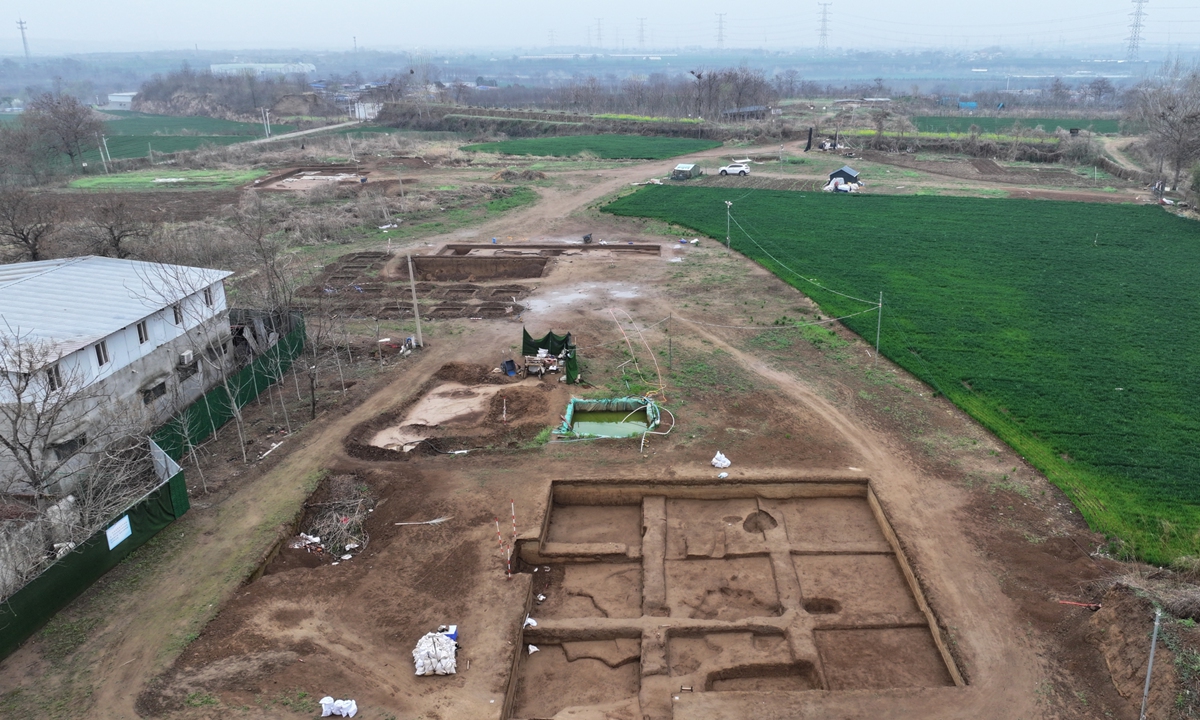
The Peiligang site in Henan Province Photo: VCG
Spanning from the Paleolithic period to the Xixia period (1038-1227), a total of 21 Chinese archaeological sites scattered nationwide have been shortlisted as final candidates for the national top 10 archaeological discoveries of 2025.As the lead archaeologist at one of the candidate sites, the Husta site in Northwest China's Xinjiang Uygur Autonomous Region, Wang Peng told the Global Times that all representatives of the 21 sites will deliver presentations in Beijing for the final selection, likely by the end of April. He also noted that one of the key criteria for selection is "highlighting the most irreplaceable significance" of each site.
Taking Wang's "home turf" the Husta site as an example, it is a large-scale Bronze Age settlement covering several dozen square kilometers, with its main residential area dating to around 1600BC. It is one of the earliest Bronze Age remains discovered in Xinjiang to date.
Wang and his team once unearthed a bronze knife at the site. It is not only one of the oldest bronze artifacts found in China but also one of the oldest tin-bronze objects ever discovered on the Eurasian steppe. Beyond the artifacts, the expert also noted that "the burial practices and tomb structures" are also among the most significant highlights of the Husta site. "The remains here bear witness to the highly developed Bronze Age civilization of ancient China," said Wang.
Besides the Husta site, the Badamu cemeteries in Xinjiang's Turpan have also been shortlisted for the final selection. A unique epitaph unearthed there provides "solid evidence of the Tang central government's jurisdiction and governance over the Western Regions," Shang Yuping, the project's lead, told the Global Times. The epitaph belonged to Li Chonghui, an official of the Tang central government's administration overseeing the ancient Xizhou Prefecture, corresponding to today's city of Turpan and its surrounding areas.
"During Li's time, Xizhou's social condition was precarious. However, it maintained its loyalty to the central government while resisting other rebellious forces," Shang said.
"Beyond the individual value of each site, the 21 shortlisted sites can be threaded into a timeline, revealing the continuity of Chinese civilization through its iterative transformations," archaeologist Sun Lang told the Global Times.
Among the 21 sites, the Paleolithic complex of Changbaishan, or known as "Changbai Mountain" in Jilin Province, the Xinmiaozhuang site in Hebei Province and the Chuandong site in Guizhou Province are all Paleolithic sites representing the earlier stretch of this timeline.
Among these sites, evidence of early human wisdom has been uncovered. Taking the Xinmiaozhuang site as an example, at just one of its pits, the No.5 pit, archaeologists discovered East Asia's earliest known "hearth" for heating of stone materials, along with over 80,000 stone artifacts. Beads, shells, and other decorative items were also found, revealing the formation of aesthetic pursuits among early humans.
Moving toward the Neolithic period, sites such as the Peiligang site in Henan Province and the Zhengjiagou site in Hebei Province have been shortlisted. Among them, the Peiligang site stands out as a stellar example.
Vivid ceramic sculptures of human and animal heads have been unearthed there. Meanwhile, traces of rice-based fermented wine, produced using Monascus mold, were discovered inside several pottery jars at the site, revealing China's early alcohol-making techniques.
"The technology behind alcohol-making reveals ancient Chinese agricultural wisdom, since the source is rice," Zhang Jian, a researcher on the archaeological project, told the Global Times. He also added that the emergence of alcohol also became a "driving force" for agricultural development at that time.
Other shortlisted sites, such as the Shangcheng ruins, the Langyatai ruins, and the Zhengpingfang site on the timelines of the Shang (c.1600BC-1046BC), Qin (221BC-206BC) and Han (206BC-AD220), as well as the Tang (618-907) dynasties, demonstrate ancient China's capital city construction and ritual systems following the stabilization of agricultural development.
Located in Zhengzhou, Henan Province, the Shangcheng ruins once served as the early capital of the Shang Dynasty. The largest storage remains from the early Shang period, along with a water management system, have been unearthed at the site, providing research materials for the state formation of the early Shang Dynasty. The Langyatai ruins in Qingdao, Shandong Province, have revealed the construction of the Langyatai Terrace by Emperor Qinshihuang, the first emperor to unify China. They also showcase the wisdom of building public facilities such as water collection and storage structures and stone-paved roads along the coast.
"Whether they are selected or not, these sites show the gradual establishment of Chinese civilization," Zhang told the Global Times.
RELATED ARTICLES