BUSINESS / PRESS RELEASE
When Generation Z takes the pen: How Yuewen's skilled novelists are defining the next decade of Chinese web novels
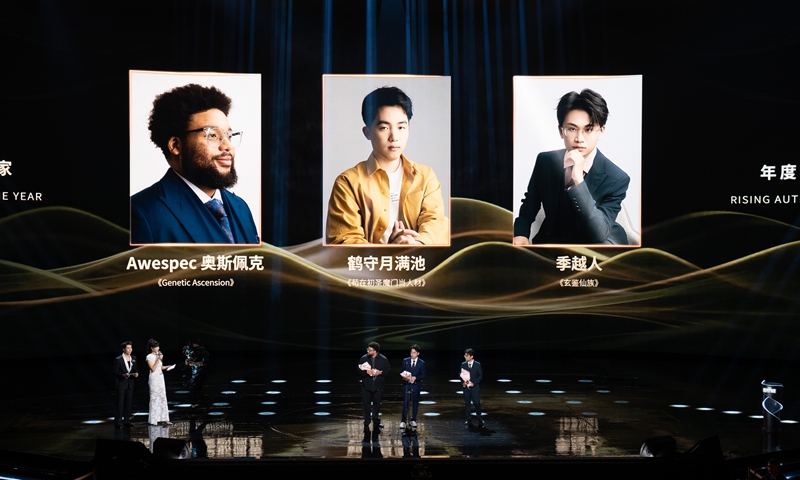
Photo: Courtesy of Yuewen
In the glittering backstage of the 2025 Yuewen Global IP Awards in Macao, three young faces stepped into the spotlight. Born between 1997 and 2002, they lifted the "Rising Author of the Year" trophy together — a quiet but unmistakable symbol of a generational handover in one of China's most dynamic cultural industries. Their stories have already racked up blockbuster numbers on the Qidian Reading app, Yuewen's flagship platform.
Behind the applause lies something deeper: a quiet change in Chinese online literature, driven by Generation Z creators who are rewriting the rules of storytelling for the next decade. This is not just a change of the guard. It is a fundamental shift in who tells China's stories — and how those stories speak to both domestic readers and the world.
When China's online literature user base first surpassed 400 million in 2018, the dominant voices were still from the post-80s generation. Today, the picture has changed. On Yuewen's platforms, writers born after 1995 now account for 70 percent of contracted writers in 2025.
Hou Xiaonan, CEO and President of Yuewen, captured the moment perfectly in an internal memo last year, when he launched the "Evergreen Content" strategy. Its core mission aims to build an ecosystem that supports generational renewal.
"When Generation Z becomes the main creative force," Hou wrote, "the globalization and diversification of online literature will happen naturally."
He Shou Yue Man Chi, born in 1998, is one of them. His breakthrough novel Just a Useful Pawn in the Stain Sect did not start with fireworks. The debut subscription was a modest 3,000. But the young author wrote with ferocious discipline — waking at 4 am and delivering 8,000 characters every day.
The reason was starkly personal: his family had gone through a period of financial hardship. "When you owe one or two million yuan," he said calmly in an interview, "self-discipline comes naturally."
The book eventually hit the industry record of 100,000 average subscribers on Qidian in just 165 days, and thanks to this success, he was able to clear the family debt in seven months. His real-life comeback reads like the ultimate "counterattack" trope his own readers crave.
If He Shou Yue Man Chi embodies gritty realism, 2002-born Ji Yue Ren represents an aesthetic rupture. A public administration student at South China Agricultural University, Ji once struggled with repeated rejections. To understand life better, he took a part-time job at a courier station. There he met a man who worked to pay for his father's medical bills — only for the father to pass away anyway. The encounter shattered Ji's view of fantasy writing. His novel Xuan Jian Xian Zu (The Immortal Mirror Clan) began modestly with 600 subscribers but eventually crossed the 100,000 mark on Qidian. In Ji's world, immortals age, die and fight bitterly over limited resources. Family fortunes rise and fall, spiritual roots are unequal and the heavens show no mercy. Gone is the effortless "everlasting victory" logic of classic web fiction. In its place is a haunting meditation on fate, loss and endurance. Veteran author Ma Boyong praised the work for its "epic sense of generational succession and relentless forward momentum."
At the same awards ceremony stood 1997-born Canadian writer Awespec (real name D.D. Spec), the first foreign author to win Yuewen's Rising Author of the Year. Writing in English on the overseas platform WebNovel, his Genetic Ascension fuses Western fantasy structures with the classic Chinese "level-up and fight" progression system. He won a silver medal and a bronze medal at the WebNovel Spirity Awards.
Awespec explained he likes reading Chinese web novels, as he's fascinated by their world-building.
He is not alone. By October 2025, Yuewen's global platform WebNovel had nearly 400 million cumulative global users and had nurtured close to 530,000 creators and 820,000 original works from around the world. Among its signed authors, post-00s now account for 50 percent, while post-05s grew 55.9 percent year-on-year.
Hou Xiaonan described the shift as moving from "content export" to "ecosystem export." Chinese web novels are no longer just translated outward; they are inspiring young creators everywhere to tell stories in their own languages using the emotional grammar China pioneered.
In 2025, Yuewen's platform attracted 400,000 new writers and generated over 800,000 new novels. The number of post-2000 writers earning over 1 million yuan annually surged by 150 percent. As another batch of post-00s writers uploaded fresh chapters late into the Shanghai night, the message was clear. This is not mere generational transition. It is a systemic transformation in creative philosophy, aesthetic standards and value systems. When young Chinese writers reinterpret "counterattack," "growth" and "power" through their own lived experience, online literature is undergoing a profound paradigm shift.
In giving Generation Z the pen and the platform, China's online literature has already begun writing its next decade — one authentic, ambitious and boundary-breaking chapter at a time.
