Illustration: Liu Xidan/GT
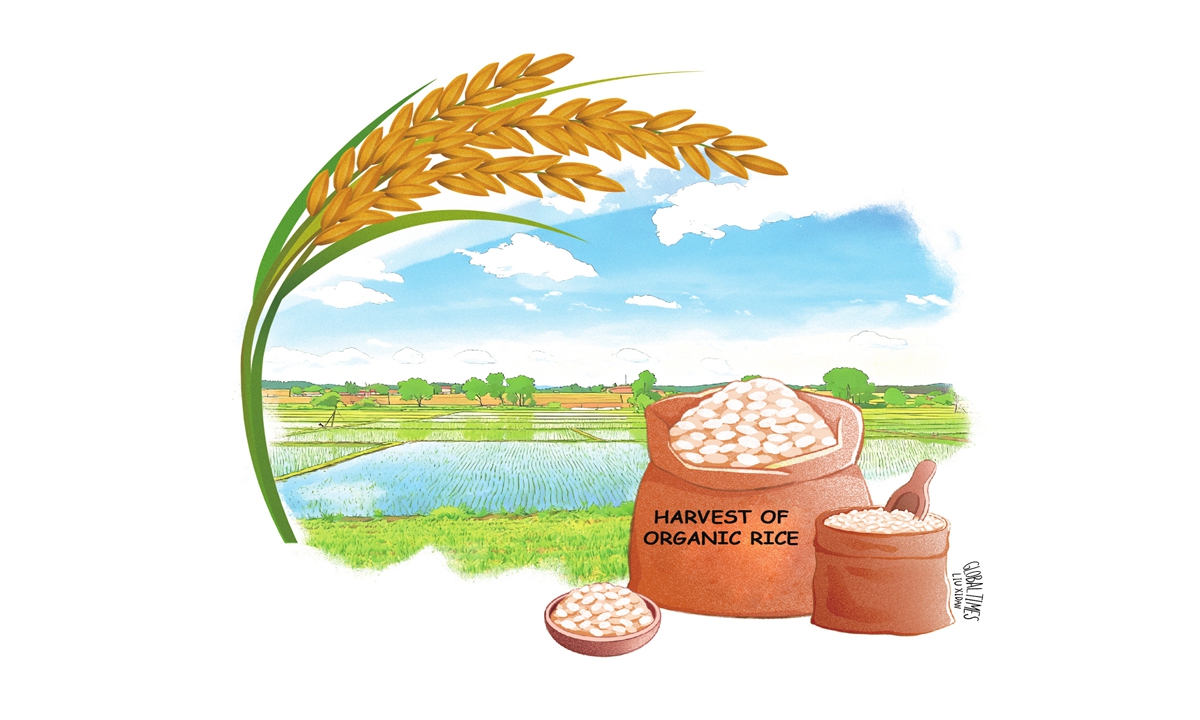
The growth of organic rice farming in Meihekou, Northeast China's Jilin Province, offers a useful insight into the shifting dynamics of China's consumer market.According to Securities Times on Thursday, local farmers have seen their profits increase by up to five times by moving from conventional green rice to organic varieties. While the average profit from growing green rice is about 400 yuan ($58.50) per mu, organic rice can yield approximately 2,000 yuan. This increase in profitability reflects not only a change in agricultural methods but also a growing demand among consumers for organic, higher-quality goods.
Despite the higher price of organic rice, demand continues to rise. A report from the People's Daily on April 5 cited data from JD.com showing a 25 percent year-on-year increase in organic rice sales this year.
This suggests that more consumers are willing to pay a premium for organic products, reflecting a broader shift toward health-conscious choices.
The demand for organic products extends beyond rice. Organic vegetables, fruits, and even condiments such as soy sauce are increasingly found in both online and offline retail markets. The growing availability of these items indicates that organic products are gradually becoming more widespread.
China's organic product market is expanding rapidly, creating ample growth opportunities. Upgrading consumer demand, higher-value agriculture, and technology-empowered retail channels are driving this shift nationwide.
China's organic product sales reached 124.7 billion yuan in 2024, up 22.79 percent year-on-year, with the country remaining the world's third-largest market for organic consumption, the Beijing-based Farmers' Daily reported in October 2025.
Organic consumption in China has strong potential for further growth, driven by a range of factors. These are likely to position organic products as an increasingly prominent segment in China's consumer market.
First, as incomes rise and awareness of health and food safety grows, demand for organic products is steadily increasing. According to the National Bureau of Statistics, China's per capita disposable income in 2025 reached 43,377 yuan, a real increase of 5 percent year-on-year. This rising affluence is accompanied by a growing emphasis on health-conscious consumption, with organic foods seen as a safer, higher-quality option.
Second, the growing demand for higher-end products is creating space for higher-value agriculture. Organic products generally offer higher profit margins than conventional farming, providing strong incentives for producers to upgrade. This dynamic is encouraging a shift toward more sustainable and higher-value agricultural practices, benefiting both farmers and consumers while supporting the broader trend of consumption upgrading.
Third, organic products are reaching a broader range of consumers, unlocking the potential of the lower-tier market. According to official data, express delivery services now cover 95 percent of China's administrative villages. As logistics and warehousing networks extend into county-level areas, fresh food e-commerce platforms and retail channels are expanding rapidly into lower-tier regions.
Fourth, organic consumption is driving growth in related services. Certification bodies, testing and inspection firms, and traceability tools such as QR codes and blockchain all play a role. Together, they form part of the modern services sector. These services help ensure product safety, build consumer trust, and improve the efficiency of the supply chain. In 2025, the number of organic certification labels used in China exceeded 6.66 billion, according to CCTV News.
These factors, along with others, are helping to establish a growing ecosystem around organic consumption, creating an expanding network and supply chain. This development suggests that organic consumption has significant room for continued growth.
Organic consumption can be considered one of the emerging trends in the broader landscape of new consumption patterns in China. In addition to organic products, numerous other consumption trends are reshaping the market, including a growing demand for higher-quality goods and a rising focus on choices that promote personal well-being. Taken together, these trends reflect the vibrancy and transformation of China's consumer market.
Meihekou's organic rice provides a clear illustration of these emerging trends. While it may be a localized case, it reflects broader changes occurring across China's consumer landscape. As consumer preferences evolve and demand for higher-quality products increases, there will be ample opportunities for businesses to engage with a market that is increasingly focused on quality, health, and personal well-being.
The author is a reporter with the Global Times. bizopinion@globaltimes.com.cn
RELATED ARTICLES