ARTS / CULTURE & LEISURE
Dolphin tragedy underscores safe distance as bedrock of wildlife-friendly tourism
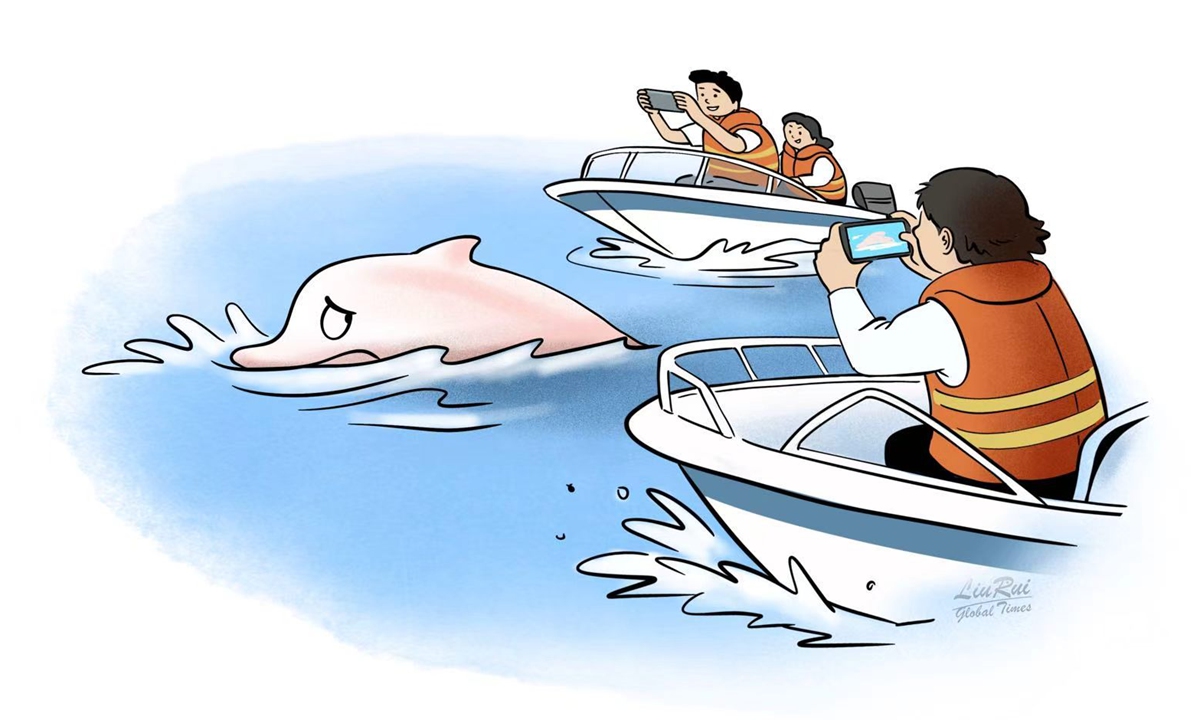
Illustration: Liu Rui/GT
Known as the "giant panda of the sea," the Chinese white dolphin has unique pink skin that is believed by some people to bring good fortune, making it a unique sight emerging from the sea. Among all the sea areas where it appears, Sanniang Bay in South China's Guangxi Zhuang Autonomous Region is the most "fortunate" as this is where the rare species appears most frequently in the country. Meanwhile, this dolphin population, in turn, brings great fortune to local tourism.However, an unfortunate event recently unfolded there. To get a close-up view of these animals, several speedboats carrying tourists chased and encircled the Chinese white dolphins. One calf reportedly died after being violently pursued. The local government quickly responded and announced the launch of a "special rectification campaign."
It serves as a constant reminder of a crucial fact: There must be a limit to how closely people observe wildlife and nature.
The site of this incident, Sanniang Bay, is a popular tourist attraction known for its pink dolphins. He Junyi, an aquatic animal protection expert, told the Global Times that developing wild dolphin resources into a tourist attraction is "not wrong at all; on the contrary, it can be a positive thing that raises public awareness."
If there is nothing inherently wrong with combining tourism and natural resources, what truly went wrong? The answer lies in people's consumer mindset.
One of the major causes of this "chasing incident" was unlicensed dolphin-watching boats operated privately by local fishermen in the area. To attract more tourists, these boat operators make promises like "Pay 120 yuan and you are guaranteed to see dolphins." Behind these promises lies a cruel trade-off: sacrificing wild animals to please tourists. Endless chasing, excessively close viewing distances, excited screams and more, these practices momentarily make tourists feel they "got their money's worth," or allow fishermen to make a quick profit.
But in the long run, it is more likely to result in tourists never being able to buy a ticket and fishermen never being able to make money again. That is to say, when incidents of harming dolphins occur repeatedly, this intelligent animal is unlikely to appear again. At the same time, the tourist spot may also earn a bad reputation, or even close permanently due to repeated incidents.
Hence, if we wish for the pink dolphin to keep bringing "luck," regulation of shady boats must be carried out. Meanwhile, the consumer mindset must shift from being "Party A" to "Party B." In other words, they need to accept the fact that going to see wild animals means entering their living space; the viewing experience is uncertain, not something that can be manufactured.
Be it regulating boats or guiding consumer behavior, this actually depends on the establishment of a more complete dolphin-watching system. This system requires clear guidelines on one hand and, more importantly, implementation on the other.
In fact, taking Guangxi as an example, this autonomous region has already issued guidelines for dolphin watching and protection. What needs to be done next is implementing them through multi-party coordination.
What can be suggested is that on the policy end, "do or don't" rules should be made clearer. On the tourist attraction end, the scenic area can increase physical measures such as setting up routine patrols and clear speed limit requirements. Meanwhile, tourists can learn to show respect. Researchers and animal lovers can also join in, voluntarily carrying out public education efforts.
"There are already many scientific researchers like me who participate in educating tourists and the public," He told the Global Times. He also added that once the general public gains a basic understanding of animal behavior, most people will "willingly adapt to the animals by controlling themselves." Emotions are universal and there is mutual respect between humans and animals, the expert said.
To some extent, establishing sound regulations for the protection of Chinese white dolphins is not a restriction, but rather a way to strengthen unique local cultural tourism.
The controversial "chasing pink dolphins" incident also shows that there is strong market demand for local dolphin-watching tourism. At the same time, this incident has revealed which aspects of this tourism niche need to be upgraded.
Guangxi is also home to other rare aquatic species of global significance, such as Bryde's whale. These resources have long served as a lever to boost local cultural tourism. Fortunately, locals have not simply exploited them. Rather, they have taken many measures to sustain these precious resources.
For example, in January, a science education base dedicated to Bryde's whale was established, serving as a window for public science outreach and research cooperation.
Through years of local marine ecological protection and restoration efforts, as of November 2025, the number of wild Chinese white dolphins appearing in Sanniang Bay has exceeded 360.
Although the recent incident in Sanniang Bay is regrettable, it should not become a reason to overlook or erase local attention and protection efforts regarding its marine mammal resources. Rather, this incident should serve as a lesson: What enables the symbiotic development of natural resources and cultural tourism is respecting boundaries between nature and people.
The author is a reporter with the Global Times. life@globaltimes.com.cn
RELATED ARTICLES