ARTS / CULTURE & LEISURE
In Spring, ancient city of Luoyang brims with color and history
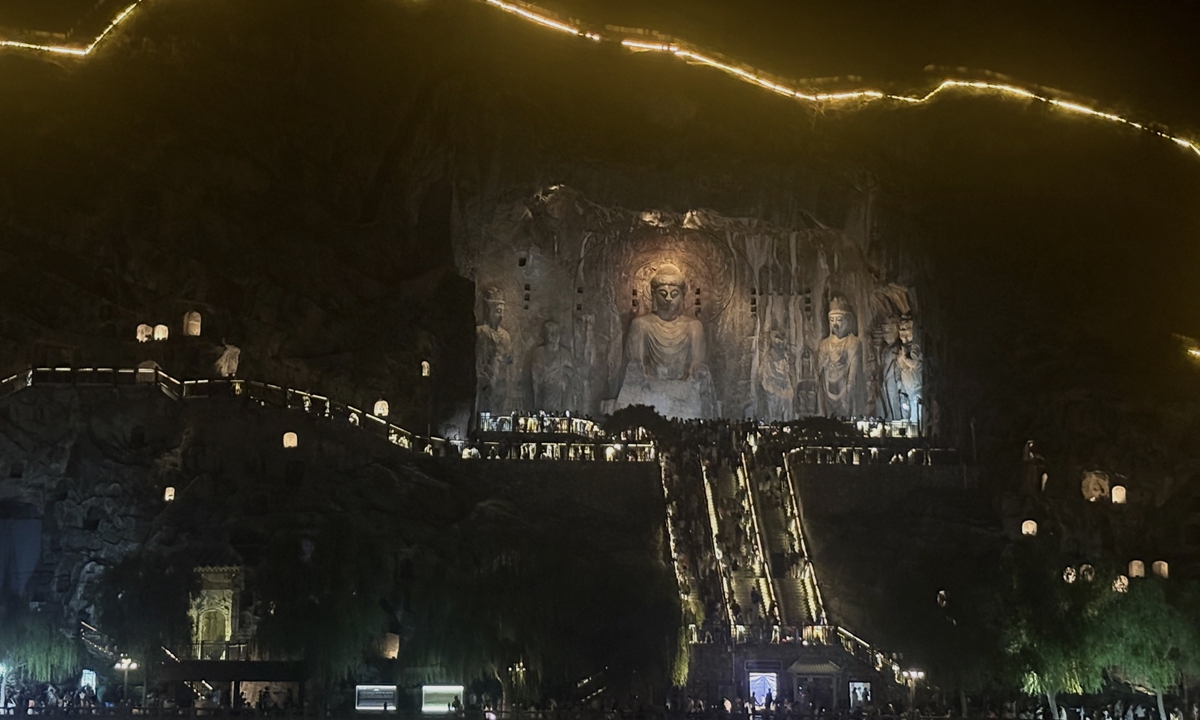
The giant Vairocana Buddha of Longmen Grottoes in Luoyang, Central China's Henan Province Photo: Li Hang
In early April, the gentle spring breeze along the Luohe River carries with it the scent of blooming peonies, signaling that the ancient city of Luoyang, Central China's Henan Province, has entered its annual season of floral splendor.
Just before the Qingming holidays (April 4-6), the 43rd China Luoyang Peony Festival opened at the Sui and Tang Dynasties City Ruins Botanical Garden.
Upon hearing the news, many like us made the garden our first stop in the city.
Within the garden, there were peonies in every hue: pink, red, white, and yellow. Walking through the garden, it's easy to see why Luoyang's peonies are renowned nationwide.
Visitors stroll slowly among the blooms, cameras and cellphones in hand, pausing to capture the delicate layers of the petals.
Some girls dressed in traditional Hanfu costumes to take pictures among the flowers, the flowing robes and intricate accessories blending naturally with the colorful sea of flowers, creating moments that seem to have been lifted from another era.
The popularity of Hanfu photography here reflects a growing trend in cultural tourism in the city.
In the Luoyi ancient city in the city's Laocheng district, shops lining the streets offer costume and makeup packages for around 200 yuan, allowing visitors to immerse themselves in the look and feel of an ancient capital.
Wang Lili, 27, from Beijing, told the Global Times that she had seen posts on China's lifestyle-sharing platform Xiaohongshu about Hanfu photo shoots in Luoyang and decided to go and have a photoshoot during her visit.
For 169 yuan, the package included both makeup and clothing, which she said was very "reasonable," though reservations were required in advance.
"Wearing Hanfu in the ancient city, felt truly immersive," said Wang.
Since the beginning of 2023, Luoyi ancient city has attracted more than 13 million visitors to experience Hanfu culture, generating over 2.2 billion yuan ($322 million) in related spending.
Young people between 18 and 35 make up the majority of participants. The number of Hanfu businesses in the Laocheng district has grown from 18 at the end of 2022 to more than 1,300, and the full-service Hanfu industry, including design, rental, makeup, and photography, now supports more than 30,000 jobs, according to the Xinhua News Agency.
But Luoyang's appeal is not limited to the vibrant colors of its spring gardens. The city's rich history is also visible in its stone-carved treasures.
The Longmen Grottoes, a UNESCO World Heritage Site, opened its "Night Tour" program on March 30.
The grottoes and niches of Longmen contain the largest and most impressive collection of Chinese art of the late Northern Wei and Tang Dynasties (386-907). These works, entirely devoted to the Buddhist religion, represent the high point of Chinese stone carving.
Experiencing the thousand-year-old Buddhist carvings under carefully arranged evening lighting is definitely a must.
As dusk falls, lamps illuminate the grottoes and their numerous Buddha statues, casting a calm, warm glow over the cliffside. Visitors begin arriving even before the lights were turned on, but the effect of the illuminated carvings draws many to pause and take in the details.
In the daytime, you can clearly see the intricate details, the textures of the Buddha sculptures and the weathering of the stone. But at night, floodlights trace the outlines of the statues and cliffs, casting fascinating shadows and creating a sense of mystery."
The largest and most iconic statue, the Vairocana Buddha, attracts a steady crowd of photographers, who were trying to capture the monumental figure framed in light and shadow. The interplay of illumination and stone shows the delicate artistry carved into the limestone centuries ago.
With over 4,000 years of history, the city served as the capital for 13 Chinese dynasties. But during the travel, it's easy to sense the dual character of Luoyang today: the lively, ephemeral beauty of spring flowers, and the quiet, enduring presence of its cultural heritage.
RELATED ARTICLES