SPORT / MISCELLANY
Chinese runner lowers national half marathon record by 30 seconds
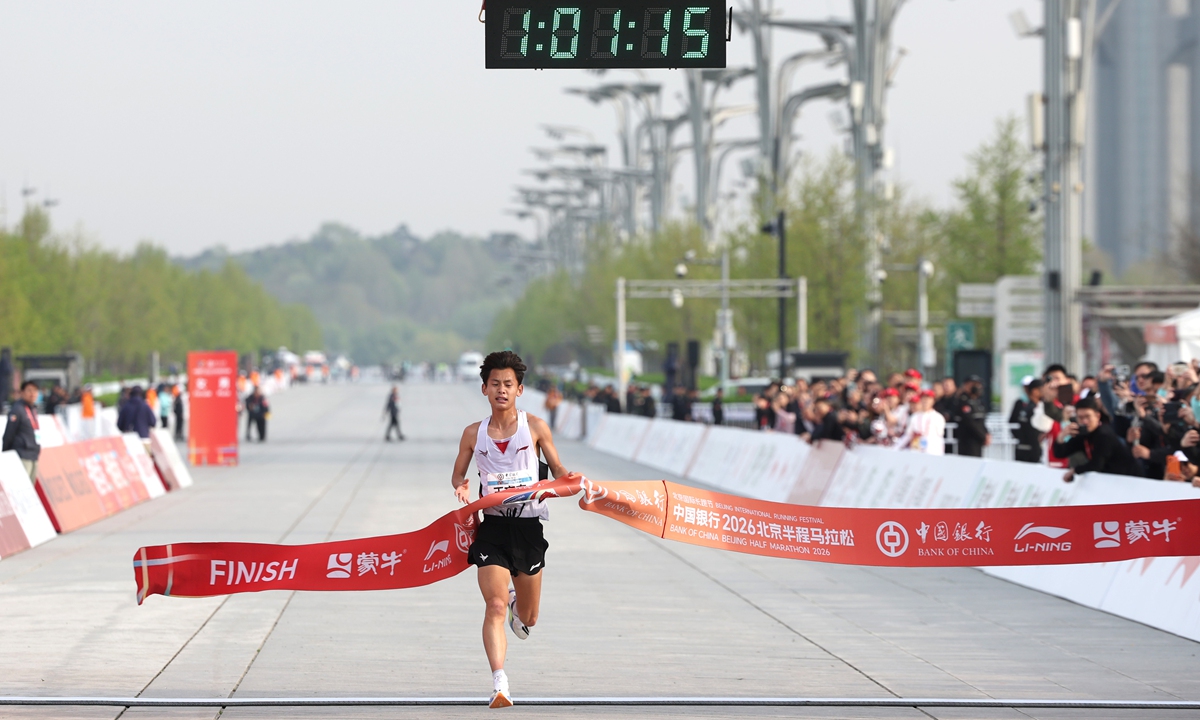
Chinese runner Wang Wenjie won the 2026 Beijing Half Marathon with a national best result of 1:01:15 on April 12, 2026. Photo: VCG
Chinese runner Wang Wenjie delivered a landmark performance during the Beijing Half Marathon on Sunday, lowering national half-marathon record by half a minute.
Competing against a strong field of runners, Wang surged to victory in 1 hour, 1 minute and 16 seconds, improving the previous Chinese national record by 30 seconds.
The earlier mark of 1:01:46 had been set in 2025 by teenage runner Yu Shuiqing in a half-marathon race in Renshou, Southwest China's Sichuan Province.
Speaking after the race, Wang said the result largely followed the race plan he had prepared with his coaching team.
"Everything went according to our plan today," Wang told reporters after finishing the race. "I managed to run at the rhythm we had practiced in training, and I was able to show the level I've been working toward."
At the age of just 21, Wang has been regarded as one of the emerging faces of China's new generation of distance runners.
He has already competed across a range of endurance disciplines, including the 10,000 meters. His personal bests include a 27:48.68 in the 10,000 meters and a marathon time of 2:10:23, performances that have steadily raised his profile within China's distance running scene.
Wang noted that the course conditions also played a role in enabling fast time.
"I had already anticipated the pace of the race beforehand. This is a course where it's relatively easy to produce strong results in domestic competitions," he said.
The 2026 edition of the race, which also marks the 10th anniversary of the Beijing Half Marathon format, saw more than 22,000 runners gather in the heart of the capital.
The race began at Tian'anmen Square, sending participants northward along the historic Central Axis before finishing at the scenic avenue of the Olympic Forest Park.
Race organizers introduced several adjustments to the route this year, including a fully point-to-point layout with no turnaround sections.
After the 17.5-kilometer mark, the number of turns was also reduced, creating a smoother final stretch designed to help elite runners chase personal bests.
For Wang, familiarity with the capital's climate and racing environment also proved advantageous.
"I usually train in Beijing, so I'm quite used to the weather and conditions here," he said. "At the 2024 Beijing Marathon I also set my personal best in this city, so I feel comfortable competing here."
Looking ahead, the 21-year-old runner said his focus will shift toward longer distances.
"I will continue to train hard and hopefully compete in the Beijing Marathon later this year," he added. "I'm looking forward to achieving another breakthrough."
In the women's race, Xu Shuangshuang claimed victory with a time of 1:09:55, securing her first title at the Beijing Half Marathon. Chinese runners Xia Yuyu and Liu Min rounded up the podium.
Beyond the elite competition, the race is widely regarded as one of China's most influential road-running events.
The Beijing International Running Festival traces its roots back to the "Victory Cup" city run first held in 1956, making it one of the country's oldest mass-participation sporting traditions.
Over the decades, the event has evolved alongside the rapid growth of recreational running in China.
In 2007, the race was merged with the Beijing International Road Relay and officially became the Beijing International Running Festival, while in 2016 it was upgraded to a half-marathon format.
For Beijing, the event serves as a flagship spring sports festival that blends elite competition with mass participation. Thousands of amateur runners join top domestic and international athletes each year, turning the race into a celebration of urban fitness culture.
Organizers said overseas registrations for the 2026 edition increased by 35 percent compared with the previous year, reflecting the growing global interest in road running in China.
RELATED ARTICLES