SPORT / MISCELLANY
Asian tournament reveals progress, gaps in Chinese badminton
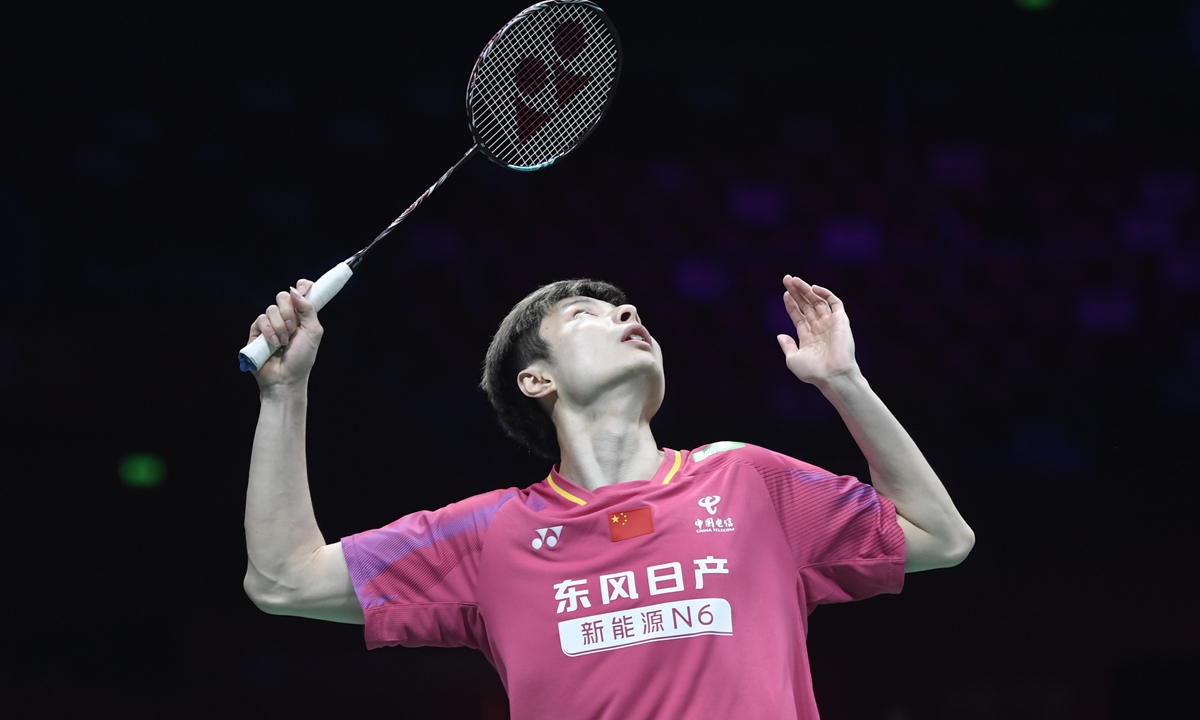
Chinese shuttler Shi Yuqi competes in the men's singles final of the 2026 Badminton Asia Championships against Ayush Shetty of India in Ningbo, East China's Zhejiang Province, on April 12, 2026. With a 21-8, 21-10 victory, Shi ended a nine-year title drought for Chinese male players at the tournament. Photo: VCG
The 2026 Badminton Asia Championships that concluded in Ningbo, East China's Zhejiang Province, on Sunday offered more than just medals for the Chinese badminton team. It revealed a program in transition, where resurgence, resilience, and remaining gaps coexist.Shi Yuqi breezed past India's dark horse Ayush Shetty in the men's singles final to secure his first Asian championship. While emerging talents Li Yijing and Luo Xumin were crowned the women's doubles title. Arch-rivals South Korea took three golds at this tournament by winning the women's singles, men's doubles and mixed doubles.
Shi's title was not merely a personal milestone, but also served as a statement of form, mindset, and leadership ahead of the Thomas Cup, Liu Yu, a Beijing-based sports commentator, told the Global Times.
For the first time since Chen Long defeated Lin Dan in 2017, China has reclaimed the men's singles crown at this tournament. More importantly, Shi's perfect run, winning five matches in a row without dropping a single game, signals a return of authority.
His own remarks also pointed to a grounded mindset. With the Thomas Cup looming, Shi emphasized match-by-match focus and maintaining competitive hunger. That perspective may be one of the most valuable takeaways from Ningbo for the team.
"I hope my performance can set a positive example for my teammates, and that everyone can work well together at the Thomas Cup to achieve strong results," Shi said after the match.
The 2026 Thomas & Uber Cup Finals, which are the pinnacle of men's and women's international team badminton, will take place from April 24 to May 3 in Denmark. China's men's and women's team are defending champions of both cups.
If Shi's triumph represents restored confidence, the women's singles final reflects a more nuanced reality. Wang Zhiyi fell in a hard-fought three-game match to South Korea's An Se-young, settling for silver.
In context, this is far from discouraging. Just weeks earlier, Wang had defeated An at the All England Open Badminton Championships, ending a daunting 10-match losing streak against the South Korean star and snapping An's 36-match unbeaten run on the international stage.
Although Wang fell short in the final, she demonstrated strong tactical resilience and pushed her physical limits, Liu noted. Wang acknowledged her shortcomings while also affirming her progress after the match.
"Not giving up on every single point is something I did better than before," Wang said.
In the doubles, the picture is mixed but instructive. Although the young pair Li and Luo won the women's doubles after top-ranked Chinese pair Liu Shengshu and Tan Ning withdrew due to injuries, their breakthrough reflects the depth of Chinese women's doubles, which have been China's most consistent event in international competitions.
However, the inconsistency in the men's doubles and mixed doubles cannot be overlooked.
Feng Yanzhe and Huang Dongping, ranking World No.1, were sent packing by a Thai pair in the mixed doubles semifinal.
This marks the second consecutive Asian campaign in which China's mixed doubles failed to reach the final, indicating that a once-dominant event is now entering a period of transition and adjustment.
In Ningbo, Chinese men's doubles pairs showed moments of strong net play and back-court power, but struggled to convert neutral rallies into attack and maintain pressure after gaining advantage. Occasional hesitation was seen in fast exchanges.
If improvements in partnership stability and defensive resilience continue, the gap to Asia's top pairs is bridgeable.
This Asian tournament showed that Chinese badminton is evolving and gearing up for the Los Angeles 2028 Olympics. And in that evolution lies both challenges and promises.
The author is a reporter with the Global Times. life@globaltimes.com.cn
RELATED ARTICLES