ARTS / CULTURE & LEISURE
Tracing ancient wisdom and modern vibrancy in every Chinese character
Beyond words
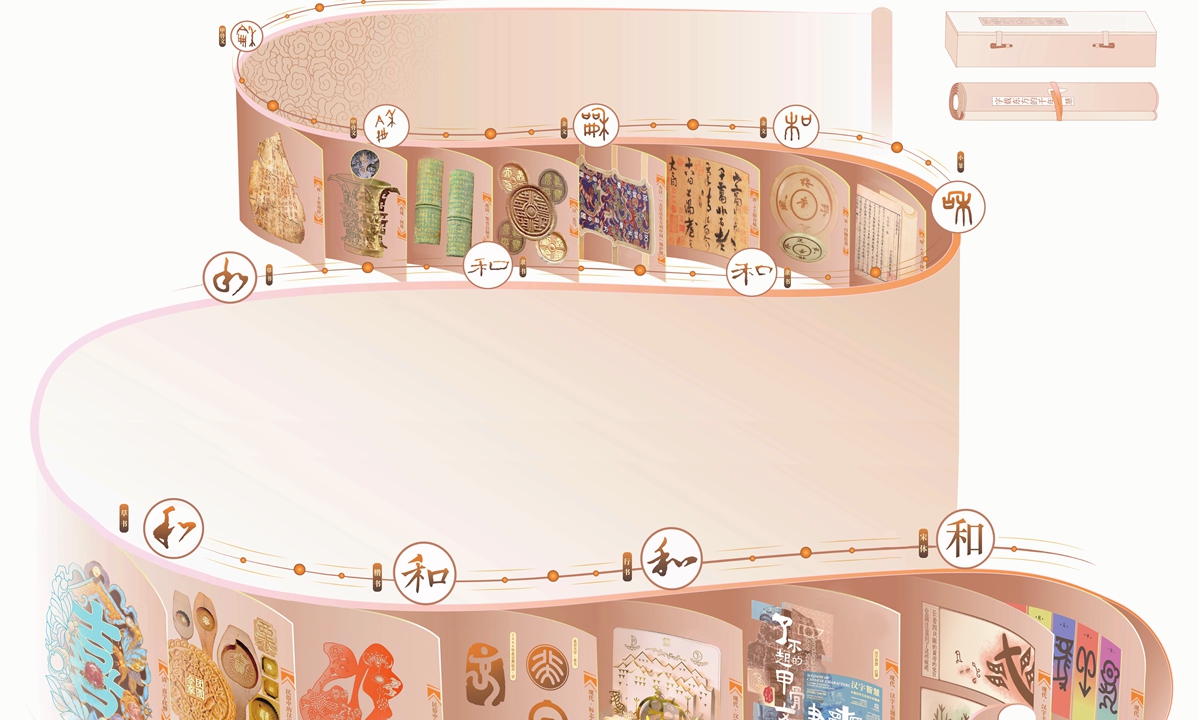
Evolution of the Chinese character 'He' Photo: Courtesy of People's Daily Overseas Edition
How much do you really know about Chinese characters? Beyond writing, do you know what else Chinese characters can be used for? There are thousands of answers to these questions.Chinese characters are not just what we write and read daily; they are also used in calligraphy and seal carving. They are seen in inscriptions on oracle bones in museums, as well as designs on crafts and everyday objects. Vast and rich, the world of Chinese characters holds the keys to Chinese civilization, and radiates infinitive creativity.
As the 2026 Chinese Language Day on April 20 approaches, let's explore the many faces of Chinese characters and discover why they have lasted for thousands of years.
Root of culture, civilization
In 1899, an accidental finding unveiled the secrets of a long-lost dynasty and brought the Yin Ruins' oracle bone script into public attention. This great discovery, significant for both Chinese civilization and human history, established the origins of Chinese characters and revealed a broad new world of writing.
Located in Anyang, Central China's Henan Province, just a few kilometers from the Yin Ruins, is the national museum dedicated to Chinese characters. Through exhibitions and research, this museum tells the story of the oracle bone script discovery, allowing visitors to view thousands of related artifacts and observe the evolution of Chinese characters over time.
"Chinese characters started in prehistoric times, were shaped in the Xia and Shang dynasties (c.2070BC- 1046BC), and matured during the Shang Dynasty (c.1600BC-1046BC)," explained Wang Shuangqing, an associate researcher at the museum.
There is a beautiful legend about the origin of characters in China. Cangjie supposedly invented writing after observing the footprints of birds and animals. While this is only a myth, it highlights that early Chinese characters were picture-based and modeled after the shapes of real things.
"The ancient Chinese people turned everything in nature and daily life into a system of visual symbols, which matches the Chinese cultural concept of 'harmony between nature and humans,'" said Wang.
Chinese characters express meaning through their form and carry concepts of nature, ethics and social rules.
For thousands of years, the Chinese people have recorded their civilization with characters on bronze vessels and in books. They have created poems, calligraphy, and seal art, showing the spiritual and artistic heights of Chinese culture. There are also word puzzles and games, all forming a broad and rich character culture.
"Chinese characters have continued from ancient times to today because they are tightly linked with Chinese civilization. Civilization keeps the script going, and the script keeps civilization alive. Their unique structure and powerful functions also support their lasting vitality," said Huang Dekuan, director of the Research and Conservation Center for Unearthed Texts of Tsinghua University and head of the National Museum of Chinese Writing.
Enduring and full of vitality
As times change and society develops, Chinese characters keep evolving and remain full of vitality.
On the one hand, with new things and ideas emerging, the meanings of characters are constantly enriched, and the number of characters keeps growing.
From over 4,000 symbols in oracle bone script, to more than 9,300 in Shuowen Jiezi, an ancient dictionary in the Han Dynasty (206BC-220), to more than 60,000 recorded in today's Grand Chinese Dictionary.
New characters have become signs of social changes. Since modern times, science and technology have given rise to technical terms and newly invented characters.
On the other hand, with the emergence of new technologies, Chinese characters have changed more profoundly, from how they are written and displayed to how they are encoded, used, and shared. Currently, with the growing popularity of museums, traditional crafts, and Chinese-style trends, Chinese character-inspired designs are everywhere, making culture visible and relevant.
At Tsinghua University's Research Center for Ancient Chinese Character Art, ancient scripts have become a field in design studies.
Artists create hollowed-out screens with oracle bone patterns, practical brush racks, and animated videos on the seasonal calendar, all using character forms.
In over 1,600 primary and secondary schools in Anyang, students now practice a set of radio calisthenics based on oracle-bone characters every day. This routine uses body movements to express 19 ancient characters, helping kids both exercise and recognize characters. It is popular in schools across Henan and being introduced in other provinces and regions, including Beijing, Sichuan, Yunnan, Guangdong and Hong Kong.
Connecting with the world
To honor Cangjie, the legendary creator of Chinese characters, the UN established Chinese Language Day on April 20, aligning it with the day of the Grain Rain solar term. This matches the global trend of more people learning Chinese.
According to China's Ministry of Education, 90 countries have added Chinese to their national education systems, and nearly 210 million people are learning or using Chinese language worldwide.
Wang, the researcher, said this "Chinese craze" is the natural result of China's growing power and cultural appeal, as well as an example of people around the world learning from each other.
During the 2025 Chinese Language Day, the National Museum of Chinese Writing staged an exhibition at the UN headquarters in New York City, presenting nearly 100 special characters. With original illustrations and AR technology, the exhibit recreated the society of Shang and Zhou dynasties (c.1600BC-221BC), sparking interest among those outside China to learn more about Chinese language and culture.
Chinese characters also inspire creativity and new forms of expression.
"Throughout history, Chinese characters and the civilization they carry have constantly absorbed strengths from other peoples and cultures, making themselves richer and more innovative," Huang said.
Wang is optimistic that, as more people around the world learn Chinese, characters will keep gaining energy. "Just as Chinese characters absorbed outside influences throughout history, they will keep renewing and opening up to the world."
The article was originally published on the People's Daily Overseas Edition on April 14, 2026.
RELATED ARTICLES