Starmer says he is 'not going to yield' to pressure from US President on Iran war; remark reflects deepening trust deficit in alliance: Chinese expert
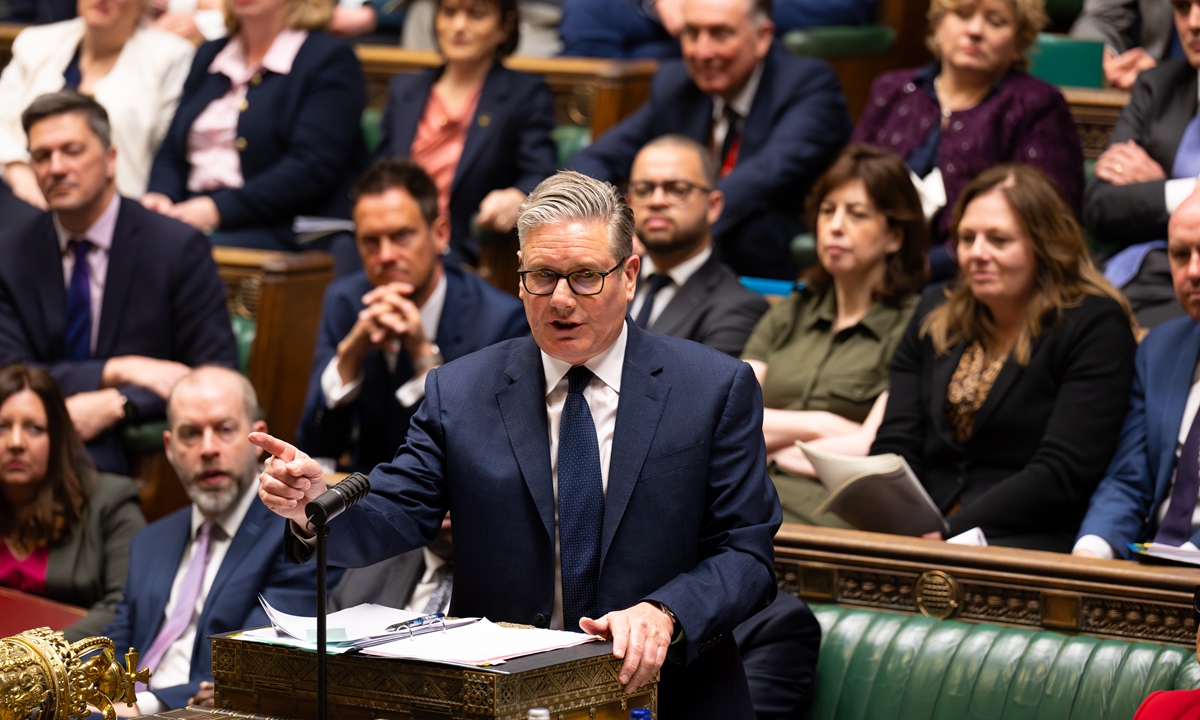
Prime Minister Sir Keir Starmer speaks during Prime Minister's Questions in the House of Commons, London, on April 15, 2026. Photo: VCG
Although the US President has repeatedly criticized UK Prime Minister Sir Keir Starmer for refusing to join the US-Israel war against Iran, Starmer once again expressed opposition, saying in his latest response that he is "not going to yield" to pressure following President Trump's warning over a US-UK trade deal, according to media reports on Wednesday. A Chinese expert said the move by the US, which seeks to tightly link economic relations with geopolitical alignment, has deepened the trust deficit across the transatlantic alliance as UK refused to bear the costs of Washington's strategic gamble.
Starmer told the Commons that "I'm not going to change my mind, I'm not going to yield, it is not in our national interest to join this war and we will not do so," according to a report by BBC on Wednesday local time.
The remarks came after US President Trump told Sky News that when the US asked the UK for help "they were not there," per the report by BBC. Pressed further on the relationship, Trump said it had "been better, but it's sad."
The US President also told the Sky News that the economic deal struck with the UK, which cut some of his tariffs on cars, aluminium and steel, was "better than I had to" and that it could "always be changed," the Guardian reported.
The US' use of trade deals as leverage, seeking to tightly link economic relations with geopolitical alignment, has not only failed to bring the UK in line but also has deepened the trust deficit across the transatlantic alliance, Wang Hanyi, a research fellow at the China-UK Center for Cultural Exchange at Shanghai International Studies University, told the Global Times on Thursday.
Regarding the matter, an analysis by CNN stated that relations between Trump and Starmer "took another turn for the worse." BBC also noted that the relationship between the two countries' leaders has in recent weeks shown signs of strain over the Middle East.
The report by Gurdian said that Starmer has increasingly leaned towards the EU, arguing that the economic and security benefits of a closer relationship with the bloc are "simply too big to ignore."
Still, the prime minister's spokesperson said the UK continues to have "a close relationship" with the US despite US President's latest comments, per BBC. "The special relationship with the US exists on multiple levels, and we have a close relationship with the USA, which spans trade, diplomacy, national security, culture, and beyond. It's far bigger than any individual issue," the spokesperson added.
The UK's position is grounded in a pragmatic assessment of national interest, Wang said. The Starmer government views the conflict not as a collective defense operation under NATO, but as a unilateral war initiated by the US.
Given widespread public opposition to military involvement and concerns that participation in Iran war would significantly strain the domestic economy, Britain is unwilling to bear the costs of Washington's strategic gamble, Wang added.
In an interview with The Mirror, the UK Chancellor Rachel Reeves said she was "very frustrated and angry" at America's actions as families across Britain suffer the consequences, the media outlet reported on Tuesday.
"This is a war that we did not start. It was a war that we did not want. I feel very frustrated and angry that the US went into this war without a clear exit plan, without a clear idea of what they were trying to achieve," she added.
Wang said that the divide between the US and UK is not an isolated incident, but a reflection of widening fractures within the broader transatlantic alliance, with France, Spain, and Italy also refusing to become involved in the conflict, underscoring Europe's deeper ambivalence between strategic autonomy and dependence on the US.
Amid mounting pressure from Washington, tensions between the US and NATO allies also flared up as President Trump previously said he was considering pulling the US out of the Western military alliance due to its European members' refusing to send ships to unblock the Strait of Hormuz, according to a report by Reuters on April 1.
The logic behind US pressure on Europe is the expectation that allies should unconditionally share the costs of hegemony, while European governments are primarily concerned with avoiding simultaneous entanglement in a war in the Middle East and the ongoing Russia-Ukraine conflict, Wang added.
"In the longer term, this approach of coercion over consultation is likely to accelerate Europe's push toward defense autonomy, while eroding NATO's cohesion and the foundations of mutual trust in ways that may be difficult to reverse," he said.
RELATED ARTICLES