ARTS / CULTURE & LEISURE
Chinese writer Ye Mei’s decades-long ecological literature journey
Green awakening
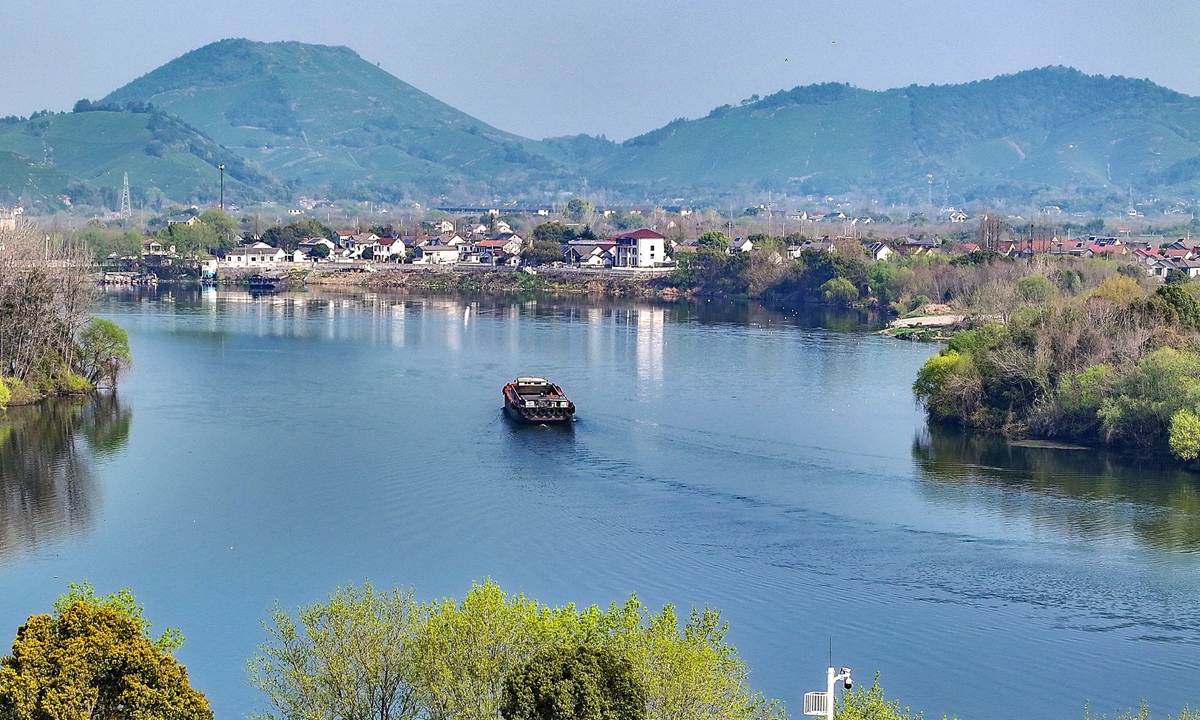
A boat travels through the waterway in Xishaoxi, Anji, East China's Zhejiang Province on March 29, 2026. Photo: VCG
On an early March afternoon, sunlight slanted through the study's window. Outside, the first forsythia flowers had begun to bloom, a hint of spring spreading from the treetops. On the desk sat the newly published long-form essay Neng Bu Yi Jiangnan (lit: Can I Not Remember Jiangnan). Its cover featured a farmer's vivid painting: lush green mountains and waters, white-walled houses with black tiles, peach blossoms in full bloom, a stream flowing gently."When I write, my mind is full of scenes," author Ye Mei told the Global Times. From the Heishui River in Jianshi county, Central China's Hubei Province, to Genhe in Hulun Buir in North China's Inner Mongolia Autonomous Region; from the spawning journey of fish in Qinghai Lake to the deep, mysterious forests of Shennongjia, Ye, a well-known ecological writer, has spent decades traveling and writing, leaving behind heartfelt records of China's rivers and mountains.
A wounded river
Ye's close connection with ecological writing began in 2007 with a revisit to an old haunt. That year, she visited Jianshi county, where she once worked. She remembered a clear river running through the town, children splashing in the water on summer evenings, mothers doing laundry on the banks, all laughter and sunlight.
But what she saw was shocking. The river had turned black and smelled foul, with darkened stones along the riverbed. Upstream, mining and coal washing had released untreated wastewater into the river.
"I was furious," Ye recalled. That same year, in Xianning's Yangloudong, another once-lively river along the Tea Horse Road had dried up. The riverbed was filled with trash, plastics rustling in the wind. That night, Ye wrote a blog post titled Qing Liuxia Qingche de Heliu (lit: Please Leave Clear Rivers Behind).
In the following years, Ye traveled along the Three Gorges, the Yellow River, and East Lake in Wuhan, Hubei, witnessing the deteriorating water quality of the Yangtze River and the disappearance of rare aquatic wildlife. She saw the Yellow River run dry, its cracked bed like scars, and how East Lake became so dirty that no one dared to swim in it. During a meeting in Hubei about sustainable development, Ye spoke sadly about the pollution, "It takes a hundred years to restore the natural ecology."
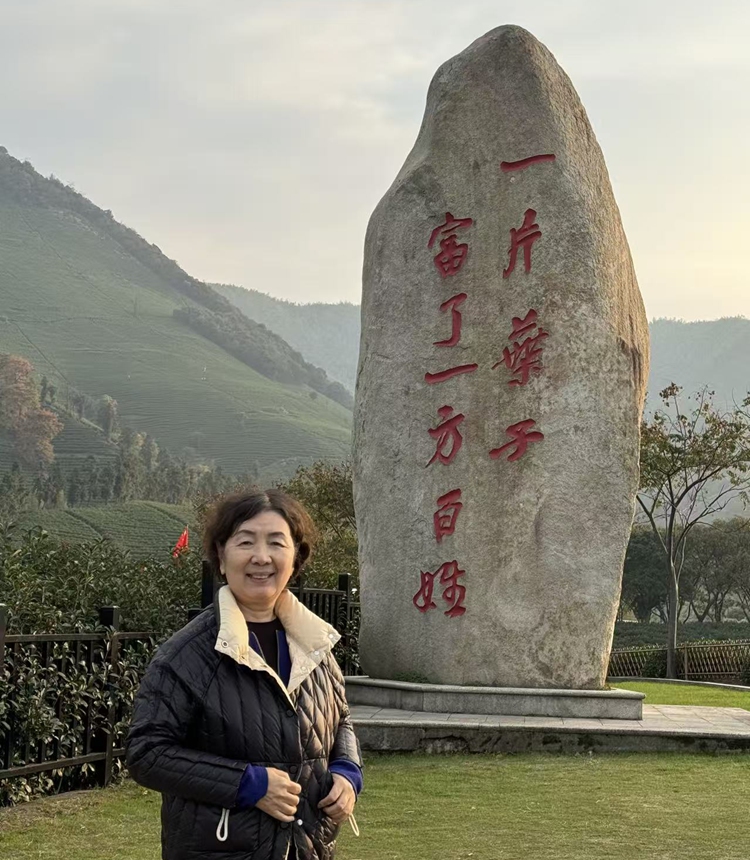
Author Ye Mei Photo: Courtesy of Ye Mei
A ray of lightIn 2011, Ye joined a cultural activity in the Jingning She autonomous county, East China's Zhejiang Province. Surrounded by green mountains and clean streams, she noticed a slogan carved by villagers in a prominent spot: "Lucid waters and lush mountains are invaluable assets."
"At that moment, I was deeply moved," Ye said, looking out the window as if back in that mountain town. At a time when environmental calls were still weak and defenders of nature often felt alone, this phrase was a sudden beam of hope. Ye suggested the village Party secretary carve these words in an even bigger and more noticeable place, so every generation would see and remember them.
After this, Ye began to write extensively about the environment. She wanted to express her feelings for rivers and mountains, and reflect on environmental changes with warm, emotional, human-centered language.
In June 2013, Ye wrote Genhe zhi Lian (lit: Love in the Genhe River), published in the Guangming Daily, describing the ecological changes along the Genhe River in the Great Khingan Mountains. Loggers who once held chainsaws had become forest rangers, protecting every tree.
Local ethnic groups, like the Ewenki and Oroqen, traded their family hunting rifles to join conservation efforts. Their ancestors had hunted here for thousands of years; now, they coexisted differently with the land.
In 2017, the article was chosen as the essay topic for the Beijing college entrance exam. That summer, even if those teenagers had never visited Genhe River, through Ye's words, they saw the river, the forest, and hunters lowering their guns. The seeds of environmental protection were quietly planted in their hearts.
Since then, Ye has written many works. Her recent long-form essay, Neng Bu Yi Jiangnan, took her over three years to finish and is dear to her. The essay follows Zhejiang's "Thousand Villages Demonstration and Ten Thousand Villages Renovation," combining the region's cultural heritage with today's ecological efforts.Like a needle stitching on silk, Ye uses her pen to knit a picture of rural revitalization.
For the book, Ye visited rural areas in Anji and Jiaxing in Zhejiang many times. She selected bold, vibrant folk paintings by local farmers for the cover and illustrations. The whole book carries the spirit and warmth of Jiangnan villages.
In Xianhou village, Chun'an county, Zhejiang, Ye discovered that the village's trees carried special meaning. The ancient camphor and cypress trees are more than 300 years old. They have witnessed the village's rise and fall over generations.
Jujube and walnut trees, meanwhile, have become the villagers' recent "money trees," helping boost local incomes as processed products made from red dates and walnuts are now sold far and wide.
Inspired by this, Ye wrote the essay Four Trees of Xianhou Village. The "four trees" quietly bring together past and present, ecology and livelihood, as well as local customs and family traditions.
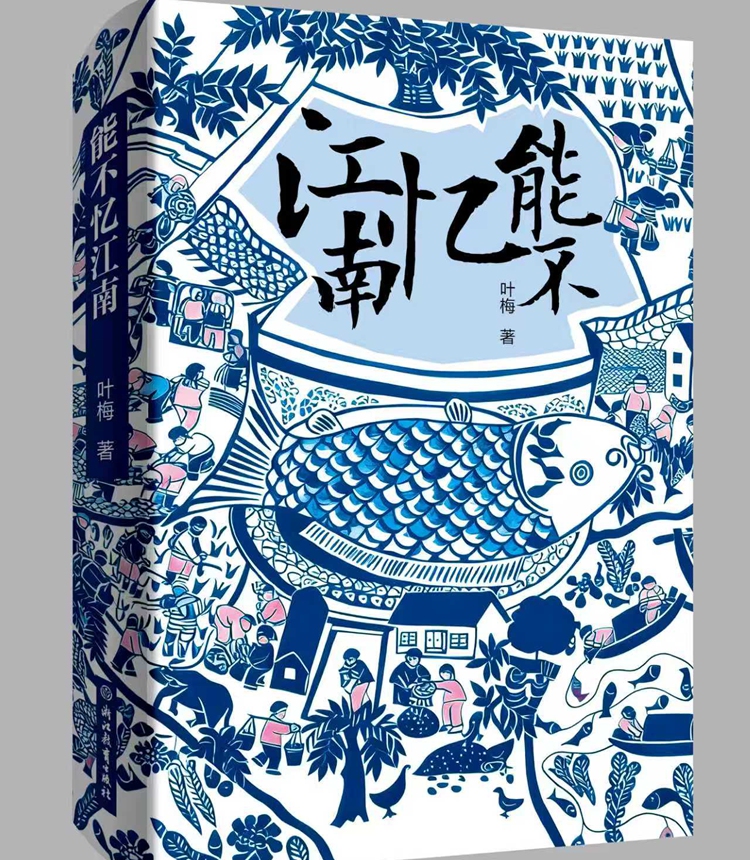
The long-form essay Neng Bu Yi Jiangnan Photo: Courtesy of Ye Mei
Roots in the soilIn 2020, Ye became the first writer appointed as a special observer by China's Ministry of Ecology and Environment. Later, she helped draft national policies supporting ecological literature. From writer to advocate, her love for this land has never changed.
Now, more authors, famous and ordinary, are joining the field of ecological writing.
"This is a good phenomenon," Ye said. "But readers also notice worries: too much imitation, repetitive subjects, a lack of real depth, like watching scenery from behind glass, visible but unreachable."
Ye said Chinese ecological writing should not just copy foreign models or stop at surface-level nature description. "I try to see the world through the feelings of a single blade of grass or a bird. Literature can give a voice to all living things." As a contemporary Chinese writer, she said it is important to connect history and today's rural ecological efforts, and to tell China's environmental stories well.
"Every river and mountain has a unique history and character. Every village experiences complex change. In every era, ecological protectors work silently. These are the true treasures of ecological literature," Ye said.
Currently, she is writing about the patriotic entrepreneur Lu Zuofu, known as the "King of Yangtze River Shipping." Lu's life was full of ups and downs, but he was devoted to education, journalism, and rural reform.
Ye has read many archive materials and visited the places where he lived and worked, inspired by his vision: "Let everyone be a gardener and turn the world into a garden."
According to Ye, Lu's story still shines with relevance today. "What he did a century ago can still inspire today's development."
From anger over a wounded river to documenting the rise of green mountains and clear waters, Ye's decades of writing have recorded China's awakening environmental consciousness and progress.
The rivers and forests she walked, the loggers, rangers, village officials, ex-hunters and volunteers she met, they all live in her writing.
And her words, like the rivers she cherishes, flow softly with warmth and depth, carrying the scent of the soil and the pulse of life.
RELATED ARTICLES