SPORT / MISCELLANY
Table tennis icon Fan Zhendong leaves behind more than victories in Saarbrucken
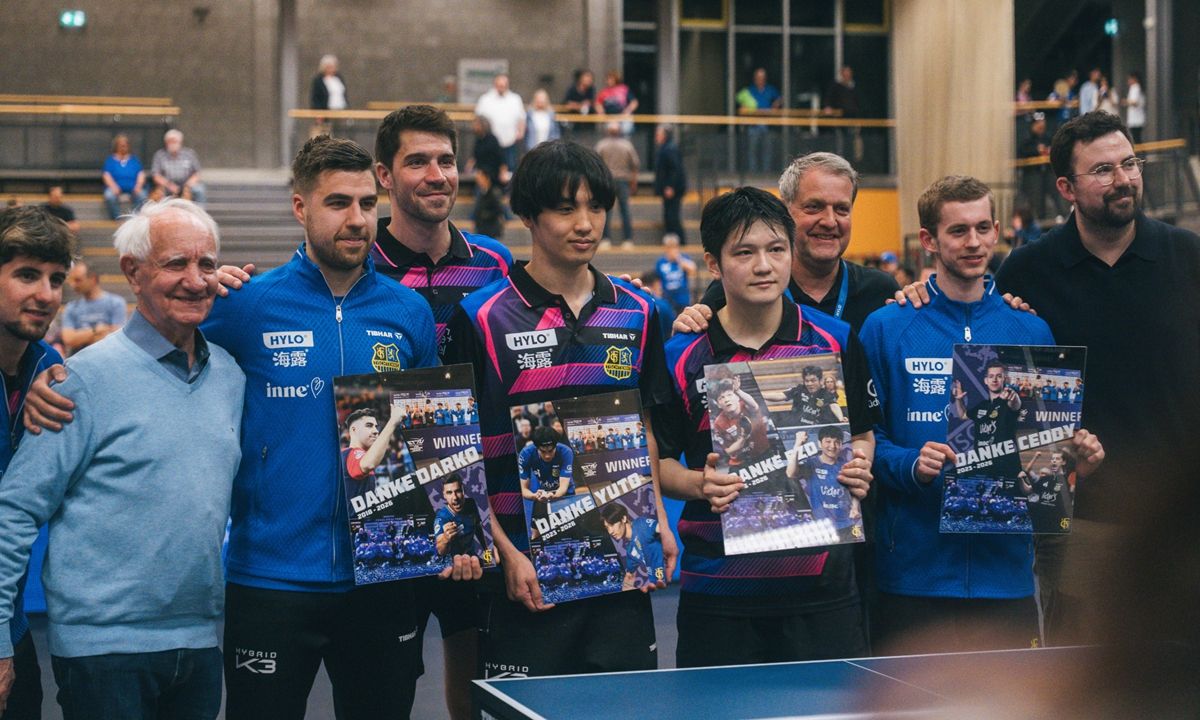
Photo: VCG
After Chinese table tennis icon Fan Zhendong finished his last home game for German club Saarbrucken on Wednesday night, the club held a farewell ceremony to pay tribute to his contributions. What Fan leaves behind is a multidimensional legacy that will be remembered for years to come.Olympic champion Fan secured two crucial points to power his club to a 3-1 victory over SV Werder Bremen in his last home game in Germany's top table tennis league. While expressing his gratitude to club staff and fans in English during the farewell ceremony, he said, "We are always friends and family. Thank you."
The 29-year-old will leave Saarbrucken at the end of the season to join another German club, Borussia Dusseldorf. He is set to continue representing Saarbrucken in the German league and the semifinals of the European Champions League for the remainder of the season.
It would be easy to frame Fan's stint in purely competitive terms. He has competed in 19 singles matches so far this season, securing 17 victories for an impressive win rate of over 92 percent, underscoring his consistency and dominance as the club's cornerstone, Chinese sports newspaper Titan Sports reported.
In January, he led the club to win the German Cup, which was his first overseas club title.
But statistics alone fail to capture the deeper significance of his season. What unfolded in Saarbrucken was a rare case of "mutual elevation": a world-class athlete finding new meaning in a foreign league, while that league and its surrounding community expanded its horizons through his presence, Liu Yu, a Beijing-based sports commentator, told the Global Times.
For a city with a population of just 180,000, Saarbrucken became, almost unexpectedly, a pilgrimage site for global table tennis fans. Home tickets sold out at prices up to seven times higher than usual, while the number of sponsors surged from just 10 to 64, signaling a remarkable boost in the club's market appeal, according to Titan Sports.
In addition to the market expansion, Fan's experience felt refreshingly human. He did not simply win matches; he earned respect with professionalism, humility, and consistency, Liu noted.
Saarbrucken said signing a player of his caliber had allowed it to play a pioneering role in the sport, describing the move as a significant moment in the history of German and European table tennis.
He arrived not as a transient superstar, but as a participant in a shared sporting ecosystem. In doing so, he helped dissolve the invisible boundaries that often separate the dominant Chinese table tennis system from the rest of the world.
By bringing China's training discipline and match mentality into daily routines, he raised the internal bar. Teammates in Saarbrucken were able to recalibrate. Training sessions became sharper, expectations higher, and the collective mindset more resilient. This kind of influence rarely makes headlines, but it is the foundation upon which long-term competitiveness is built.
At a broader level, Fan's presence offered European table tennis a close-up view of excellence. The gap between China's dominance and the rest of the world is often discussed abstractly. In Saarbrucken, it became tangible. In that sense, he became a conduit of knowledge.
For Chinese sports, the implications are equally significant. Fan's season provides a blueprint for future overseas ventures. It demonstrates that exporting talent is not a one-way transaction, but a two-way dialogue. Success abroad is not only about maintaining competitive superiority, but about engaging with local cultures, elevating ecosystems, and leaving behind something that endures.
As the lights dimmed on his farewell night, what lingered was not just applause, but gratitude for something less tangible and more lasting. In Saarbrucken, Fan did more than dominate a league, he built a bridge. And bridges, unlike victories, are meant to last.
The author is a reporter with the Global Times. life@globaltimes.com.cn
RELATED ARTICLES