UK, France reportedly to lead ‘defensive’ mission in Strait of Hormuz; practical impact will likely be limited: expert
By Published: Apr 18, 2026 01:09 PM

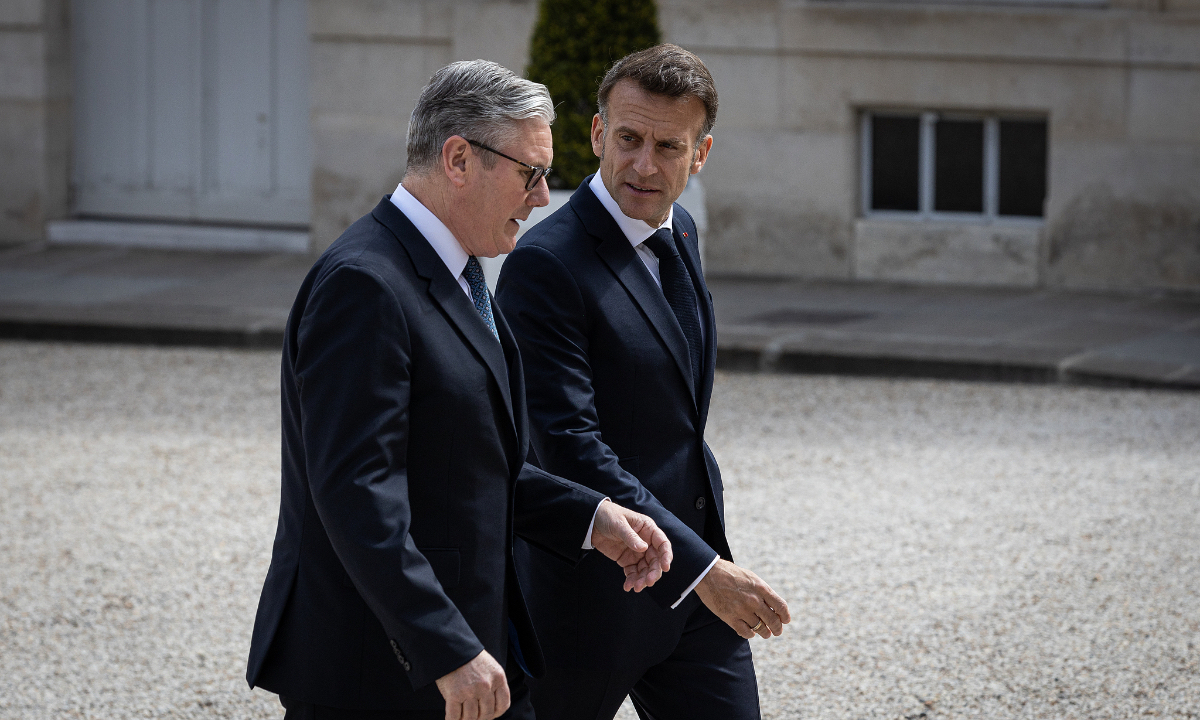
France's President Emmanuel Macron welcomes Keir Starmer, the British Prime Minister, before the meeting on the Initiative for Maritime Navigation in the Strait of Hormuz at the Elysee Presidential Palace in Paris, France, on April 17, 2026. Photo:VCG
The UK and France will lead a multinational mission to protect commercial shipping routes in the Strait of Hormuz, with more details to be announced next week, British Prime Minister Keir Starmer has said, after attending a meeting with many European leaders regarding the situation in the critical waterway, according to media reports.
The reported move came as, according to Xinhua, Iran's foreign minister said commercial vessels' passage through Strait of Hormuz is "completely open" and US President Donald Trump thanked Iran for the announcement of a full reopening of the Strait of Hormuz.
Amid these developments, what are the UK, France and other relevant countries trying to achieve with the meetings? What impact their efforts will have on the situation in the Strait of Hormuz? In an interview with the Global Times, a Chinese expert said on Saturday that this looks like a Europe attempt to use diplomatic tools to maintain its influence in Middle East affairs; however, given the complexity of the situation, the practical impact will likely be limited.
France and the UK on Friday chaired a meeting in Paris of 49 countries to discuss preparations for a possible multinational defensive mission to protect shipping in the Strait of Hormuz once conditions allow, according to Reuters.
"We will take this forward with a military plan conference in London next week where we will announce more detail on the composition of the mission, and over a dozen countries have already offered to contribute assets," Starmer told reporters alongside the leaders of France, Germany and Italy, per the report.
According to Al Jazeera, Washington’s absence from the table was deliberate. French President Emmanuel Macron said the mission to provide security for shipping through the strait would be “strictly defensive” and limited to non-belligerent countries.
Notably, while the UK and France convened the meeting on Friday, Iranian Foreign Minister Seyed Abbas Araghchi said on Friday that the strait will be "completely open" for the passage of all commercial vessels for the remaining period of the US-Iran ceasefire, aligning with the newly-enforced truce in Lebanon, Xinhua reported.
After Iran announced to reopen, Trump issued 11 tweets in a row on the Hormuz situation, according to media reports.
Trump thanked Iran for the announcement of a full reopening of the Strait of Hormuz on Friday, but in a follow-up post, Trump said that the US naval blockade on Iran will remain in full force until Washington's transaction with Tehran is "100 percent complete,” according to Xinhua.
However, if the US continues its naval blockade of the Strait of Hormuz, Iran will consider it a violation of the ceasefire between the two countries and will close the waterway, the semi-official Tasnim news agency reported Friday, citing an informed source close to the Supreme National Security Council, per Xinhua.
Iran’s Islamic Revolutionary Guard Corps (IRGC) has laid out strict conditions for transit through the Strait of Hormuz, saying vessels must obtain permission from its naval command, while military ships remain barred from crossing the strategic waterway, CNN reported.
In a statement on Friday, the IRGC Navy Command said civilian vessels will only be allowed to pass through designated routes approved by Iranian authorities, according to CNN.
The UK and France-led mission reflects Europe’s attempt to wield diplomatic tools on the Strait of Hormuz issue, driven not only by the severe impact of the blockage on Europe’s economy and energy supplies, but also by a desire to enhance its influence in Middle East affairs and demonstrate its strategic independence from the US in the region, Cui Hongjian, a professor at the Academy of Regional and Global Governance at Beijing Foreign Studies University, told the Global Times.
However, Cui also noted that the meeting’s practical impact on resolving the issue would remain limited, as none of the direct parties involved in the blockade of the Strait of Hormuz were included.
Al Jazeera reported that the France and UK-led effort was partly a response to Trump, who had berated European allies for failing to join the war, called NATO members “cowards,” and told the UK: “You don’t even have a navy.”
Regarding the situation in the Strait of Hormuz, with Iran signaling goodwill by fully reopening the Strait of Hormuz to commercial vessels, international pressure has shifted onto the US to lift its blockade of Iranian ships and ports, Cui said, adding that under such circumstances, Europe’s challenge is no longer how to deal with Iran, but how to engage with the US to ease its current blockade policies.
RELATED ARTICLES