ARTS / CULTURE & LEISURE
Pickleball finds its place in China’s sports landscape
Small paddle gets big momentum
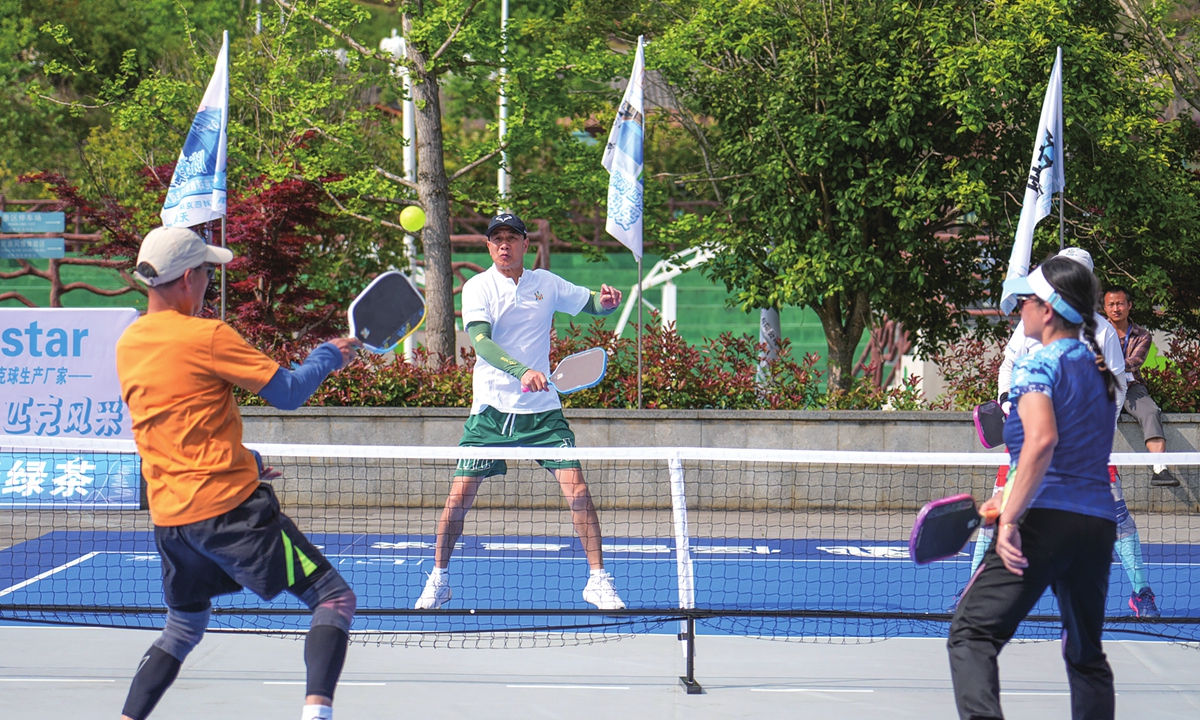
Pickleball enthusiasts gather to play in the Qianxinan Bouyei-Miao autonomous prefecture, Southwest China's Guizhou Province, on April 18, 2026. Photo: VCG
For Chengdu local Yin Hongrun, picking up a paddle to play pickleball on weekends has become a new hobby, as the sport's low barrier to entry, lightweight equipment and friendly atmosphere make it easy for her to meet new people and enjoy a relaxed social experience."I've really taken to pickleball on weekends. The equipment is light and easy to carry, and it's such a social sport. I've made so many new friends through it. That's why I love playing," Yin, a white-collar professional in her 30s, told the Global Times.
"I used to play badminton, but pickleball feels easier to start," she said. "You can learn the basics very quickly, and the rallies are really fun."
Pickleball, a racquet sport that blends the elements of tennis, badminton and table tennis, has grown rapidly worldwide. While the US remains its largest market, China has begun to emerge as one of the sport's most intriguing new frontiers, propelled by the enthusiasm of a new generation of players and a fast-growing tournament system.
At the grass-roots level, the sport's appeal lies largely in its accessibility. Compared with tennis, pickleball courts are smaller, rallies are easier to sustain and the learning curve is relatively gentle. These characteristics make it appealing to beginners, families and elder players.
Many observers say pickleball could transform from a niche pastime into a major participant sport. According to industry estimates, the number of pickleball participants globally exceeds 80 million, with Asian markets expanding quickly as awareness spreads.
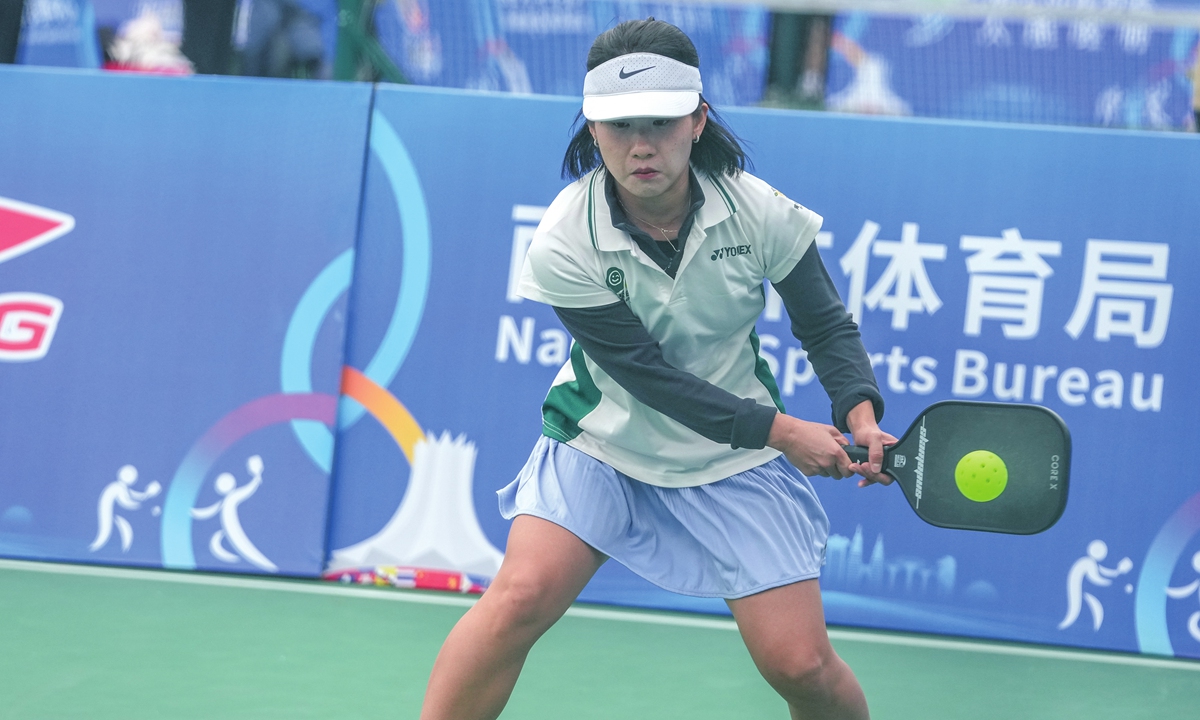
An athlete plays pickleball in Nanning, South China's Guangxi Zhuang Autonomous Region, on January 1, 2026. Photo: IC
Arriving at the right momentFor Chinese sports administrators, pickleball's rise comes at a time when the country is actively encouraging public participation in recreational sports.
In 2025, the State Council - China's cabinet - issued a policy document aimed at boosting sports consumption and encouraging the development of emerging sports events.
The policy emphasized enriching sports competitions and supporting new sports disciplines, a signal that created favorable conditions for sports like pickleball to grow.
At the national level, the General Administration of Sport has also included pickleball as an official event in the finals of the second National Fitness Games scheduled for April 2026.
Sun Wenbing, deputy secretary-general of the Chinese Tennis Association (CTA), which oversees pickleball's development in China, said pickleball has entered what he describes as a "golden period of development" in the country.
"Pickleball is no longer a niche sport for a small group of people," Sun told the Global Times. "It is becoming a new option for mass fitness and a new hot spot for sports consumption."
Fast-growing competitions
One of the key drivers behind the sport's rapid rise in China has been the establishment of a structured tournament system under the CTA.
In March 2024, the CTA launched the China Pickleball Circuit (CPC) along with an accompanying points ranking system.
The goal was to create a comprehensive competition framework spanning national, provincial and local levels, while allowing both elite athletes and amateurs to participate.
The results were immediate. Within just two years, the number of pickleball competitions expanded dramatically, from around 80 events in 2024 to more than 600 planned events annually by 2026, according to Sun.
The system includes multiple tiers of competition: national championships representing the highest domestic level, champion tournaments attracting top domestic and international players, mixed racquet events that combine pickleball and tennis, and community competitions designed to encourage participation among people of all ages.
Such a structure is designed to ensure the sport grows simultaneously at the grass-roots and professional levels, Sun said.
"The age range of participants now spans from around 10 years old to over 60," she said. "That is one of the unique advantages of pickleball: It can connect different generations through a sport."
Rapid expansion, however, requires more than tournaments. Recognizing that the sport had little existing infrastructure in China, the CTA moved quickly to establish a framework of rules and standards.
The association introduced official competition rules for pickleball in China and a national ranking system for players. It also issued technical standards for equipment such as balls, paddles and court surfaces, filling what had previously been a regulatory gap.
At the same time, training programs for referees and coaches have been introduced to support the sport's professionalization.
In 2025 alone, China trained more than 2,300 referees for pickleball competitions, nearly six times the number trained the previous year, Sun said, while coaching programs have also been expanded through a four-tier certification system, with more than 40 training sessions held annually and demand far exceeding available spots.
Bridge between cultures
Beyond participation and industry growth, pickleball has also worked as a tool to deepen international exchanges.
Recent activities illustrate that potential. International stars have also begun appearing at exhibitions and youth exchange events in Chinese schools and universities.
At one such event, tennis legends Andre Agassi and Steffi Graf were invited to engage with Chinese students and demonstrate the sport. Their appearance attracted significant attention from young players who had never previously encountered pickleball.
These exchanges, Sun said, help transform the sport into more than just competition.
"Sports can bring people closer and help civilizations communicate," Sun noted. "Pickleball is a striking example of cultural exchanges."
The arrival of major international tournaments, such as upcoming stops on the Professional Pickleball Association's Asian tour, is expected to further raise the sport's profile and attract more fans.
Despite the momentum, pickleball in China is still in its early stages.
Infrastructure remains limited compared with more established sports, and awareness among the general public is still growing.
Many cities have only a handful of dedicated courts, with most games played on converted tennis or badminton courts.
Observers also note that China's sports culture has long been dominated by traditional racquet sports such as table tennis and badminton, which remain far more widespread. But some analysts say those very traditions could eventually help pickleball flourish.
"The development of the sport still lies on expanding participation while strengthening the competitive system," Zhang Bin, a Beijing-based sports commentator, told the Global Times.
"The sport's quick reflexes, compact court and the similarities with table tennis and badminton make it easier for players familiar with those sports to adapt," Zhang said.
RELATED ARTICLES