ARTS / CULTURE & LEISURE
A rational look at France’s artifacts return bill
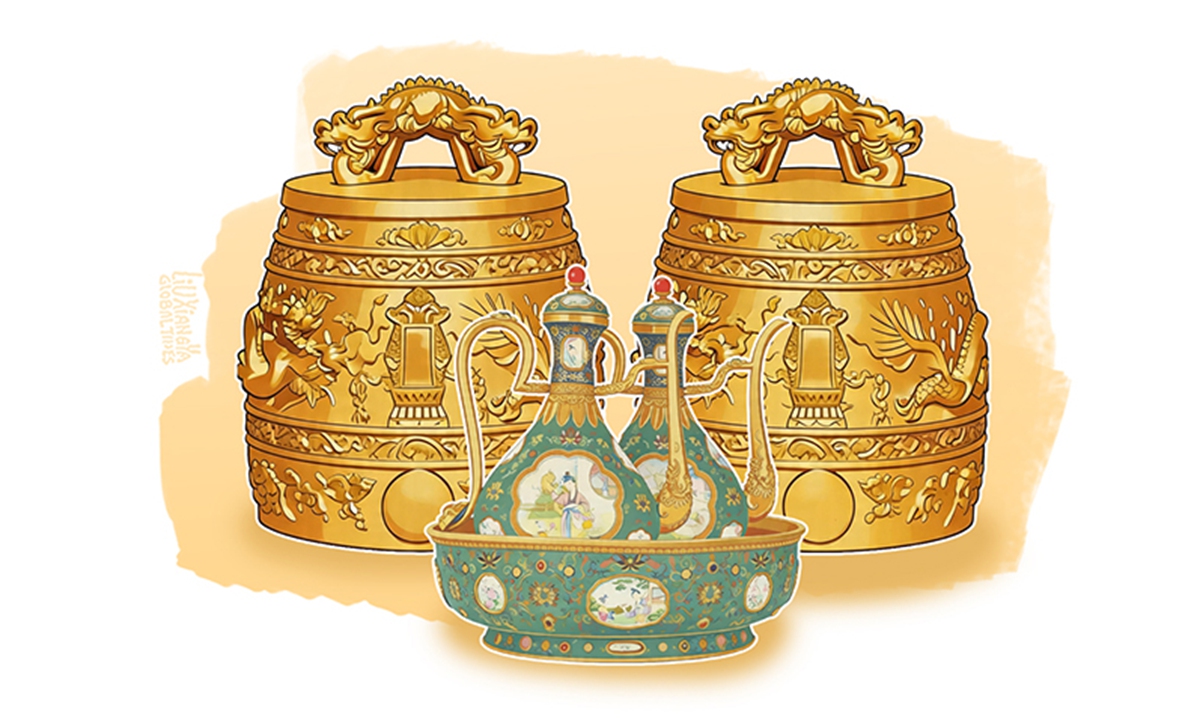
Illustration: Liu Xiangya/GT
On April 13, the French National Assembly approved a draft law to simplify the restitution of foreign artifacts acquired illegally between 1815 and 1972, with 170 votes in favor and 0 against.French lawmaker Jérémie Patrier-Leitus posted a video of his speech regarding the passing of the bill, during which he referenced French writer Victor Hugo's letter in 1861 to Captain Butler about the sacking of the Old Summer Palace in Beijing. "One day will come when France, once freed and cleansed, will return this plunder to looted China," the writer wrote.
There can be no doubt that, as a major Western and former colonial power, France's enactment of this bill breaks through the major legal obstacles that have long hindered the return of historically displaced cultural property, obstacles such as the principle of the inalienability of public collections, the non retroactivity of laws, and statutes of limitation, and opens a new chapter in the recovery and return of cultural objects. This is of far reaching historical significance and great practical value.
However, even after the bill becomes law, it will not mean that Chinese cultural artifacts looted by France, including those from the Old Summer Palace, will return to China immediately. The dream that Victor Hugo hoped for still has a long way to go before it can be truly realized.
First, although the bill does not explicitly limit the return of objects to African countries, given the legislative background, the priority for restitution is likely to be former French colonies in Africa.
Second, the bill excludes from its scope military goods, public archives, and archaeological finds, but it does not provide precise definitions of these key concepts.
Consequently, how terms such as "military goods" are interpreted will directly determine whether Chinese artifacts taken by France through war can be included within the scope of the restitution.
Third, to ensure that France retains control over the return process, the bill establishes a restitution procedure involving two committees: first, a scientific committee formed jointly by France and the requesting state; second, a Commission on the Return of Cultural Property composed of representatives from national museums, the government, and parliament. Only after an application has been reviewed by both committees can the French culture minister issue an administrative order authorizing a return.
It is thus clear that after the bill takes effect, contrary to what some social media accounts have claimed, France will not automatically and comprehensively return all foreign cultural objects unlawfully acquired between 1815 and 1972. Instead, the bill merely removes, through legislation, the legal obstacles that previously hindered the return of cultural property to foreign countries, thereby making restitution possible where it was once almost impossible.
In the future, which countries will receive returns and which specific artifacts will be returned will depend primarily on the priorities and procedures established by France, as well as on the preparation and strategy of the requesting countries.
Therefore, for China, action is needed first and foremost. Under the overall leadership of national cultural heritage authorities, China should organize specialized experts to track and study the subsequent legislative process and the meaning of the bill's provisions, conducting a comprehensive, accurate, and timely legal analysis and assessment of the bill to lay the groundwork for initiating claims at the appropriate time.
In addition, China should as soon as possible begin provenance research on the cultural relics lost to France, gathering the full chain of evidence documenting their removal from China to their acquisition by French museums.
Based on the difficulty of the provenance research and the value of the artifacts, China should draw up a list and priority order for claims against France, thereby building the policy, evidentiary records, and team infrastructure necessary for negotiations with the French government on the restitution of Chinese cultural relics looted by France.
Finally, France's enactment of legislation facilitating the return of cultural property stands in stark contrast to Japan's long-standing passive stance on returning Asian artifacts that it looted. Consequently, China should strengthen its public diplomacy efforts.
While positively acknowledging France's actions, China should also direct international attention to the issue of Japan returning looted cultural objects, calling on Japan to align itself with the historic trend of the times, reflect on its past crimes, and cease its continued silence and inaction on the restitution of cultural property.
In particular, in recent years, Japan has witnessed a rightward shift in its domestic politics, and rhetoric denying or even glorifying the country's war crimes has become increasingly vocal. This should be a matter of great concern to the international community. The countless Chinese cultural relics violently taken by Japanese invaders are not only a testimony to China's humiliating modern history but also irrefutable evidence of the heinous crimes Japan committed during its invasion.
Therefore, calling on Japan to face squarely the just demands of the international community, to change its stance at an early date, and to return the Chinese cultural relics it looted is not only an inalienable right of the Chinese nation but also a powerful tool to combat right wing forces in Japan. It is of great historical and practical significance for safeguarding the victorious outcomes of World War II and the post war international order.
The author is a professor from the China University of Political Science and Law. life@globaltimes.com.cn
RELATED ARTICLES