US extends Iran ceasefire before truce expires amid standoff; Strait of Hormuz to be next focus of rivalry: Chinese expert
By Published: Apr 22, 2026 11:49 AM

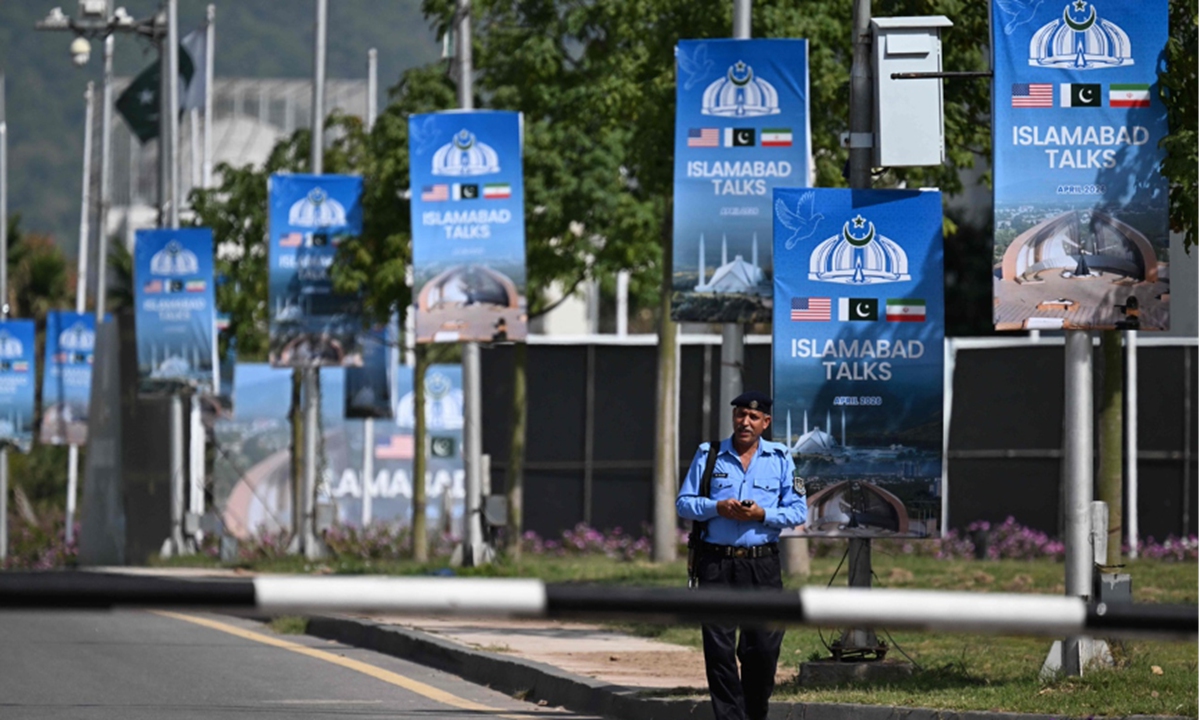
A security personnel walks along a closed road near the Serena Hotel at the Red Zone area in Islamabad on April 21, 2026, amid heightened security measures ahead of US-Iran peace talks. Photo: VCG
US President Donald Trump claimed Tuesday that he will extend the ceasefire with Iran, as the current two-week truce is due to expire on Wednesday night. The move was described by The New York Times as striking a "starkly different tone" from his remarks earlier Tuesday, when he threatened military action if Iran did not agree to US demands.
When asked about China's reaction to US President's extended ceasefire with Iran and whether Chinese diplomacy played a role in extending the ceasefire, Guo Jiakun, spokesperson for China's Foreign Ministry, said on Wednesday that the current situation in the region is at a critical stage of whether the conflict can end. The pressing priority is to prevent by all means a relapse in fighting.
China supports relevant parties in continuing the political and diplomatic effort to resolve disputes with the aim of realizing a full and lasting ceasefire and keeping the Middle East and Gulf region peaceful and stable. China stands ready to act in the spirit of the four-point proposition put forward by President Xi Jinping and work with the international community to play an active and constructive role to this end, said Guo.
A Chinese expert said the US-Iran standoff has long revolved around ceasefire arrangements, creating a broader strategic deadlock, and that future rivalry will likely center on the Strait of Hormuz.
"Based on the fact that the Government of Iran is seriously fractured, not unexpectedly so and, upon the request of Field Marshal Asim Munir, and Prime Minister Shehbaz Sharif, of Pakistan, we have been asked to hold our Attack on the Country of Iran until such time as their leaders and representatives can come up with a unified proposal," Trump wrote on Truth Social.
Trump claimed he will "extend the ceasefire until such time as their proposal is submitted, and discussions are concluded, one way or the other." The US military will continue the blockade against Iran and "remain ready and able, the president claimed.
Trump's announcement was a marked departure from his comments earlier in the day, when he told CNBC that if Iran did not agree to US demands, "I expect to be bombing," according to the New York Times. It said this was a "starkly different tone."
In an interview with Bloomberg on Monday, Trump claimed that it is "highly unlikely" that he extends the ceasefire if a deal is not reached before the deadline, according to the ABC News.
Washington's shifting remarks is more like tactical adjustments, reflecting the current administration's diplomatic style of responding to evolving circumstances, Wang Jin, a professor at the Institute of Middle Eastern Studies at Northwest University in Xi'an, told the Global Times on Wednesday.
The US stance on whether to extend the ceasefire has also been shaped by shifts in Iran's own posture. In Washington's view, Tehran's position has been inconsistent, with hardliners opposing further talks and more pragmatic voices calling for dialogue. As a result, the US has adjusted its messaging in response to signals from Iran, while also weighing risks in the Strait of Hormuz and the broader regional security environment.
US Vice President JD Vance, whose trip to Pakistan for talks with Iran has been put on hold, was at the White House for meetings on Tuesday, along with Trump's envoy Steve Witkoff and son-in-law Jared Kushner, multiple media outlets reported.
US Secretary of State Marco Rubio and Secretary of Defense Pete Hegseth arrived at the White House on Tuesday afternoon to join discussions over Washington's next steps, according to the reports.
In response to the ceasefire extension announcement, an adviser to Mohammad Bagher Ghalibaf, the influential speaker of the Iranian Parliament, wrote on X on Wednesday that "the extension of the ceasefire by Donald Trump has no meaning. The losing side cannot set the terms. Trump's ceasefire extension is certainly a ploy to buy time for a surprise strike. The time for Iran to take the initiative has come."
Secretary General António Guterres of the United Nations on Tuesday welcomed the extension of the ceasefire between Iran and the US, saying that the ceasefire extension was "an important step toward de-escalation" that will create "critical space for diplomacy and confidence-building between Iran and the United States," according to his spokesman, Stephane Dujarric, AFP reported.
Wang said he sees less risk of renewed escalation, but the main focus of future rivalry will shift to the Strait of Hormuz, where the US is likely to maintain pressure by intercepting Iranian or Iran-linked vessels, while Iran will try to tighten control over shipping routes and use that leverage to offset losses from economic sanctions.
RELATED ARTICLES