ARTS / CULTURE & LEISURE
Chinese-led team uncovers oldest known body fossils of ringed worms
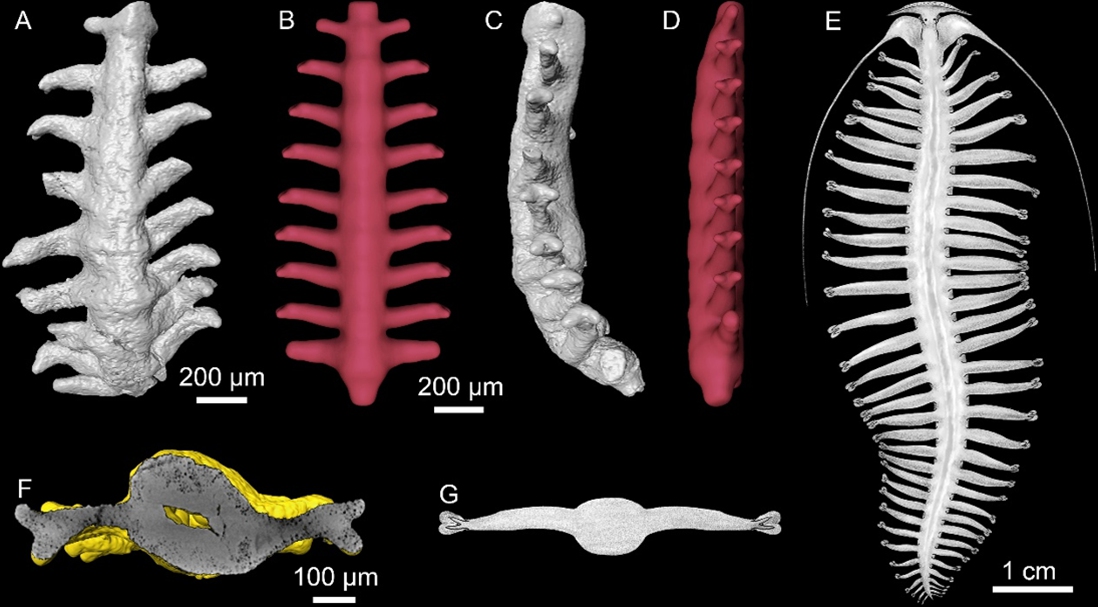
Comparison between Zhangjiagoivermis longicruris (A-D, F) and Tomopteris (E, G). Photo: Courtesy of Zhang Huaqiao of the Nanjing Institute of Geology and Palaeontology
An international research team led by Chinese scientists has discovered the oldest known body fossils of annelids, extending the evolutionary record of a major animal group by more than 10 million years to 535 million years ago, according to the Nanjing Institute of Geology and Palaeontology of the Chinese Academy of Sciences (NIGPAS).
The findings come from fossils uncovered in the Kuanchuanpu formation in Northwest China's Shaanxi Province. The site dates to about 535 million years ago, the earliest stage of the Cambrian Period, a critical interval when most major animal groups first appeared and rapidly diversified.
The study was published in the Proceedings of the National Academy of Sciences of the United States of America on Tuesday. It describes seven tiny fossil specimens that preserve the internal molds of ancient worms through phosphate mineralization.
Annelids, also known as ringed worms, are among the most species-rich and ecologically widespread groups of animals on Earth, including familiar organisms such as earthworms and leeches. They have soft bodies without mineralized bones or shells and rarely fossilize, making their early evolutionary history difficult to reconstruct. Prior to this discovery, the oldest confirmed annelid body fossils were bristle worms and sipunculans dated to about 518 million years ago.
The newly identified fossils are only a few millimeters long but display clear segmentation along their bodies, a defining characteristic of annelids. Each body segment bears paired appendages, or parapodia, which in modern relatives are used for movement and respiration.
Under high-powered microscopy, researchers observed that the appendages in these ancient species ended in bifurcated, leaf-like structures.
Two species are distinguished based on the relative length of their appendages.
The former species has relatively short appendages similar to modern nereids. The latter one closely resembles fossil and extant tomopterids in their relatively long appendages. Based on their different morphologies, researchers infer that the former species likely crawled across marine sediments in search of food, as in modern nereids, whereas the latter one may already have been capable of swimming in the water column, suggesting a swimming lifestyle and representing the earliest known semi-pelagic annelid.
These findings indicate that annelids had already acquired a polychaete-like body plan in the Fortunian and that early members of the clade had diverged from their living sister group and differentiated into forms with both short and elongate parapodia by the Fortunian Age, according to the paper.
"These fossils provide a rare and direct window into the earliest phase of annelid evolution," Zhang Huaqiao, the leading researcher involved in the study and also a member of NIGPAS, told the Global Times. "They show that even at this early stage, these animals had already diversified in body forms and lifestyles."
These represent the oldest known body fossils of annelids in the Phanerozoic and suggest that the earliest Cambrian annelids may have differentiated into polychaete morphologies and that annelids may have had an evolutionary history prior to the Cambrian explosion.
The discovery not only fills a gap in the earliest evolutionary history of annelids but also suggests that the group had already diversified during the earliest Cambrian, evolving both bottom-dwelling and swimming lifestyles.
"This study shows that as the curtain was just rising on the Cambrian explosion, animals were already experimenting with a range of survival strategies," noted Zhang. "These seemingly inconspicuous ancient worms, transitioning from simple forms to more specialized ones, from crawling to swimming, laid an important foundation for the later development of complex and diverse marine ecosystems."
RELATED ARTICLES