Japanese lower house approves bill to establish 'national intelligence committee'; Move reflect expanding centralized power, surveillance risks and rightward shift: Chinese expert
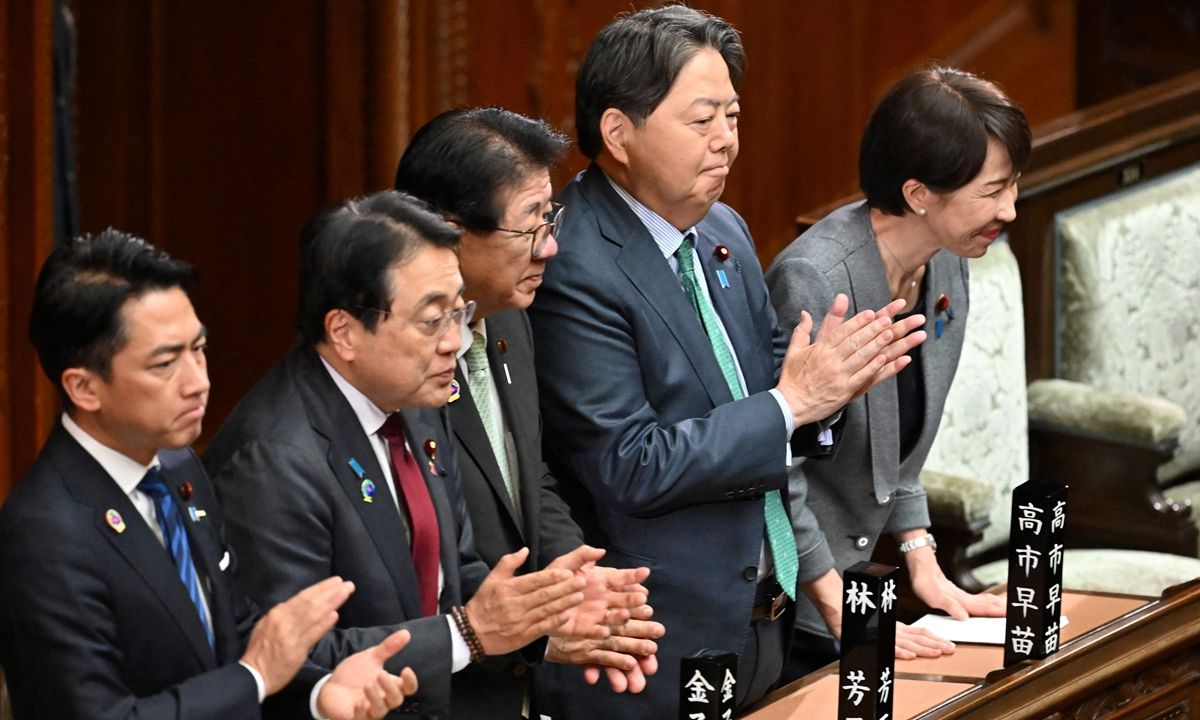
Japan's Prime Minister Sanae Takaichi (Right) and her cabinet ministers react after the government's bill to establish a national intelligence committee was passed by a majority vote of both ruling and opposition parties during a plenary session of the House of Representatives in Tokyo on Thursday April 23, 2026. Photo: VCG
A set of related bills aimed at strengthening the Japanese government's intelligence (information gathering and analysis) functions was approved by a majority of both ruling and opposition parties at a plenary session of the House of Representatives on Thursday, the Asahi Shimbun reported on Thursday.In Japan, worries are mounting that the bill could erode privacy rights and freedom of expression. A Chinese expert said that the move reflects a broader push to centralize power under the Japanese prime minister and carries potential risks of expanded surveillance and a continued rightward shift in Japan's political landscape.
With support from some opposition parties, the bills are expected to pass the House of Councillors as well, where the ruling bloc is in the minority, according to the Asahi Shimbun.
The enactment of the bill is expected before the current parliamentary session ends in mid-July, according to The Mainichi.
The legislation calls for the establishment of a "national intelligence committee," composed of the prime minister and Cabinet ministers to serve as the decision-making body, and a "national intelligence bureau" to handle operational duties. Acting as a central command hub for intelligence organizations spanning multiple ministries and agencies, including the National Police Agency and the Ministry of Foreign Affairs, it aims to enable more consolidation and analysis of information, thereby supporting more accurate government policy decisions related to national security, per the Asahi Shimbun.
The objective of these measures, domestically, is to strengthen the concentration of power in the hands of the prime minister by creating a vertically integrated intelligence system. Functions that were previously dispersed across multiple ministries and agencies would be unified under a centralized structure. Another key aim is to align and integrate Japan's intelligence framework more closely with those of Western countries, particularly the US and its allies, including the Five Eyes intelligence network, Xiang Haoyu, a distinguished research fellow at the China Institute of International Studies, told the Global Times on Thursday.
The expert said that concerns persisted that expanded intelligence powers could lead to greater surveillance of personal data and be used for political purposes, including suppressing dissent or targeting opposition forces.
According to Japanese media reports, Prime Minister Sanae Takaichi has long advocated strengthening intelligence capabilities. However, concerns that the legislation could lead to infringements on privacy rights and freedom of expression are continuing to grow in Japan.
The Tokyo News reported on Thursday that concerns have repeatedly been raised that the legislation could lead to enhanced surveillance of the public in the course of intelligence activities, infringe on the privacy of individuals subject to investigation, and deviate from political neutrality.
However, amendments sought by the opposition, proposed by the centrist Reform Alliance to stipulate respect for personal data and privacy as well as the assurance of political neutrality, failed to materialize, with efforts limited to the adoption of a supplementary resolution calling for due consideration. As such resolutions carry no legal binding force, it remains unclear whether these concerns will be adequately addressed.
The Yomiuri Shimbun reported on Wednesday that concerns have been raised over the bill that it could lead to excessive surveillance by intelligence agencies and that increased involvement of politicians might undermine the political neutrality of those agencies.
Another major impact, externally, is that Japan's current foreign policy has shown a tendency to shift pressure outward, with its focus directed toward neighboring countries, Xiang said. Its relations with nearby countries, including China, Russia remain strained. In this context, future intelligence collection and analysis, as well as monitoring of online public opinion and efforts in overseas intelligence, counter espionage and anti-infiltration, are likely to be also oriented toward Japan's neighboring countries.
An article released on April 17 on the official website of Japan's Social Democratic Party said that the first major risk of the bill lies in the very nature of "intelligence," which is inherently intertwined with military activities. Strengthening intelligence-gathering systems, including espionage, could lead to expanded surveillance of citizens and pose a threat to privacy. The second risk is the difficulty of ensuring transparency.
According to the article, during deliberations on the bill, Takaichi claimed that while disinformation campaigns by foreign actors would fall within the scope of investigation, the activities of civic groups with no links to foreign forces would not. However, it remains questionable whether such a strict distinction can truly be maintained.
The Social Democratic Party has opposed what it describes as a dangerous bill to establish a national intelligence committee and has pledged to make every effort to have it scrapped, according to the article.
Xiang noted that during the era of Japanese militarism, particularly in World War II, intelligence and security agencies such as the Special Higher Police and operations linked to the South Manchuria Railway Company were involved in intelligence gathering and infiltration activities, including in Northeast China. In Japan, these systems were also used to monitor and suppress public speech and political tendencies.
Amid what is widely seen as a pronounced rightward shift in Japanese society, the bill was able to pass despite widespread concerns and skepticism, reflecting the broader rightward trend in the country's political and social landscape, Xiang said.
RELATED ARTICLES