Tokyo reportedly plans to resume Japanese military ranks including 'Taisa'; move exposes dangerous political ambitions and military expansionist motives: Chinese expert
By and Published: Apr 26, 2026 09:14 AM


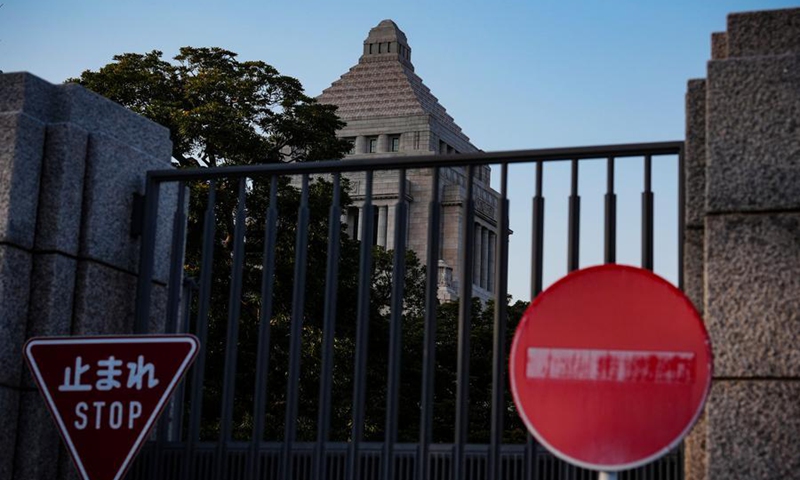
This photo taken on Jan. 19, 2026 shows a view of the National Diet Building in Tokyo, Japan. (Xinhua/Jia Haocheng)
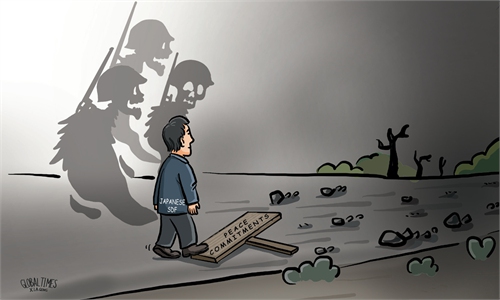
In another move that shows the revival of Japanese militarism, the Japanese government reportedly is moving closer toward changing the rank titles of Self-Defense Force (SDF) officers to resemble those of the military, which will stir concern from regional countries.
According to the Yomiuri Shimbun on Saturday, the Japanese government plans to submit a revised Self-Defense Forces Act to the Diet within this year, focusing on altering the rank titles of SDF officers. This is the first change to SDF rank titles since its establishment in 1954. The Japanese government cited the need for international standardization.
The existing SDF rank system comprises 16 gradations spanning from the highest flag officer positions down to entry-level enlisted personnel, according to globalsecurity.org.
Under the proposed revision, the title of chief of staff, a four-star general who respectively commands the Ground, Maritime and Air Self-Defense Forces, will be changed to "Taishō," and other flag officers will be changed to "Chūjō," according to the Yomiuri Shimbun.
"1-sa," equivalent to colonel, will be changed to "Taisa," while "2-sa" and "3-sa," equivalent to lieutenant colonel and major, will be changed to "Chūsa" and "Shōsa," and "1-i," equivalent to captain, will be changed to Tai-i.
The titles of "sō" (non-commissioned officers) and "shi" (regular soldiers) will remain unchanged.
"The title of Taisa has long stood as a symbol of Japanese militarism. The current Japanese administration's deliberate push to reinstate Taisa and other obsolete Imperial Japanese military ranks exposes dangerous political ambitions and military expansionist motives, which demand close vigilance from all Asian nations and the international community," Zhang Junshe, a Chinese military affairs expert, told the Global Times on Saturday.
The Japanese government's move has triggered attention and discussions in the media and public opinion spheres in Asia, a region hurt immensely by Japan's war of aggression eight decades ago.
South Korean media outlet Chosun Biz ran an article on Saturday titled "Japan moves to militarize SDF ranks, stoking fears of war-capable shift." The Chosun Daily, citing critics, said that this move is a step toward gaining official recognition of the Self-Defense Forces as a formal military.
Criticism as well as concerns have also been expressed on social media. A Japanese netizen commented on X, "This is something that the current Takaichi administration is pushing forward somewhat unilaterally, and it does not represent the will of the people." Another Japanese netizen wrote, "The Takaichi cabinet is too strongly focused on returning to the pre-war era and militarism; it's impossible."
Meanwhile, a Chinese Weibo user commented, "It is a blatant revival of the militaristic fascist system!"
"This move fully demonstrates that the current Japanese government lacks reflection on its militarist history and instead takes pride in militarist symbols rather than feeling ashamed of them. It also exposes the ugly face of historical revisionism," Xiang Haoyu, a distinguished research fellow at the China Institute of International Studies, told the Global Times on Saturday.
The planned revision of the Japanese SDF's rank designations is a political attempt by Tokyo aimed at completely shedding its "self-defense armed forces" positioning and seeking the status of a regular military, the scholar noted.
Judging from the way the Japanese government plans to implement this rank adjustment, it also reveals a guilty conscience and calculated scheming, the scholar added.
In November last year, news surfaced as several Japanese officials stated that Japan is planning to revise the ranks of the SDF and intends to restore the use of terms like "Taisa" from the Imperial Japanese Army. Chinese Foreign Ministry spokesperson Mao Ning warned that right-wing forces in Japan are making every effort to break free from the constraints of the pacifist constitution and are going further down the path of military expansion.
The Chinese spokesperson said that we must never allow the revival of Japanese militarism, never allow anyone to challenge the post-war international order, and never allow the peace and stability of the world to be undermined again.
RELATED ARTICLES