BUSINESS / PRESS RELEASE
Chinese robotics firm MagicLab unveils its latest world model and global ambitions at Silicon Valley tech summit
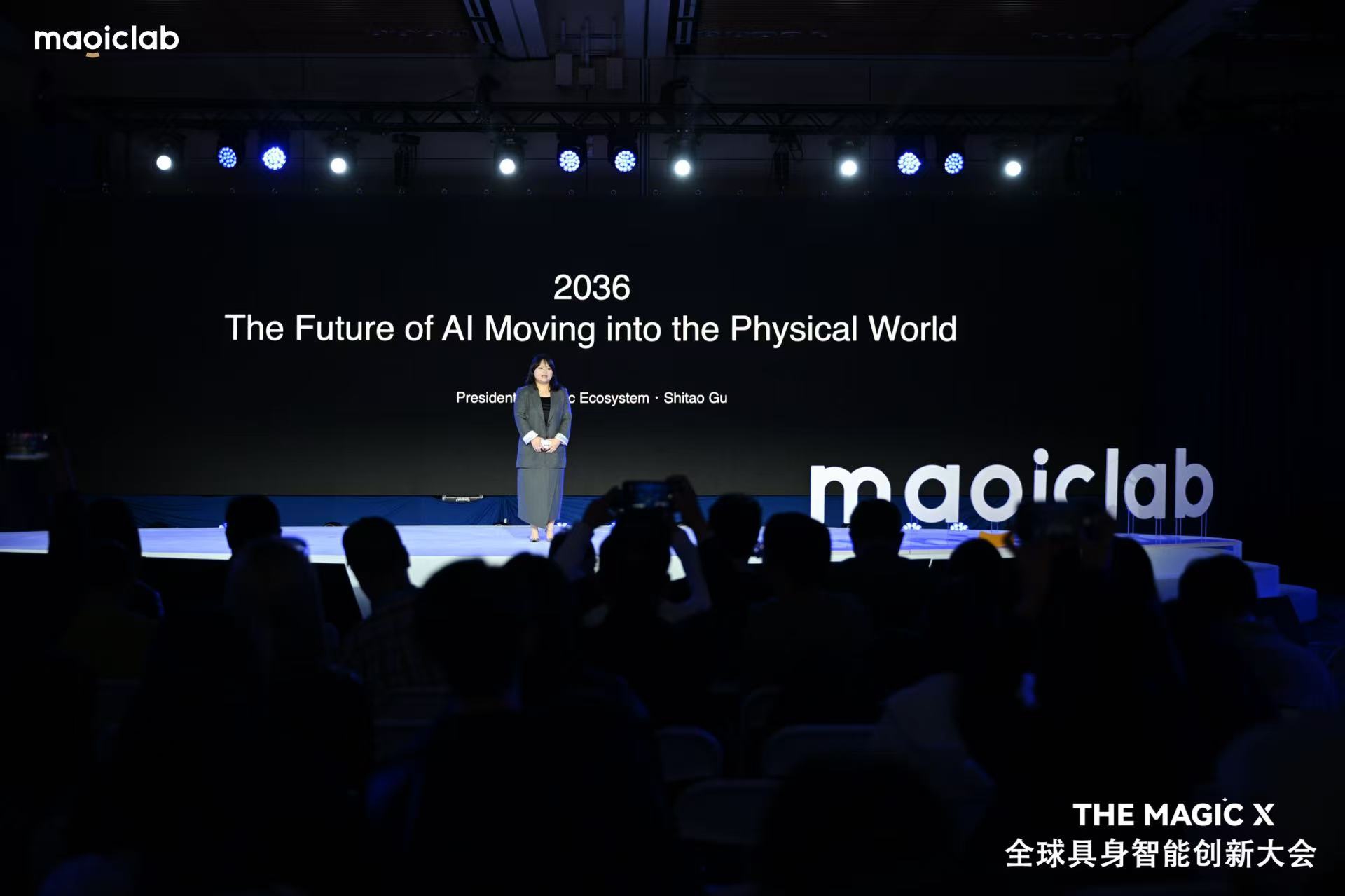
Gu Shitao, president of MagicLab Photo: Courtesy of MagicLab
The Global Embodied Intelligence Summit (GEIS), initiated by Chinese embodied AI company MagicLab, opened in Silicon Valley on Tuesday local time. As one of the first global high-level summits in the sector, the event featured a series of cutting-edge technology releases and forward-looking dialogues on embodied AI, highlighting MagicLab’s ambitious development plans in the field over the next decade, positioning itself as a representative of China’s intelligent manufacturing startups.
One of the core technology launches at the summit was MagicLab’s self-developed world model, Magic-Mix, which consists of WAM, the decision engine, and Creator, the data engine. The two operate in close coordination, forming a dynamic closed-loop system in which generated data is used for training and feedback drives continuous evolution.
To address challenges in robot data collection, MagicLab has built a large-scale training data pool. Gu Shitao, president of MagicLab, said at the GEIS that the company collects about 16,000 data entries per day, with its high-quality dataset exceeding 1 million hours. Magic-Mix Creator can generate synthetic data in batches, reducing reliance on real-machine data collection while ensuring a stable supply of high-quality training data for large models.
On the training side, Magic-Mix adopts a collaborative approach combining video and motion, addresses issues such as cumulative task errors and deviations in physical cognition in open environments through multiple innovative designs. The coordination of the two modules gives robots both cognitive and physical capabilities, enabling millisecond-level responses to complex scenarios.
The launch of the Magic-Mix world model strengthens MagicLab’s technological foundation in the core intelligence of robotics, aiming to build full-chain autonomous capabilities and empower intelligent operations across industrial, service, and home scenarios, the company said.
In terms of latest hardware products, MagicLab unveiled its advanced H01 dexterous hand and its flagship humanoid robot, MagicBot X1, designed for seamless integration into real-world applications.
The MagicHand H01 dexterous hand features 20 degrees of freedom, replicating the flexibility of human hand movements. Equipped with 44 sets of high-precision tactile sensors, it can accurately detect subtle force variations and perform more delicate operations.
The product also demonstrates strong perception and safety capabilities, enabling predictive motion to reduce operational errors. With millimeter-level closed-loop response, it can react quickly under high-speed motion, ensuring safe human-robot collaboration and suitability for close-range interaction scenarios such as industrial production and healthcare services.
The flagship humanoid robot MagicBot X1 stands 180 centimeters tall and weighs 70 kilograms, with a maximum joint torque of 450 N·m. Its overall motion speed has improved by more than 30 percent, while its 31 active degrees of freedom increase its range of motion by over 50 percent compared with the MagicBot Gen 1, a previous model, enabling it to handle more complex and highly dynamic scenarios.
MagicBot X1 is equipped with a dual-battery system enabling virtually unlimited endurance, ensuring 24/7 continuous operation. The product is available in standard and research editions: the former emphasizes out-of-the-box usability and efficient commercial deployment, while the latter is designed for universities, laboratories, developers, and industry partners, supporting low-level secondary development and customizable configurations.
In addition to debuting cutting edge technological achievements, the GEIS brought together leading global scholars as well as representatives from enterprises, governments, and the investment community, attracting more than 1,000 AI practitioners, developers and investors.
Actor, singer and music producer Zhang Yixing, also known as Lay Zhang, was invited to attend as a representative of Chinese youth, engaging in in-depth discussions on global frontier technologies, while also promoting Chinese culture.

Zhang Yixing, also known as Lay Zhang Photo: Courtesy of MagicLab
Former San Francisco mayor Willie Brown shared insights on the transformative impact of embodied intelligence on production and daily life, while Turing Award laureate Martin Hellman delivered a keynote speech analyzing the challenges of building safety, reliability and trust systems for deploying robots in the physical world.
Notably, alongside the newly released world model and robotic hardware products, the summit also hosted two thematic forums, examining the core technological pathways of embodied intelligence from the perspectives of the “body” and the “brain.” Representatives from leading global AI companies, including MagicLab, Nvidia, Amazon and OpenMind, shared their perspectives during the discussions.
Founded in January 2024, MagicLab served as a strategic partner for intelligent robots at the 2026 Spring Festival Gala. During one of the most-watched annual events in February this year, the company’s quadruped robots, dressed in special costumes, mimicked giant pandas at the Yibin sub-venue in Southwest China’s Sichuan Province, while its humanoid robots performed alongside human dancers, drawing worldwide attention.
Since 2025, the company has accelerated its overseas expansion, with its business now covering 50 countries and regions, and overseas revenue accounting for more than 60 percent of the total. By hosting the GEIS in Silicon Valley, the company is leveraging its global partner network to redefine the embodied AI paradigm.
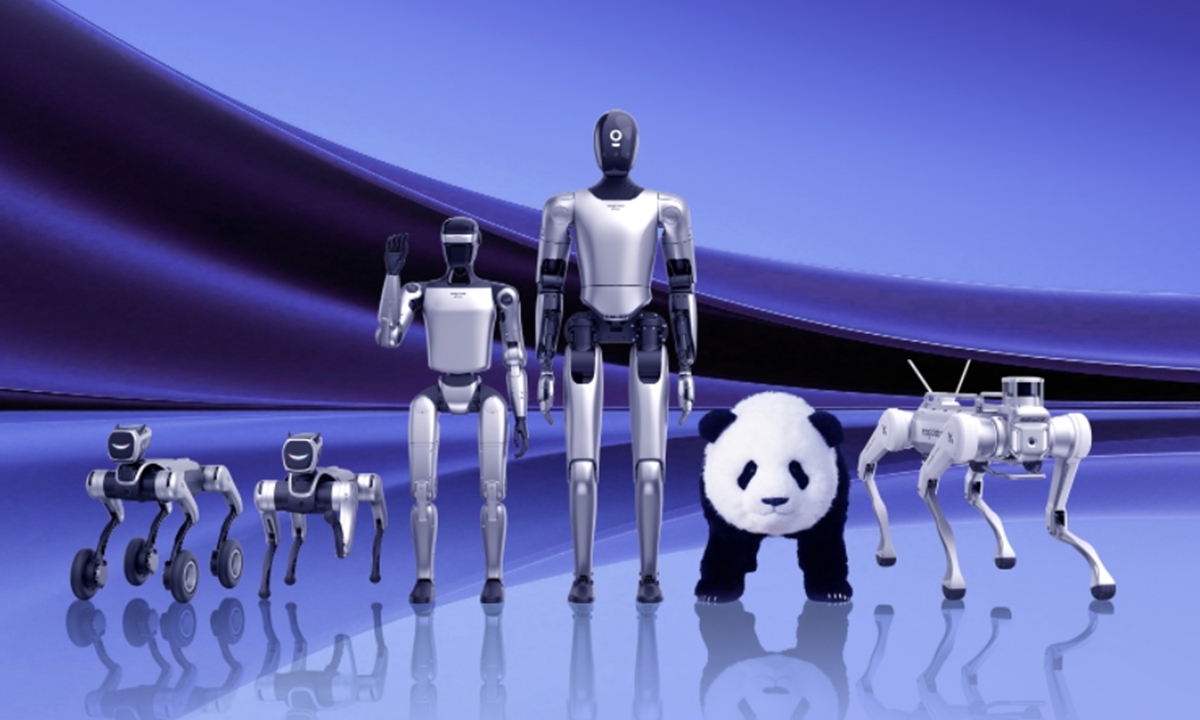
Photo: Courtesy of MagicLab
In the field of robotic applications, MagicLab has established a diversified portfolio of solutions spanning nine key scenarios, including healthcare services, industrial manufacturing, inspection and security, smart guidance, public safety, smart logistics, events and entertainment, scientific research and education, and home living.
At the GEIS, Gu, MagicLab’s president, announced the company’s long-term growth trajectory, projecting a pathway toward $14 billion in annual revenue by 2036 driven by the mass commercialization of embodied AI.
Under its “Co-Create 1000 Initiative,” the company has entered strategic collaborations with Silicon Valley-based AI companies, including Openmind, PrismaX AI, Cosmicbrain AI, and Physis. Over the next five years, MagicLab plans to invest $1 billion to build a dedicated developer ecosystem for robotics, enabling further development and fostering a global network of partners and developers.
