ARTS / CULTURE & LEISURE
Chongqing-set thriller ‘Vanishing Point’ becomes May Day box-office dark horse
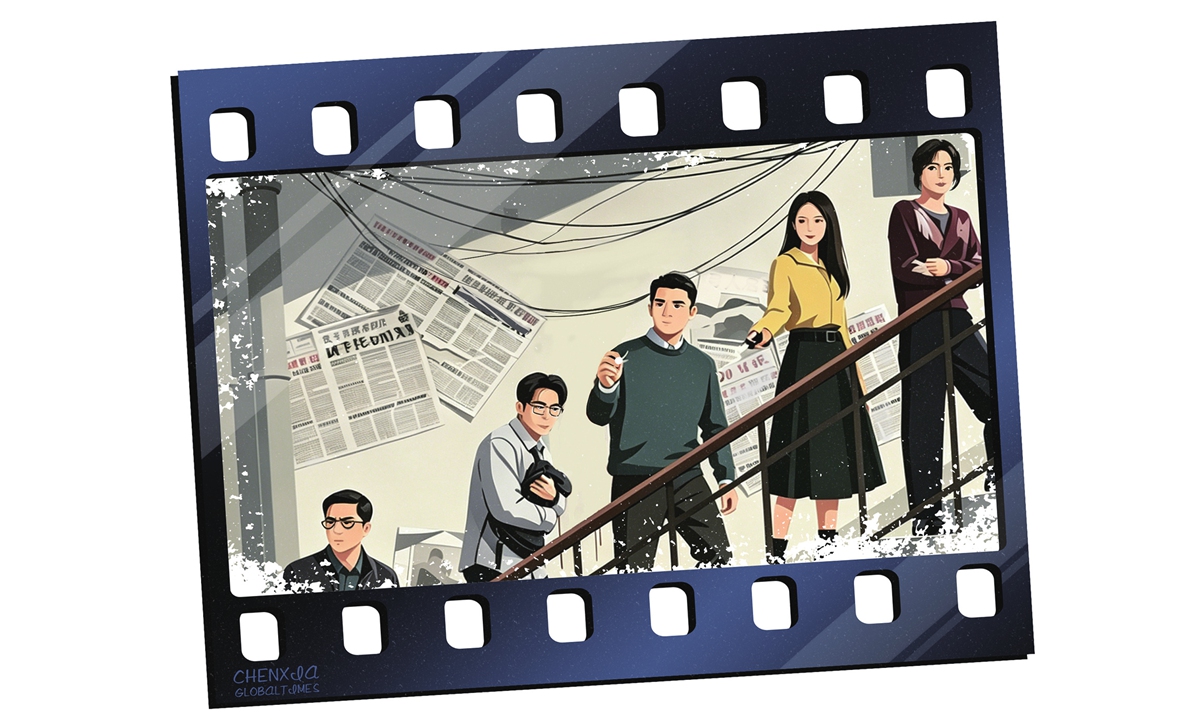
Illustration: Chen Xia/GT
Fog lingers along the riverbanks, softening the city's layered skyline where residential blocks rise unevenly across the hills. Inside one aging apartment building, a series of intertwined crimes gradually unfolds, not as a spectacle set in an unfamiliar world, but as part of the ordinary urban environment in Southwest China's Chongqing Municipality.This setting forms the narrative foundation of Vanishing Point, a surprise box-office leader during the five-day May Day holidays. As of Tuesday, the movie had garnered more than 260 million yuan ($38 million) at the box office. On Chinese review platform Douban, the movie opened with a 7.7/10 rating, placing it above several higher-profile releases in the same period and marking one of the stronger recent performances for a May Day thriller.
Experts noted that in recent years, Chinese suspense films, including Chen Sicheng's Detective Chinatown series, have made significant progress, though innovation still needs to be strengthened. By filming in familiar domestic settings while developing its own stylistic approach, Vanishing Point reflects both ongoing experimentation and broader efforts to advance the genre in China.
According to Shi Wenxue, a Beijing-based movie critic, the movie's success has been driven by a combination of factors, including strong intellectual property recognition, sustained word-of-mouth and its use of a recognizable domestic setting.
Adapted from a well-regarded novel and television series, the movie benefits from an established audience base. Its strong ratings and rapid box-office rise reflect a favorable early reception, while its three intertwined storylines create a form of "everyday suspense" that resonates with viewers. Strong performance in lower-tier cities, combined with nationwide promotional campaigns, further expanded its reach and visibility, said Shi.
Shi also noted that the movie's success is closely linked to its use of a recognizable domestic setting. In his view, situating the story in a familiar Chinese city helps avoid the "floating" or detached quality often associated with earlier crime thrillers influenced by stylistic Southeast Asian settings.
Some domestic crime movies in recent years, despite possessing strong graphic intensity, have lacked narrative depth, leading to audience fatigue. By contrast, this movie's grounding in everyday settings gives its suspense a more tangible credibility, he added.
Set against Chongqing's misty riverside geography and dense hillside housing, the movie's suspense is not constructed through distance or spectacle, but through the recognition that ordinary urban life already contains enough complexity to sustain unease.
Directed by Cheng Wei-hao and starring Zheng Kai, Liu Haocun, and Roy Chiu, the movie relies heavily on spatial storytelling rather than exposition-heavy explanation.
Structured around three parallel storylines, the narrative follows a missing child case, an assault on a woman living alone, and a gambler who hides a corpse in order to continue fraudulently collecting a pension. At the beginning of the movie, each storyline unfolds independently, without immediately indicating how they will eventually connect. However, as the narrative progresses, the movie ultimately brings these threads together in a coherent and convincing way.
Technically speaking, the movie is carefully constructed. Its cinematography frequently uses tight framing and restrained lighting to emphasize enclosure. The camera often remains close to doorways, corridors and interior thresholds. The sound design is also deliberate, relying on sudden noise, muffled movement and stretches of silence to build tension.
However, the movie is not without limitations. At roughly 140 minutes, its pacing is uneven, particularly in the first half. The resolution holds together coherently, but it lacks the surprise the movie seems to aim for, with much of the reveal feeling anticipated rather than discovered.
Even so, Vanishing Point reflects ongoing efforts within China's suspense genre. Sun Jiashan, an associate research fellow at the China National Academy of Arts, told the Global Times that Chinese suspense films have long faced a shortage of innovation, such as Chen's earlier Detective Chinatown series. As a result, Chen has developed considerable experience in refining and adapting suspense storytelling, and remains among the few directors in China's film market in recent years to achieve strong box-office results in the genre.
Sun added that Chen's Lost in The Stars represents a set of recent efforts and explorations in the evolution of China's suspense cinema. But now Vanishing Point goes further in certain respects, particularly in its narrative construction and its decision to situate the story in a familiar domestic setting.
The May Day lineup may be only a prelude. Some upcoming suspense titles are poised to test a broader question: How far is the ceiling for the genre in China's market? As competition shifts from headline-driven gimmicks to structural storytelling, and from emotion-led consumption to narrative-driven craft, the strongest phase for domestic suspense cinema may only just be beginning.
The author is a reporter with the Global Times. life@globaltimes.com.cn
RELATED ARTICLES