SPORT / SOCCER
China's U17 Asian Cup setback exposes flaws in youth football system
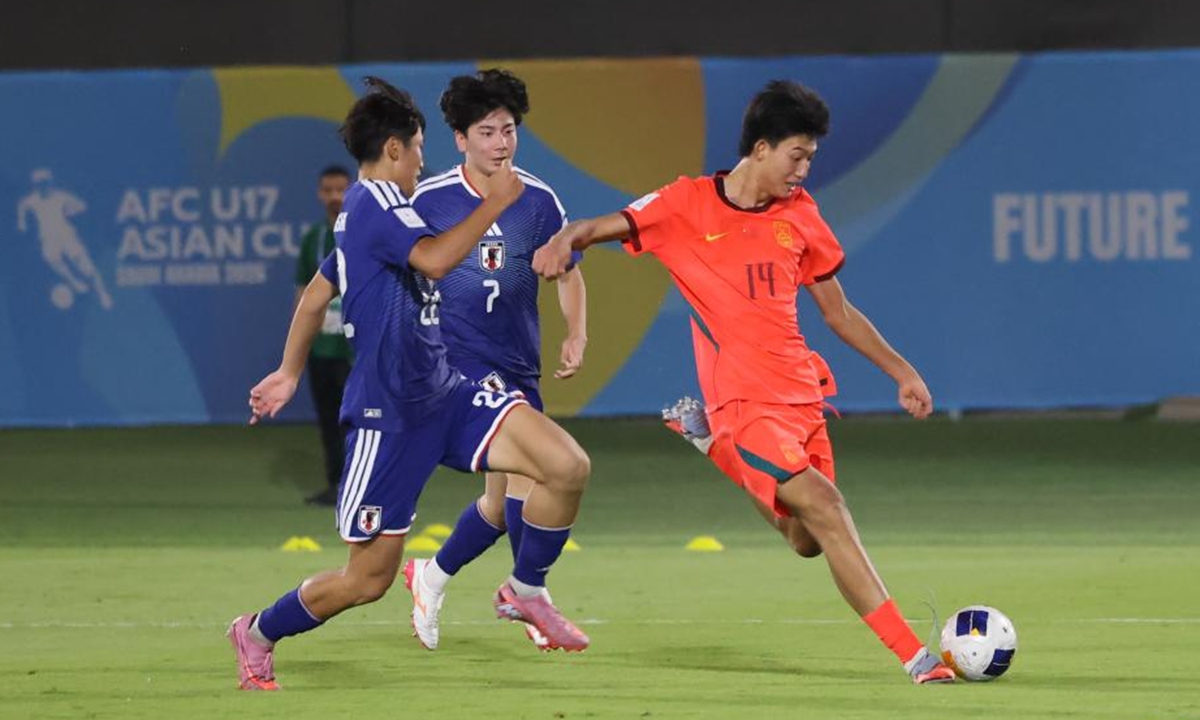
Zhao Songyuan of China (right) shoots during the group match between China and Japan at the 2026 AFC U17 Asian Cup in Jeddah, Saudi Arabia, on May 9, 2026. Photo: Xinhua
China's highly anticipated U17 national football team finds itself on the brink of elimination after two consecutive defeats at the AFC U17 Asian Cup - a crushing turn that turned a promising campaign into yet another sobering lesson for Chinese football.After a 1-0 loss to Indonesia in its opener, the Chinese team fell again in its second group-stage match - this time to Japan - leaving the team in a precarious position ahead of the final round.
China now needs a combination of results to keep its hopes alive for the FIFA U-17 World Cup, which is awarded to the teams reaching the knockout stage.
The mathematical possibilities remain, but the broader issue runs much deeper than one disappointing tournament.
For many years, Chinese national teams at various age levels have relied on an intensive centralized training model. Players are assembled months in advance for extended camps, with the expectation of building chemistry and tactical discipline. This approach has occasionally produced respectable short-term results, but its limitations have become increasingly apparent.
The core problem is that long training camps cannot replicate the demands of real competition.
Modern football is shaped by match rhythm, decision-making under pressure, and repeated exposure to high-intensity opposition. Players improve most when they are competing regularly in meaningful club matches, not when they spend weeks isolated from domestic league action.
China's U17 team appears to be another example of this structural weakness.
Many of the selected players entered the national team setup without having established stable playing time at their clubs. Some had limited experience in competitive matches and had not been consistently tested against strong opposition. Once they stepped onto the continental stage, the gap in tempo and physicality became evident.
Training together for months may help football players understand a coach's tactics, but it does not guarantee the instinctive understanding required during matches. Timing of runs, awareness of teammates' habits, and split-second decisions are forged in repeated competitive games, not simply through rehearsed drills.
This has long been a paradox in Chinese football: The national team seeks cohesion by removing players from the very competitive environments that are essential for their development.
The contrast with Asia's leading youth football nations is striking.
Asia's leading team, Japan, places far greater emphasis on domestic competition and player autonomy. Young players are expected to earn their places through consistent performances in league and academy matches. Selection is often based on current form rather than early projections or extended camp participation.
As a result, these teams arrive at major tournaments with players who are battle-tested and accustomed to making decisions under real pressure.
China, by contrast, still appears overly reliant on administrative preparation and too hesitant to trust the developmental value of competition itself, which is why the current predicament feels so familiar.
The Chinese U17 team's final group match against Qatar will determine whether this generation can keep their dream alive. Depending on other results, China may need to defeat Qatar by at least two goals to secure qualification outright. Even a one-goal win could leave the team relying on results elsewhere, a position no coach wants to be in.
Youth tournaments should not be judged solely by results. Players are still developing, and setbacks are part of the process. But when similar shortcomings emerge time and again, they point to systemic issues rather than isolated failures.
Chinese football has invested heavily in youth development over recent years. Facilities have improved, academies have expanded, and more young players are receiving professional coaching. These are meaningful steps. But infrastructure alone is not enough.
The most effective development tool remains regular, high-quality competition. Young players need to earn their places through league performances, face stronger opponents consistently, and grow within an environment where form matters more than reputation.
If China truly wants to close the gap with Asia's best, it must trust the game itself. No amount of centralized preparation can substitute for the lessons learned on the pitch.
The U17 team may still have one final chance to rescue its tournament. But the larger challenge for Chinese football lies in ensuring that future generations do not enter major competitions underprepared. In football, as in development, the surest path forward is to keep control in your own hands.
The author is a reporter with the Global Times. life@globaltimes.com.cn
RELATED ARTICLES