Passengers begin evacuating from hantavirus-hit cruise ship at Canary Islands; WHO advises 42-day early symptom surveillance in response to GT
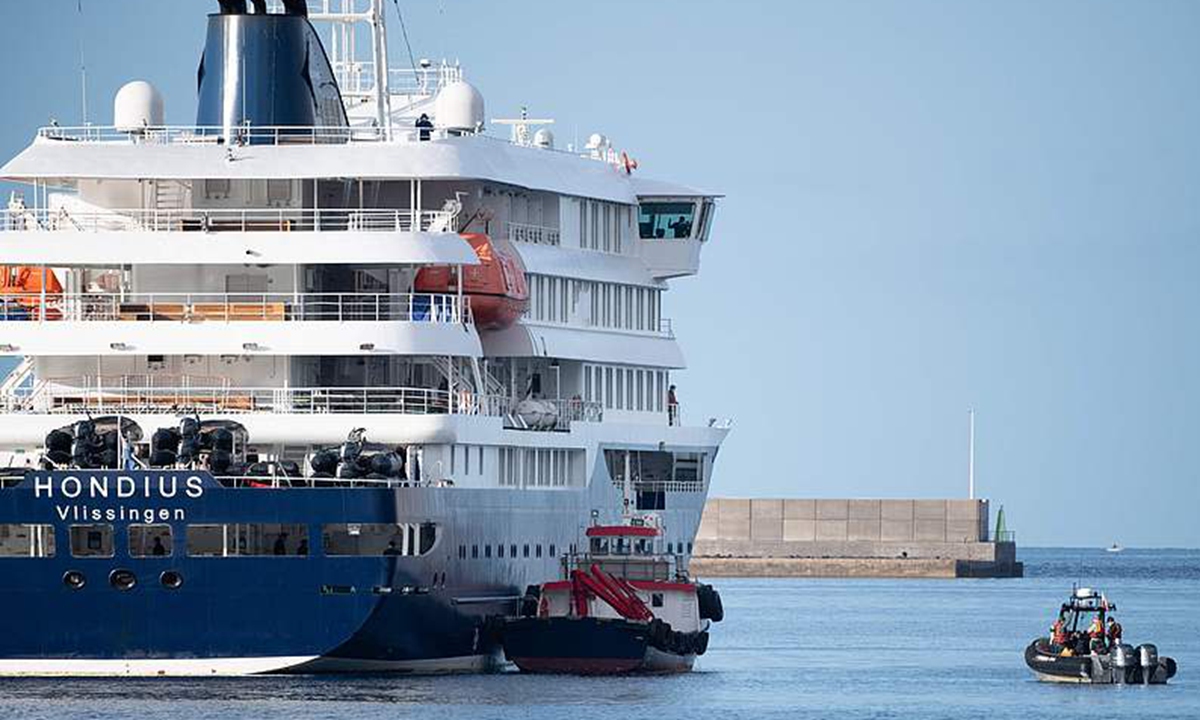
Boats approach the Dutch flagged hantavirus-stricken cruise ship MV Hondius on May 10, 2026. Photo: VCG
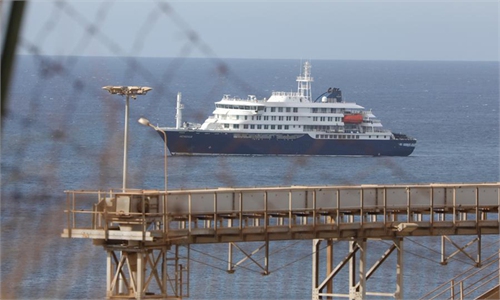
A cruise ship hit by a deadly hantavirus outbreak finally arrived off Spain's Canary Islands on Sunday, with the evacuation now began and health officials boarding the boat to conduct a final check and begin disembarking passengers. As Spain steps in to take in the vessel, the procedures are shadowed by widespread international attention and lingering concerns.
The World Health Organization (WHO) had thanked Spanish Prime Minister Pedro Sanchez for the country's decision to receive the ship MV Hondius. Meanwhile in response to a Global Times inquiry on the latest developments, the WHO did not give a direct answer, but stated in its response that people on board the affected ship and flights should be monitored for early symptoms for 42 days after their last potential exposure to hantavirus.
A report issued by Spain's Health Ministry before the cruise ship docked in Tenerife confirmed the ship had cleared the appropriate health checks before laying anchor, according to Reuters. Passengers will board a flight back to Madrid on a Spanish military plane, government officials said, emphasizing that they will have no contact with members of the public.
However, the situation has continued to capture international attention as some passengers had disembarked and dispersed across multiple countries before the hantavirus outbreak was fully understood, prompting some to draw comparisons to the early days of the COVID-19 pandemic, per CNN.
The WHO and officials from various countries have stressed that the public health risk from hantavirus remains low. A Chinese health expert told the Global Times that at the moment, the virus is far less transmissible than influenza and COVID-19, but severe cases are associated with a high fatality rate.
Unlikely another COVID
BBC, viewing through a long camera lens, reported that passengers could be seen wandering around on the deck of the ship, or at the windows, all in white medical face masks, as the first evacuation took place.
A total of 147 passengers and crew were onboard the cruise ship which departed from Argentina on April 1, and 34 passengers and crew had previously disembarked, according to the WHO. As of May 8, a total of eight cases, including three deaths, have been reported. Six cases have been laboratory-confirmed as hantavirus infections, with all identified as Andes virus, a rodent-borne hantavirus endemic in South America and the only known strain of hantavirus capable of limited human-to-human transmission.
They will be divided into groups by nationality and ferried to the coast in small boats. Charter planes will be on the tarmac at the local airport, ready to repatriate them to their home countries, per the BBC report.
The WHO also noted in its response to the Global Times that the disease can have a high case fatality rate, reaching 40-50 percent, particularly among elderly individuals and those with co-morbidities, and it noted that the average age of passengers on board the ship is 65 years old.
High-risk contacts may include cabin mates, intimate partners, persons with prolonged close indoor exposure, healthcare workers with unprotected exposure, and individuals handling contaminated materials or body fluids without appropriate personal protective equipment, the WHO stated.
After the WHO previously said that confirmed infections had been identified among people connected to the cruise ship MV Hondius, health authorities across several countries are racing to trace and contain an outbreak of hantavirus, per CNN.
Before the ship's Sunday arrival in Spain, some Tenerife dock workers gathered outside the Canary Islands' parliament building in the town of Santa Cruz on Friday, to voice concerns that the imminent arrival could pose a health risk for them, the BBC reported.
As the hantavirus outbreak has sparked widespread public unease, Director-General of the WHO Tedros Adhanom Ghebreyesus wrote in a letter to the public published on X on Saturday, saying, "I need you to hear me clearly: this is not another COVID. The current public health risk from hantavirus remains low."
He said in the post that the passengers will be transferred to land at the industrial port of Granadilla, away from residential areas, in sealed and guarded vehicles, through a fully cordoned corridor, and repatriated directly to their countries of origin. "You will not have contact with them, nor will your families."
Spanish Health Minister Monica Garcia said on Saturday that there are currently no new contacts in Spain linked to confirmed hantavirus cases and reiterated that "the risk to the population remains low."
Meanwhile, the WHO previously warned that more cases may emerge given the virus has an incubation period of up to six weeks, although no new symptomatic cases have been reported onboard, per Xinhua.
Chinese infectious disease expert Zhang Wenhong said the outbreak this time has drawn widespread attention mainly due to its unusual transmission route, according to the Shanghai Observer on Saturday.
Zhang emphasized that hantavirus is usually transmitted to humans by rodents, mostly through environmental exposure. An outbreak aboard a cruise ship, a closed modern means of transportation, is an extremely rare occurrence, and the specific transmission cause remains to be further confirmed via viral sequencing.
Meanwhile, he added that this outbreak serves as a typical case of climate change reshaping the geographical boundaries of infectious diseases. Hantavirus is an ancient virus that coexists with rodents. Climate warming and ecological environmental changes enable pathogens originally confined to specific regions and hosts to break geographical restrictions and spread to new areas.
China getting prepared
Responding to public concern over the hantavirus, the Chinese Center for Disease Control and Prevention (China CDC) said on Friday that hantavirus is mainly transmitted by rodents through respiratory, digestive and contact routes. It rarely spreads from person to person, and daily social contact in public places poses no infection risk.
More importantly, the Andes virus currently has no known natural host in China and no human infections involving the strain have been reported domestically, according to the China CDC.
On Saturday, the local center for disease control and prevention in Yibin, Southwest China's Sichuan Province, stated that online claims have circulated linking a local resident of Yibin to the MV Hondius cruise ship hantavirus outbreak.
After verification, it was found that a Yibin resident surnamed Chen disembarked from the cruise ship on March 31, whereas the first confirmed case aboard the vessel boarded on April 1. There is no temporal or spatial overlap between them.
It has been 39 days since Chen disembarked, and the individual has not developed any relevant symptoms. Health authorities have taken samples from Chen and Chen's family members for testing, and all nucleic acid tests have returned negative results. Based on expert's evaluation, Chen has no risk of infection and poses no risk of community transmission, according to the statement by the center.
Yang Zhanqiu, deputy director of the pathogen biology department at Wuhan University, told the Global Times on Sunday that the transmission risk of this virus is far lower than that of influenza, but severe infections can carry a high fatality rate.
Unlike influenza and COVID-19, which primarily cause respiratory infection, this virus can cause systemic infection and malfunction of the kidney. Because the kidneys are essential for filtering and excreting metabolic waste, renal impairment can lead to accumulation of harmful substances in the body, Yang added.
The China CDC noted that reducing contact with rodents remains the primary strategy for preventing hantavirus infection. Recommended measures include keeping homes and workplaces clean, and avoiding direct contact with rodents, their droppings and carcasses.
RELATED ARTICLES