ARTS / FILM
Gong Li announces opening of Cannes Film Festival in Chinese, with Chinese AI dramas featured in official selection
Actress Gong Li announces opening in Chinese
By Published: May 13, 2026 01:02 PM
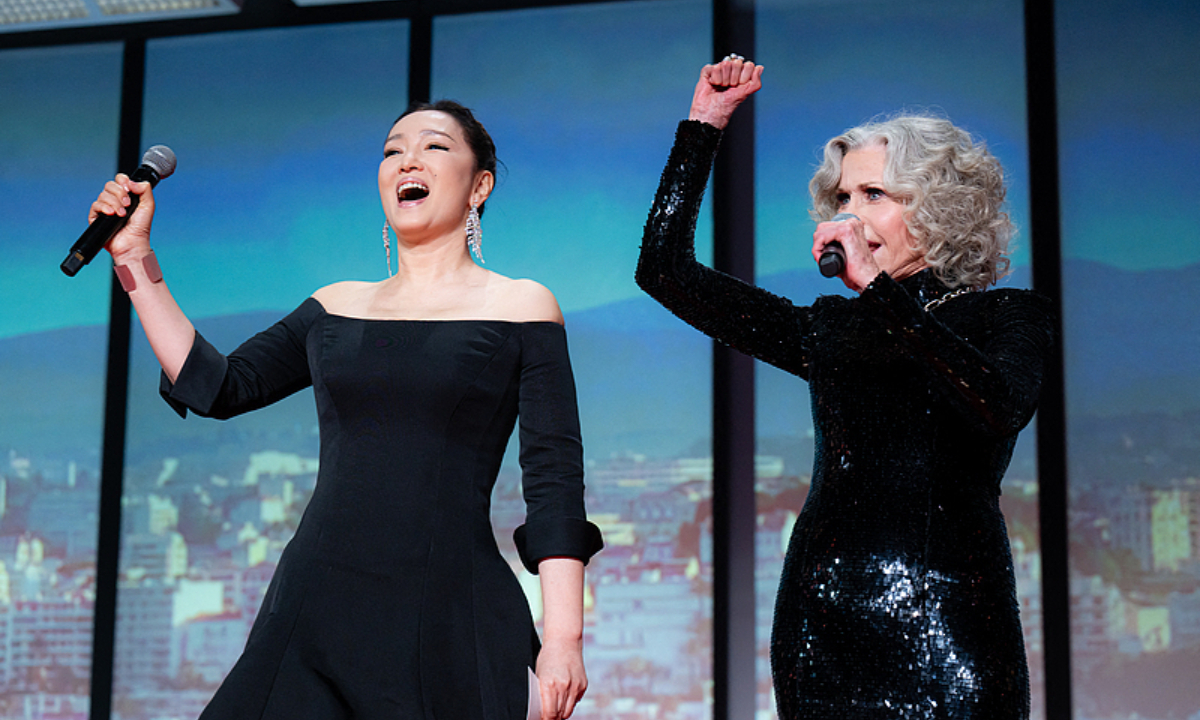
Gong Li (left) and Jane Fonda are on stage during the opening ceremony of the 79th Cannes Film Festival on May 12, 2026. Photo: VCG
The 79th Cannes Film Festival opened on Tuesday evening in Cannes, France. This year, from actress Gong Li's presence at the opening ceremony to the competition's various sections, Chinese elements have attracted attention at the festival. For the first time, two Chinese AI-generated short dramas were selected for the official screening section. In addition, according to media reports, the highly acclaimed film Dear You, which has performed strongly in Chinese cinema since the May Day holidays, will also be screened at the festival on Friday to reach a wider international audience.Li Sixue, a film critic who is attending this year's film festival, told the Global Times on Wednesday that she could clearly feel the presence of Chinese films and faces at the event. For example, the Chinese-French co-production A Girl Unknown, written and directed by Chinese filmmaker Zou Jing, has been shortlisted for the feature film competition in the Critics' Week section at the festival.
The opening ceremony drew a lot of attention on Chinese social media as actress Gong Li appeared on the stage and announced the opening of the film festival in Chinese. Videos posted on social media platform Sina Weibo show that Gong first said in English that she felt deeply honored to represent Chinese cinema at Cannes. After noting that film has the power to connect people across languages, cultures, and generations, she then announced in Chinese the opening of the festival, which was met with enthusiastic applause from the audience.
This marks the first time in Cannes history that a Chinese-born performer has delivered the opening address, according to the China News Service.
Li Sixue also took notice of this moment. She said that Gong announcing the opening of the festival in Chinese was truly inspiring, and that the continuous presence of Chinese-born filmmakers at Cannes is very important for Chinese cinema.
At this year's festival, two Chinese AI-produced short films, The Golden Tomb Seeker and Tower of Hunger, stood out from over 1,000 entries from over 120 countries to be selected as two of the 21 official screening works, attracting great attention. According to Shanghai-based outlet The Paper, this is the first time fully AI-produced Chinese short films have entered the official screening section at Cannes.
The Golden Tomb Seeker integrates traditional folk customs and suspense elements, while Tower of Hunger is adapted from the science fiction work of the same name that takes post-apocalyptic survival as its main narrative thread. Both works were completed by AI tools throughout the entire process from script development, visual design to special effects generation, The Paper reported.
"The selection of these two works is not only a testament to the strength of China's AI technology, but more importantly, it demonstrates how experienced creators can use AI to tell compelling stories and explore a new, efficient, and high-quality model for sharing Chinese culture with the world," Shi Wenxue, a veteran film critic based in Beijing, told the Global Times on Wednesday.
Shi noted that in China, AI-generated creation enjoys a favorable environment and a positive atmosphere in various aspects, including technological feasibility, innovation in models, cultural communication, and talent development. The selection of these two works for sections of the Cannes Film Festival is a sign that seeds planted in this fertile soil are beginning to sprout. "Naturally, we can expect a flourishing of diverse achievements in the near future."
The special section for AI short films at this year's Cannes Film Festival shows that mainstream international festivals are actively embracing AI-driven storytelling. However, creators should note that this inclusion is selective. It requires AI works to possess genuine cultural depth and distinct aesthetic identity, rather than relying solely on showcasing technical prowess. Therefore, Chinese teams still need to find the core of Chinese aesthetics within their works, Zhang Peng, an associate professor specializing in creative culture at Nanjing Normal University, told the Global Times on Wednesday.
Meanwhile, Chinese films Farewell My Concubine and Torino Shadow were selected for the "Cannes Classics" section at this year's festival. Director Chen Kaige's Farewell My Concubine won the Palme d'Or at the 46th Cannes International Film Festival in 1993. Chinese director Jia Zhangke's short film Torino Shadow will make its Cannes premiere in the section, according to the Xinhua News Agency.
This year's festival is set to run until May 23, with awards to be announced that same day.
RELATED ARTICLES