BRASIL 247 / MORE
Brazil launches $11 billion program against organized crime
Strategy includes investments, public security credit line, prison measures, homicide investigations and actions against arms trafficking
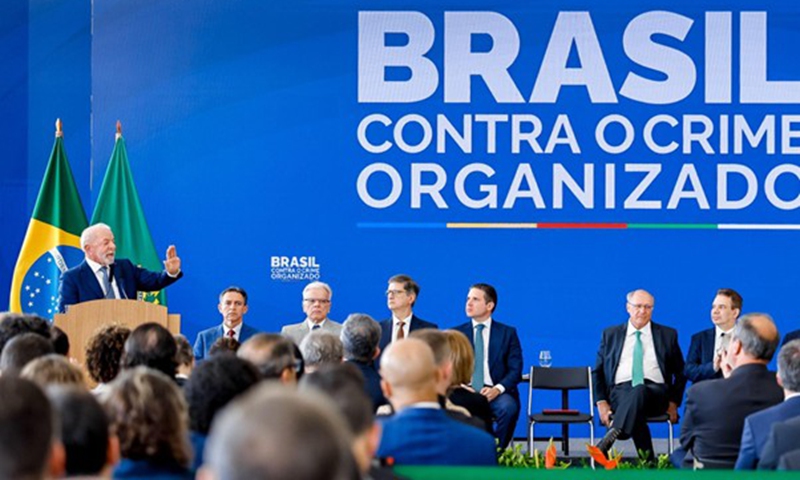
Photo: Courtesy of Brasil 247
By Brasil 247 - The Brazilian government launched on Tuesday the "Brazil Against Organized Crime" program, a new national strategy aimed at dismantling the economic, operational and territorial structures that sustain criminal organizations across the country. According to Brasil 247, the initiative combines intelligence, federal coordination and immediate measures to target criminal finances, strengthen security in 138 prisons, expand homicide investigations and combat the trafficking of weapons, ammunition, accessories and explosives.
The program foresees 1.06 billion reais in direct federal resources for 2026, distributed across four main areas. In addition, the government is creating a specific 10 billion reais credit line for public security projects involving states, municipalities and the Federal District.
In total, the package mobilizes 11 billion reais in investments and financing. The strategy seeks to move beyond confronting only the armed branches of criminal groups by also targeting their leadership, logistics and financial structures.
The program will be structured around four fronts: financial asphyxiation of organized crime, strengthening prison security, increasing homicide clearance rates, and combating the trafficking of weapons, ammunition, accessories and explosives.
Under the financial enforcement axis, 388.9 million reais will be allocated to target illicit financial flows, money laundering operations and assets accumulated by criminal organizations. Measures include the creation of a National Integrated Organized Crime Task Force for interstate operations and the strengthening of state-level integrated task forces.
The government also plans to expand Integrated Financial Investigation and Asset Recovery Committees, broaden the use of criminal analysis tools and accelerate the auctioning of seized criminal assets through centralized sales managed by the Ministry of Justice and Public Security.
The second axis allocates 330.6 million reais to reinforce control over the prison system. The goal is to implement maximum-security standards in 138 strategic prison units across Brazil's 26 states and the Federal District.
Measures include the acquisition of drones, scanning kits, X-ray machines, vehicles, ground-penetrating radar systems, body scanners, metal detectors, audio and video monitoring systems and cellphone jammers.
The proposal seeks to reduce the operational control exercised by criminal organizations from inside state prisons by bringing security standards closer to those used in the federal penitentiary system.
The plan also includes the creation of a National Penal Intelligence Center to integrate prison intelligence nationwide and support operations aimed at removing cellphones, weapons, drugs and other illicit materials from prisons.
The third axis allocates 201 million reais to increase homicide clearance rates through improvements in criminal investigations and forensic capabilities.
The program foresees investments in scientific police units, forensic institutes, the Integrated Genetic Profile Database Network and the National Ballistics Analysis System.
Equipment to be acquired includes scientific freezers, refrigerated vehicles for body transportation, autopsy tables, ballistic comparison devices, DNA analysis tools, biological sample collection kits, storage systems and chromatographs.
The fourth axis, with 145.2 million reais in funding, focuses on combating the trafficking of weapons, ammunition, accessories and explosives. The government plans to create a National Network to Combat Arms and Explosives Trafficking, strengthen the National Weapons System and equip specialized police units.
The strategy also includes technical cooperation initiatives focused on traceability, identification of weapon origins, analysis of illegal trafficking routes and integrated operations against arms smuggling and diversion.
The 10 billion reais credit line may finance patrol vehicles, motorcycles, boats, personal protective equipment, drones, body cameras, radio communication systems, video monitoring systems, body scanners, signal blockers, forensic equipment, information technology infrastructure and other technological solutions for public security.
The resources will come from the National Social Infrastructure Investment Fund.
(Reported by Brasil 247 on May 12, 2026)
