Multiple Chinese chambers oppose EU’s CSA2 revisions; Stable relationship with China indispensable for Europe’s recovery, competitiveness: expert
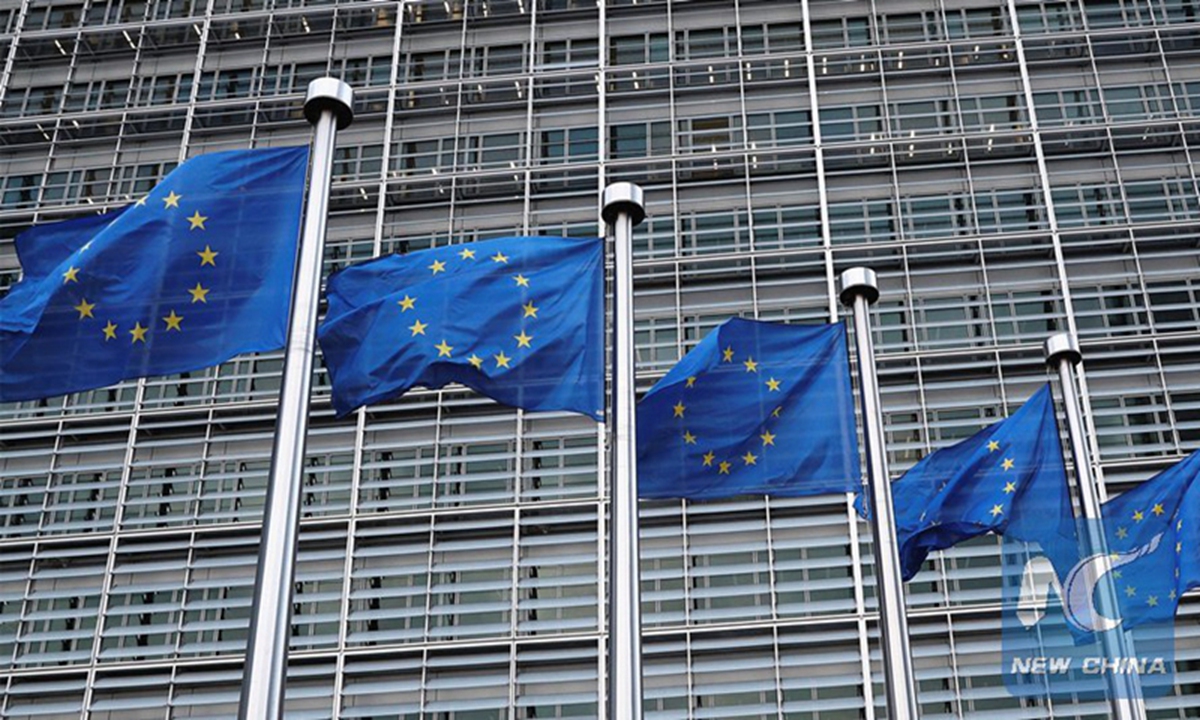
The European Union flags in front of EU headquarters in Brussels, Belgium. Photo: Xinhua
Multiple Chinese business chambers in the EU have expressed strong opposition to the bloc's proposed revision of the Cybersecurity Act (CSA2), reiterating that the proposed mandatory, comprehensive, and time-bound exclusion policies across multiple key industries would cause disruption to normal market operations, undermine the EU's own green and digital transitions, and harm China-EU economic and trade relations.
The China Chamber of Commerce to the EU (CCCEU) said on Wednesday that the chamber has submitted its feedback on the CSA2, stating that strengthening cybersecurity and protecting critical infrastructure should adopt a proportionate, risk based, evidence based, and technology neutral regulatory approach, while safeguarding the openness and competitiveness of the EU single market, according to a statement provided to the Global Times on Wednesday.
The Chinese chamber noted that certain elements of the current CSA2 proposal could introduce overly broad restrictive measures that are not based on a transparent, evidence based risk assessment methodology. In particular, the proposed mandatory, comprehensive, and time limited exclusion clauses across multiple critical sectors raise serious concerns.
These measures could disrupt normal market operations, increase compliance costs for businesses, and have broader adverse effects on Europe's green and digital transitions, industrial competitiveness, and economic relations with key trading partners, it said.
The fresh warning came as the European Commission (EC) proposed a new cybersecurity package including a "Proposal for a Regulation for the EU Cybersecurity Act" in January, which aims to gradually phase out components and equipment from "high-risk suppliers" in critical infrastructure. This move is widely seen as targeting Chinese companies and forms part of a broader set of EU protectionist tools targeting China.
Brussels is targeting "high-risk" vendors - commonly understood to be Chinese suppliers in critical sectors, Politico.eu reported. The proposed rules set new criteria for European governments when deciding to ban vendors from their networks, including assessing "non-technical risks" like whether companies are subject to political pressure, according to the report.
In addition to the CCCEU, a number of Chinese business chambers based in European countries, including chambers in Poland, Spain and Italy, have also voiced their concerns in recent days.
For example, on Monday (Spanish time), the Chinese business chamber in Spain, the CCINCE, issued a statement saying that an open, fair and fully competitive market is the foundation for Europe's long-term industrial competitiveness, adding that "excluding specific suppliers in the name of security essentially sacrifices market efficiency and technological diversity for so-called security." This not only fails to create a sustainable risk governance mechanism, but may also introduce new vulnerabilities, according to the CCINCE statement.
"The EU's actions not only undermine China-EU relations, but also severely harm the interests of European enterprises. Ultimately, they will damage Europe's competitiveness and overall economy - the consequences are serious," Zhang Jian, a vice president of the China Institutes of Contemporary International Relations, told the Global Times on Wednesday.
The China Chamber of Commerce for Import and Export of Machinery and Electronic Products (CCCME) said on Monday that it has submitted comments to the EC from the perspective of an industry association.
In its comments, the chamber emphasized that the EU's relevant cybersecurity risk assessments should be conducted based on objective, clear, explicit technical standards with commercial certainty.
"The introduction of the concept of 'non-technical risks' in the current revised draft clearly targets specific countries and companies, and is unconstructive, and represents a mismatch between ends and means. This will seriously undermine the EU's business environment, the interests of Chinese and European enterprises, and consumer welfare," it said.
The chamber called on relevant EU parties to earnestly listen to the rational voice of the industry, prudently assess the risks and drawbacks, address mutual concerns through bilateral government consultations and industry cooperation, and jointly safeguard the overall situation of China-EU bilateral economic and trade cooperation.
The Cybersecurity Act will be applicable immediately after approval by the European Parliament and the Council of the EU, according to the EC website.
Pragmatic cooperation needed
The EU's proposed revision of the CSA2 could carry a price tag of nearly 367.8 billion euros ($431.5 billion) if it forces the replacement of Chinese suppliers across 18 critical sectors, according to a report released by the CCCEU and London-based professional services provider KPMG.
Michele Geraci, former Italian undersecretary of state and NYU Shanghai adjunct professor, told the Global Times in an interview on Wednesday that the fact that European leaders have been frequently visiting China recently while the EU continues to introduce measures such as the proposed CSA2 revision is "highly contradictory."
"Instead of seeking cooperation, the EU keeps creating barriers. While China continues to open up, Europe is becoming more closed. It's a very ironic reversal of expectations," Geraci said.
China urged the EU to view the China-EU economic and trade relations in a comprehensive, objective and positive manner, abide by the WTO rules and market principles, and stop actions that hurt others while bringing no benefits to its own, Foreign Ministry spokesperson Lin Jian said on May 8.
If the EU side insists on revising the Act and treating Chinese firms in a discriminatory way, China will take resolute measures to safeguard the firms' legitimate rights and interests, Lin said.
Previously, China's Ministry of Commerce (MOFCOM) responded that the proposed revision would cause substantive harm to China-EU economic and trade relations, severely disrupt global industrial and supply chains, and undermine the EU's own digital and green transitions.
China will closely follow the progress of the draft revision and stand ready to engage in dialogue with the EU on the matter, the MOFCOM spokesperson said, warning that should the EU insist on turning the draft proposal into law and discriminate against Chinese companies, China would have to take corresponding countermeasures.
"Past experience shows that the push for 'decoupling' or 'de-risking' within certain EU political circles is neither pragmatic nor viable. As two pillars of a multipolar world and key stakeholders in global governance, China and the EU share profound responsibilities," Jian Junbo, director of the Center for China-Europe Relations at Fudan University's Institute of International Studies, told the Global Times on Wednesday.
"At a time when Europe is striving to bolster its economic recovery and competitiveness, a healthy and stable China-EU relationship is indispensable for safeguarding genuine multilateralism and driving sustainable growth," Jian said.
RELATED ARTICLES