SPORT / FOOTBALL
FIFA secretary general voices support for Chinese football development during China visit, but avoids World Cup broadcast rights pricing, language issues: media
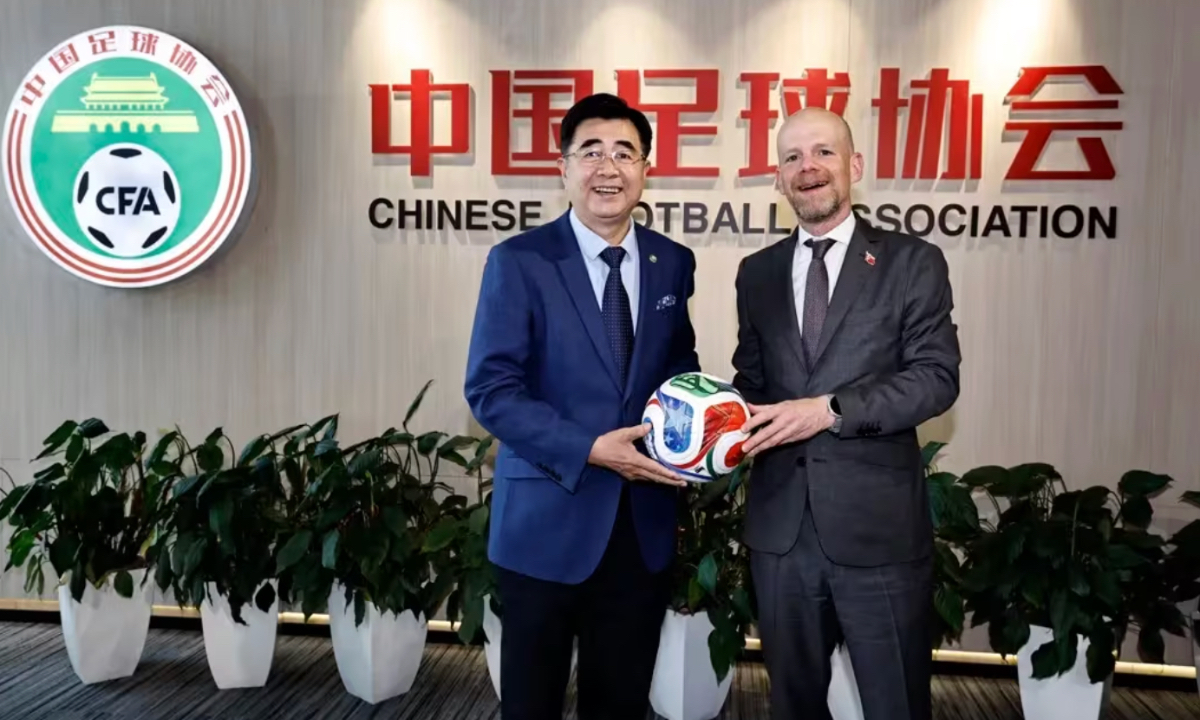
Song Kai, President of the Chinese Football Association and FIFA Secretary General Mattias Grafström Photo: Courtesy of the FIFA
With less than one month remaining before the 2026 FIFA World Cup kicks off, FIFA Secretary General Mattias Grafström met with senior Chinese sports officials in Beijing on Tuesday, voicing FIFA's support for the development of Chinese football while making no public response to ongoing disputes over broadcasting rights pricing and the absence of a Chinese-language option on FIFA's official website, according to reports by multiple Chinese media outlets.Zhang Jiasheng, deputy director of the General Administration of Sport of China, and Song Kai, president of the Chinese Football Association (CFA), met with Grafström and FIFA Chief of Global Football Development Arsène Wenger. Both sides discussed issues of strengthening cooperation and promoting the development of football in China, according to the FIFA.
The meeting came as FIFA has yet to finalize a broadcasting agreement for the World Cup in the Chinese mainland, with only less than 30 days remaining before the tournament opens.
According to multiple Chinese media reports, FIFA's initial asking price for the Chinese mainland broadcasting rights was between $250 million and $300 million, nearly double the fee paid for the 2022 Qatar World Cup and about 17 times higher than the price reportedly charged in India.
FIFA responded to the Global Times on May 5 that negotiations with China's state broadcaster China Central Television (CCTV) were ongoing. "Discussions in China regarding the sale of media rights for the FIFA World Cup 2026 are ongoing and must remain confidential at this stage," a FIFA spokesperson said in an emailed response to the Global Times.
No response about the negotiations has been seen from CCTV as of press time.
At the same time, FIFA has also faced criticism online over the lack of a Chinese-language option on its official website, despite offering versions in English, Japanese, Korean and several other languages.
Neither Grafström nor FIFA did not publicly respond to questions regarding World Cup broadcasting rights pricing or the lack of a Chinese-language version on FIFA's official website, according to reports on the meeting.
According to a Wednesday post by the Chinese Football Association on its official account on China's X-like platform Sina Weibo, during the meeting, Song briefed the delegation on recent progress in China's football reform and development, emphasizing that the CFA places high importance on its strategic cooperation with FIFA and is willing to pursue practical collaboration in key areas including youth talent development, national team building and technical advancement.
"We held really fruitful discussions with Vice Minister Zhang and President Song, who both share FIFA's determination to develop the beautiful game in this beautiful country," explained Grafström, according to a post on FIFA's official website. "There is so much potential to be unlocked across China PR, and they have such an important role to play within the region and as a FIFA member. With the vision and the energy from both CFA and the government to do that, I am sure - with FIFA's support - we will achieve that goal."
Later Tuesday, the FIFA delegation also visited the Chinese Football Association National Youth Academy, where they observed a tactical training session conducted by the U-14 boys' national team and received briefings on its training system, talent identification mechanisms, and the application of sports technology and data analytics.
"I can only commend the CFA on what they have achieved and what they are doing at their national academy," said Wenger. "Their holistic approach to talent development, with the physical, tactical and game-intelligence aspects of football, is destined to bear fruits in the future," according to the FIFA.
He noted FIFA will continue to share its expertise and resources to reinforce the training of China's elite youngsters in line with the goals of the FIFA Talent Development Scheme.
Negotiations over World Cup broadcasting rights continue to attract significant attention.
The Beijing Daily said as the Chinese national football team failed to qualify for the World Cup, its appeal in China has diminished sharply. Furthermore, this World Cup is being hosted in North America, meaning most high-profile matches kick off in the early hours or morning Beijing time, which has already greatly weakened advertisers' willingness to invest, per the report. It further warned that as the tournament draws near, relevant negotiations remain deadlocked; having missed the sponsorship window, the loss of advertisers has become inevitable.
Journalists from Chinese mainland media outlets are still unable to obtain visas, leaving them ineligible to apply for on-site studios, field work booths and commentary seats at World Cup venues. This will inevitably lead to a drop in broadcast quality, the Beijing Daily said.
Statistics show that Chinese sponsors have poured over $500 million into this World Cup. Should the broadcast fall through, it would be unacceptable for Chinese businesses, while FIFA would also lose much of its leverage in sponsorship recruitment and price hikes, reported the Beijing Daily.
Additionally, multiple media reports, including Chinanews.cn, pointed out that during the 2022 Qatar World Cup, China accounted for 49.8 percent of total global viewing time on digital and social media platforms. Chinese sponsors contributed $1.395 billion in total, ranking first globally and surpassing major US companies, including Coca-Cola, McDonald's and Budweiser.
Global Times
RELATED ARTICLES