Central Asia's first urban light rail launches operation in Astana, marking a major BRI milestone for China and Kazakhstan
By Yin Yeping, and Published: May 17, 2026 07:48 PM


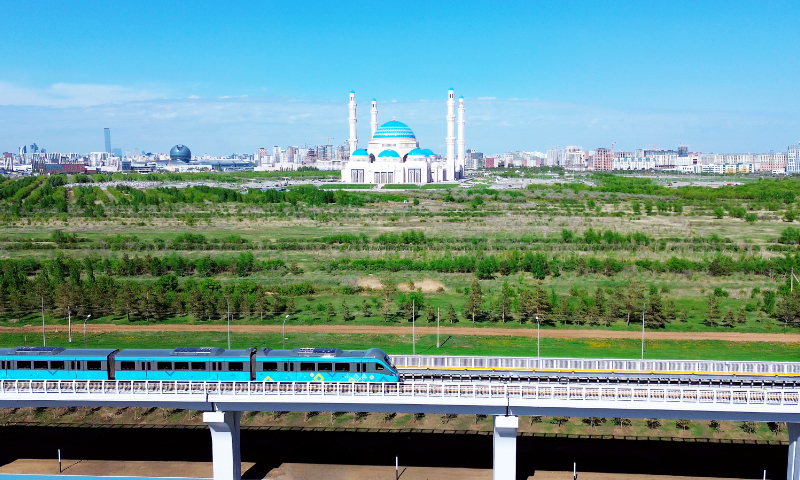
Photo taken on May 16, 2026, show a train of the first phase of the Astana Light Rail project runs in Astana, the capital city of Kazakhstan. The project officially began operation on May 16, marking the launch of Central Asia's first urban light rail system, with a subsidiary of China State Construction Engineering Co (CSCEC) serving as the project's main contractor. Photo: Courtesy of CSCEC
The first phase of the Astana Light Rail project in Kazakhstan's capital Astana officially began operation on Saturday, marking the launch of Central Asia's first urban light rail system, with China Construction Sixth Engineering Bureau Co, a subsidiary of China State Construction Engineering Co (CSCEC), serving as the project's main contractor.
Kazakh President Kassym-Jomart Tokayev attended the inauguration ceremony in the Kazakh capital on Saturday and expressed gratitude to the Chinese side for the successful implementation of the project.
The launch marks another achievement of high-quality cooperation between China and Central Asian countries under the Belt and Road Initiative (BRI), and it will provide strong support for more convenient travel for local residents in Kazakhstan, an industry insider said.
The project, which is also the region's first fully automated driverless smart rail transit line, and the first city light rail built entirely with Chinese technology, Chinese standards and Chinese equipment, has become an important achievement of China-Kazakhstan BRI cooperation upon its completion and operation, the Global Times learned from the company.
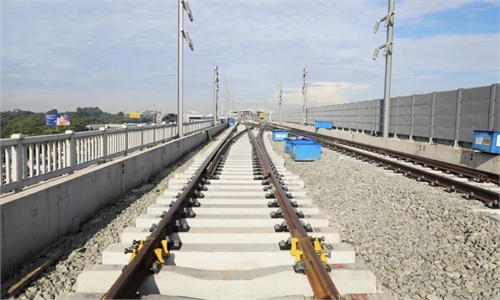
With a total length of 22.4 kilometers, the first phase of the Astana light rail project is fully elevated with double tracks, featuring 18 stations, and uses a GOA4-level fully automated driverless system with a maximum operating speed of 80 kilometers per hour.
Global Times reporters learned from CSCEC that on the opening day of Phase I of the light rail, all 18 stations along the line saw heavy passenger flows in good order. Many people came, especially the elderly and children, and some locals dressed in traditional ethnic costumes took photos to experience the new transit line.
Inside the carriages, the modern and bright interior as well as smooth and quiet rides won wide praise from passengers. Young people recorded moments with cameras and shared them on social media, while parents brought their children to experience the charm of driverless technology. The average daily passenger flow is expected to reach 25,000 to 45,000 in the initial operation stage.
The official opening and operation of the Astana Light Rail further improved the city's public transport network and connected its north-south major traffic artery, Ji Chenglong, executive project manager of China Construction Sixth Engineering Bureau Co, told the Global Times.
During morning and evening rush hours, commuting time between the two ends of the light rail route is nearly halved compared with private cars, dropping from 60 minutes to 28 minutes, which greatly boosts riders' travel efficiency.
As a technologically leading urban rail transit project in Kazakhstan and even the whole of Central Asia, the Astana Light Rail promotes the upgrading of local transportation infrastructure, stimulates urban development vitality and facilitates high-quality economic and social development, the manager said.
"It is also a key livelihood project marking in-depth practical infrastructure cooperation between China and Kazakhstan under the BRI, as well as an iconic model for deepening bilateral friendly exchanges, enhancing people-to-people bonds and realizing people-to-people connectivity. It has laid a solid foundation for infrastructure connectivity and win-win cooperation between China and Central Asian countries," Ji said.
Ji noted that during the construction of the project, Chinese enterprises successfully overcame construction difficulties for rail transit in cold regions. They adopted green and intelligent construction technologies including Building Information Modeling, intelligent welding robots and prefabricated construction, effectively lifting construction quality and efficiency.
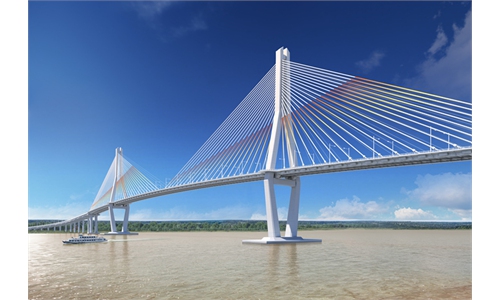
A total of 2,598 tons of special low-temperature resistant steel used for the Ishim River Bridge was prefabricated in factories in North China's Tianjin Municipality. The steel was transported more than 4,600 kilometers to the construction site, and the bridge was finally assembled rapidly in a modular building-block style.
The Astana Light Rail is not only a product of advanced technology and engineering, but also a model of hard connectivity, soft connectivity and people-to-people connectivity.
During construction, China Construction Sixth Engineering Bureau Co actively fulfilled its social responsibilities by hiring local workers to participate in the project, creating more than 2,000 employment opportunities and conducting more than 100 technical training sessions, cultivating a group of local rail transit professionals familiar with technical know-how and international standards, and helping to drive local industrial upgrading, the Global Times learned from the company.
At the same time, the project has promoted local cultural exchanges and enterprise-university cooperation, carrying out joint initiatives with local universities and research institutions in areas such as technological research, talent recruitment and cultural mutual learning.
Global Times reporters previously visited a station of the light rail in 2024. Pakizat Anuarhan, a local Kazakh working on the project, told the Global Times that she lives in Astana's suburbs and usually commutes for 90 minutes to reach the city center by bus. "With the light rail, it'll take just 20 minutes. Many people, like me, can't wait for it to open," she said.
RELATED ARTICLES